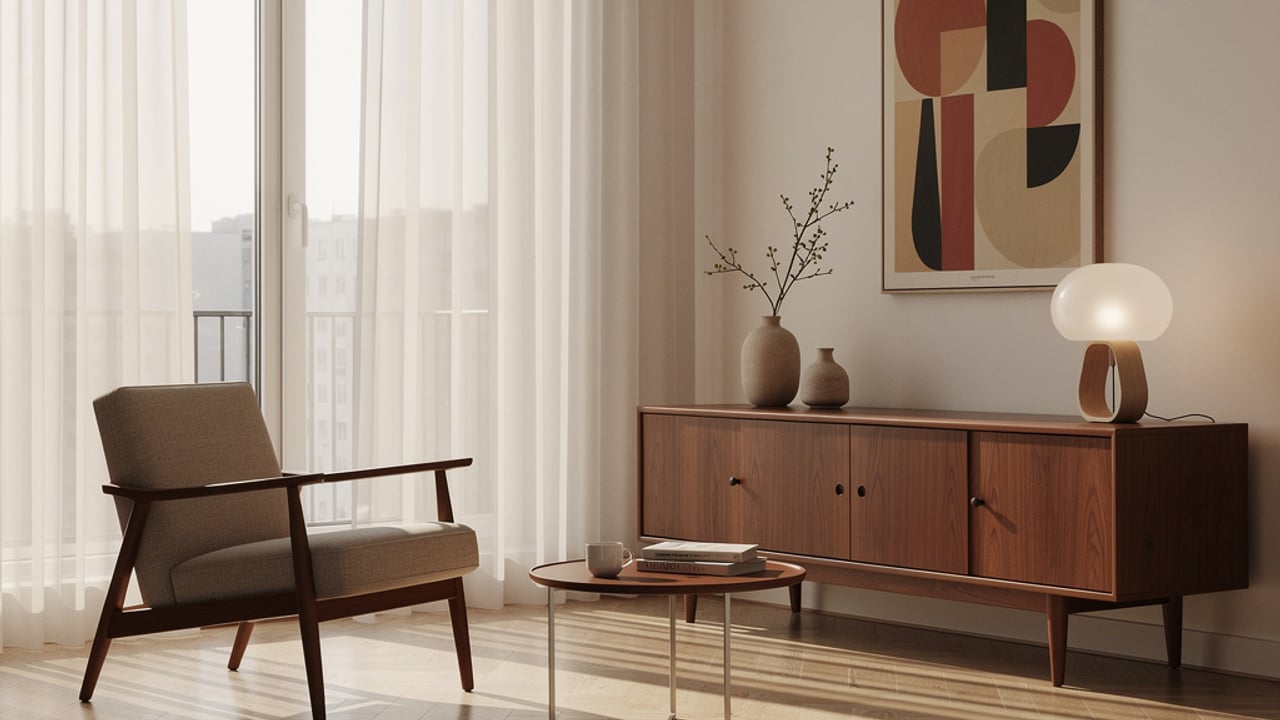
STYLE · MID CENTURY RETRO

The Enduring Grammar of Mid Century Retro

Form distilled to its necessary truth.

Between 1950 and 1980, designers reimagined every domestic object from first principles. The furniture that emerged from those decades remains among the most rigorously resolved ever produced. This is a guide to understanding, identifying, and acquiring it with confidence.

mid-century·designs

mid century retro

ESSAY · 01

Work & Context

mid-century·designs

A Brief History of mid century retro

The phrase mid century retro describes a broad aesthetic orientation rooted in the postwar decades, when technological optimism, new synthetic materials, and a wholesale rejection of Victorian ornament converged in the design studios of Scandinavia, Italy, and North America. What distinguishes the period is not nostalgia — the designers themselves were emphatically forward-looking — but the retrospective recognition of a coherent visual language that subsequent generations have consistently returned to as a touchstone.

The material conditions of the era were decisive. Moulded plywood, fibreglass-reinforced polyester, cast aluminium, and foam-padded steel frames became the vocabulary through which Eero Saarinen, Robin Day, Arne Jacobsen, and dozens of their peers expressed ideas about comfort, economy, and spatial fluidity. A single shell chair could be produced at scale without sacrificing the sculptural intention that drove its conception. That tension between industrial method and artistic ambition is precisely what collectors continue to value.

Authenticity matters in this market. Production runs were long, licences were contested, and unlicensed reissues have proliferated since the 1990s. Understanding the original manufacturer’s marks, the period-correct upholstery specifications, and the precise alloy composition of cast components separates a genuine object from a plausible copy.

Notable designers within mid century retro

No survey of mid century retro is complete without Charles and Ray Eames, whose 1948 Low Side Chair demonstrated that compound curvature in moulded fibreglass was structurally viable at a domestic scale. Arne Jacobsen’s Series 7 chair of 1955 extended the moulded plywood experiments of the previous decade into a form so resolved that it required no subsequent revision. Verner Panton’s stacking chair of 1967 — the first single-material, single-form injection-moulded chair — announced that the aesthetic could accommodate a more overtly Pop sensibility without surrendering structural rigour.

Beyond seating, the period produced credenzas by Florence Knoll whose proportional severity anticipates minimalism, lighting by Gino Sarfatti that treats the bulb as a sculptural element rather than a necessity to be concealed, and storage systems by Dieter Rams whose grid logic remains a direct ancestor of contemporary interface design.

Where to find authentic mid century retro

Authentic mid century retro pieces circulate through a narrow network of specialist auction houses, estate sales, and vetted online marketplaces. Generalist platforms carry significant risk: provenance documentation is inconsistently supplied, condition descriptions are subjective, and the distinction between an authorised reissue and a period original is routinely obscured.

At mid-centurydesigns.com, every object is assessed against manufacturer records, period catalogues, and — where available — original purchase documentation. Pieces are photographed under controlled lighting to render construction details, patina, and joinery with accuracy. Condition reports specify any restoration undertaken, the materials used, and whether structural integrity has been affected.

Caring for your mid century retro

Preservation of mid century retro objects requires an understanding of the materials involved. Teak and rosewood veneers, dominant in Scandinavian production, respond well to annual treatment with a light Danish oil applied sparingly and buffed to a matte finish. Fibreglass shells should be cleaned with a pH-neutral solution; abrasive compounds remove the original gel coat and diminish value substantially.

Upholstered pieces present the most complex conservation decisions. Period-correct wool bouclé or leather is increasingly difficult to source; when replacement is unavoidable, documentation of the original fabric — a swatch, a photograph, a specification from the manufacturer’s archive — should accompany the piece. Chrome tubular steel frames can be professionally re-chromed, though patinated originals are generally preferred by serious collectors for the evidence of age they carry.

FAQ · 02

Frequently asked about mid century retro

5 Answers

01
How do I distinguish an original mid century retro piece from an unauthorised reproduction?
Examine manufacturer's marks stamped or labelled on the underside of the object, cross-reference with period production catalogues, and assess the material composition. Original fibreglass shells have a specific weight and surface texture absent from later polyurethane copies. Provenance documentation — receipts, auction records, estate inventories — significantly strengthens attribution and market value.
02
Which designers command the highest prices in the mid century retro market?
Eames, Jacobsen, Saarinen, and Panton consistently achieve the strongest results at auction. Early production examples, particularly pre-1965 Herman Miller and Knoll pieces with original upholstery intact, carry substantial premiums. Scandinavian cabinetmakers such as Finn Juhl and Hans Wegner have seen sustained price appreciation over the past decade among specialist collectors.
03
Is it advisable to reupholster a vintage chair before selling?
Generally, no. Collectors and institutions prize original materials as evidence of authenticity and period production standards. If upholstery is structurally compromised — foam degraded, springs collapsed — professional stabilisation is appropriate, but wholesale re-covering with non-period fabric diminishes provenance value. Always retain samples of any removed original textile and include them with the object.
04
What documentation should accompany a high-value mid century retro purchase?
A condition report prepared by a specialist, photographs of all maker's marks, any available purchase receipts or auction catalogues in which the piece appeared, and written confirmation of any restoration undertaken. For museum-deaccessioned objects, a formal letter from the institution constitutes strong supporting evidence and typically commands a price premium at resale.
05
Are authorised reissues considered collectible in the same category as period originals?
Authorised reissues produced by the original licensee — Vitra, Herman Miller, Fritz Hansen — occupy a separate but legitimate market. They are correctly described as current production and priced accordingly. Period originals from the 1950s through 1970s are classified as vintage and valued for material evidence of their manufacturing era, commanding multiples of reissue prices among serious collectors.

GLOSSARY · 03

Related Terms

8 Entries

Organic Modernism
A design tendency of the 1940s and 1950s that softened the orthogonal rigidity of the International Style through biomorphic forms, compound curves, and materials — notably moulded plywood and fibreglass — that permitted sculptural freedom within industrial production constraints.
Danish Modern
A Scandinavian furniture movement centred in Denmark from the late 1940s through the 1960s, characterised by joinery-forward construction, solid teak or rosewood, and a craft ethic that synthesised traditional cabinetmaking with modernist formal reduction. Key figures include Hans Wegner, Finn Juhl, and Børge Mogensen.
Bauhaus Functionalism
The design philosophy developed at the Bauhaus school (1919–1933) holding that form must be derived from function and material logic. Its influence on postwar furniture is pervasive, particularly in tubular steel construction and the subordination of ornament to structural expression.
Pop Design
A design movement of the 1960s and early 1970s that introduced bold colour, disposable materials, and cultural iconography into domestic objects. Verner Panton and Joe Colombo are central figures; the aesthetic represents a deliberate rupture with the restrained materialism of earlier modernism.
Teak Veneer
A thin slice of Burmese or Thai teak bonded to a substrate — typically particleboard or plywood — used extensively in Scandinavian and British furniture production from the 1950s onward. Valued for its warm grain, natural oil content, and dimensional stability across varying humidity conditions.
Fibreglass Shell
A structural form created by layering glass fibre matting with polyester resin in a mould, then curing under pressure. First used for furniture by Charles and Ray Eames in 1950, the technique permitted compound curves impossible in sheet metal or plywood at comparable cost.
Italian Rationalism
An Italian design current active from the 1930s into the postwar decades, advocating geometric clarity, industrial materials, and the subordination of individual expression to systemic design logic. It underpins the work of firms including Cassina and Arflex during the 1950s and 1960s.
Knoll International
An American furniture manufacturer founded in 1938 by Hans Knoll, instrumental in bringing European modernist designers — including Mies van der Rohe and Eero Saarinen — into licensed production for the American contract market. Period Knoll pieces are among the most consistently authenticated in the vintage market.