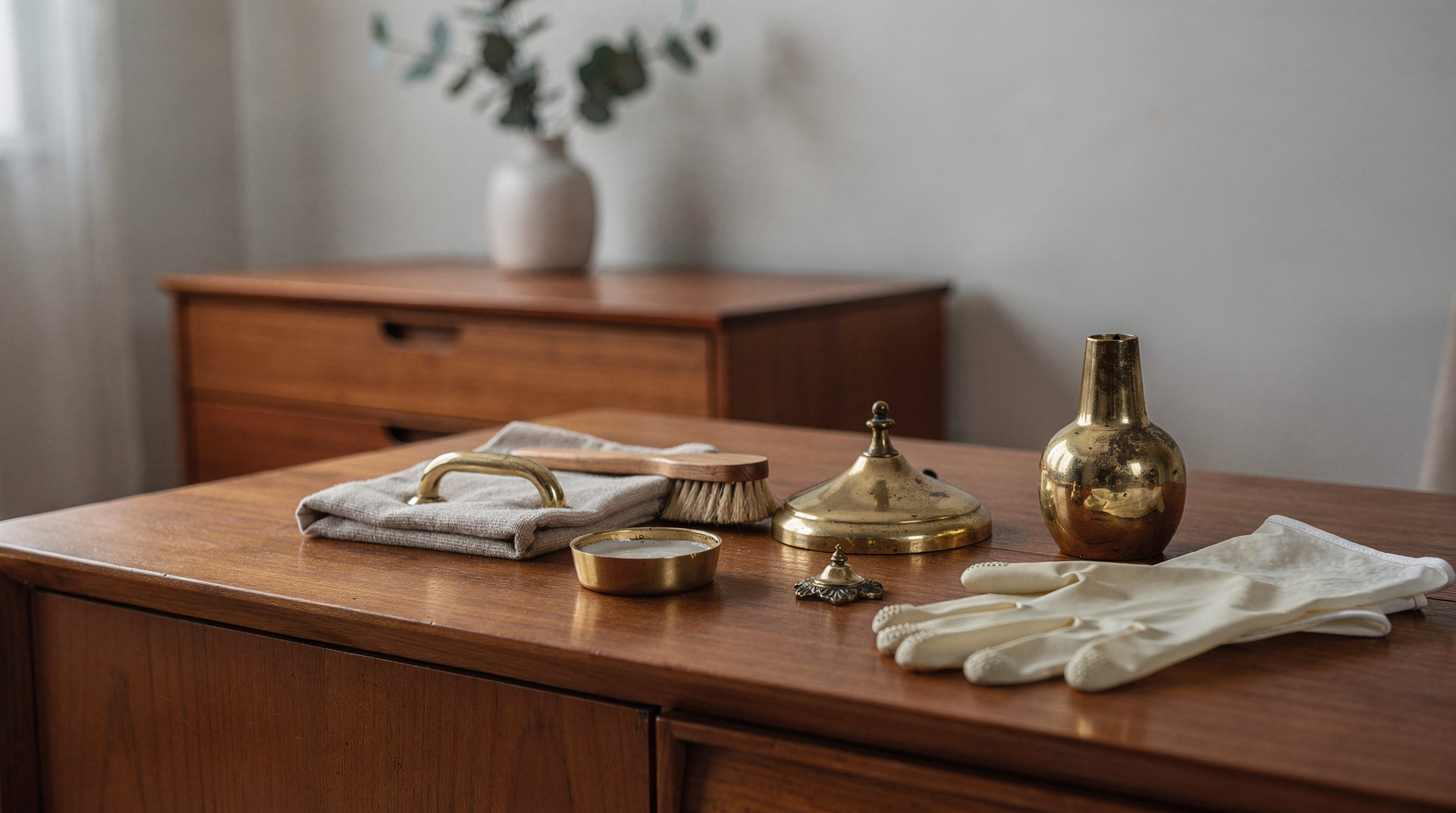
Deoxidizing and polishing brass: restoration with care
On Mid-Century furniture, brass is rarely mere decoration. It is foot, base, stretcher, handle, hinge, escutcheon — a structurally visible connection and an aesthetic signature at the same time. Anyone who collects original pieces from the decades between 1945 and 1970 is familiar with the typical patina: a warm, irregularly grown surface somewhere between honey-coloured lustre and dark-brown oxide layer, occasionally with greenish-blue darkening where hand sweat, cleaning agents or moisture have acted over decades. This patina is both a witness to time and a value factor. Removing it without thought means intervening in the very substance of the object.
The following text explains which alloys and surface treatments were used in Mid-Century furniture, which workshops and designers were influential, and how you can tell whether a brass component should be polished, chemically deoxidized or best left untouched. Restoration here is always a balancing act between the legibility of a surface and respect for its historical materiality.
Characteristic materials and surfaces
In Mid-Century furniture-making, you will encounter brass in several variants — distinguishing between them comes before any cleaning.
- Solid brass (CuZn alloys): Usually with zinc content of around 15 to 40 per cent, used for feet, base frames, handles and load-bearing fittings, for example on Italian sideboards of the 1950s or Scandinavian secretaires.
- Brass-plated steel or die-cast zinc components: Electroplated coatings just a few micrometres thick. Common on serial furniture of the 1960s. Polishing with abrasive pastes can wear through the layer within just a few passes. A magnet helps: if it attracts, there is steel underneath.
- Clear-lacquered surfaces: Many manufacturers sealed brass parts ex-works with zapon lacquer or nitrocellulose to prevent tarnishing. A dull, patchy cloudiness usually indicates aged lacquer layers, not oxidized brass. No amount of polishing will help here — the lacquer must be properly removed by a specialist.
- Burnished and dark-patinated finishes: Deliberately chemically blackened surfaces, for example on lamps or fittings in the circle of Paavo Tynell or on French work of the 1950s. This patina is a deliberate design choice and must not be polished away.
Before you reach for polishing paste, citric acid or an ammonia solution, always check: solid or plated, lacquered or bare, intentionally dark or oxidized.
Regional schools and defining designers
The approach to brass varied considerably by region, and this is reflected in the appearance of pieces today.
- Italy: At Osvaldo Borsani (Tecno), Ico Parisi, Gio Ponti and in the circle around Arredoluce, brass was used as a structural and decorative element in equal measure. Characteristic features are slender, conically turned legs, curved base frames and fine decorative profiles. Surfaces were often high-gloss polished and lacquered.
- Scandinavia: With Hans J. Wegner, Finn Juhl or Kai Kristiansen, brass appears more restrained — as a patinated shoe on a wooden leg, an escutcheon or a hinge. The workshops often worked with a warm, matte, lightly brushed finish that was designed to age.
- Finland: Paavo Tynell and the Taito Oy workshop created lamps from perforated and punched brass whose appeal lies precisely in the unevenly aged surface. Aggressive polishing destroys the character of the work.
- France: At Maison Jansen, Maison Baguès or in the circle around Jacques Adnet, brightly polished, sometimes gilded brass work dominated, frequently in combination with leather or glass.
- USA: Paul McCobb (Calvin Group), Edward Wormley for Dunbar and the work of Harvey Probber show brass as a narrow base rail, connector or handle, usually clear-lacquered.
These different traditions help determine what condition a collector accepts as authentic and what degree of polishing is value-preserving.
Authenticity, condition and the limits of restoration
When assessing a Mid-Century piece, the rule is: the brass surface should be read like the wood patina. Some practical pointers:
- Even, warm patina without verdigris and without active corrosion should generally be preserved. A dry clean with a soft cotton cloth, or if necessary a drop of neutral soapy water, is sufficient.
- Localised oxidation or flash rust at contact points with steel components can be treated carefully with a soft brass brush and mild polishing paste — always locally, never across the whole surface.
- Chemical deoxidizing with citric acid, vinegar-and-salt mixtures or commercially available brass cleaners alters the surface irreversibly. It is inadvisable above all on plated components and intentionally burnished work. On solid pieces that have already been reworked at some point, it may be appropriate, but must be neutralized (clean water, immediate drying) and subsequently waxed or lacquered.
- High-gloss polishing is only acceptable from a conservation standpoint where the piece was demonstrably high-gloss ex-works (e.g. Italian work of the 1950s). On Scandinavian furniture it destroys the historical impression.
- Documentation: Record the condition before and after every measure photographically. For collectors and on resale, the traceability of interventions is a value factor.
When in doubt, the conservatorial ground rule applies: a preserved patina cannot be reconstructed, but a later polish is always still possible. If you are unsure, consult a conservator specializing in metals before intervening.
At mid-centurydesigns.com we curate furniture and objects with exactly these details in mind. Every piece is examined for provenance, originality of the fittings, condition of the brass components and previous interventions. Where patina has been preserved, we note this. Where restoration has taken place, we specify the nature and extent of the work. This allows you as a collector to decide what degree of ageing is right for you and to acquire a piece whose material history you know.