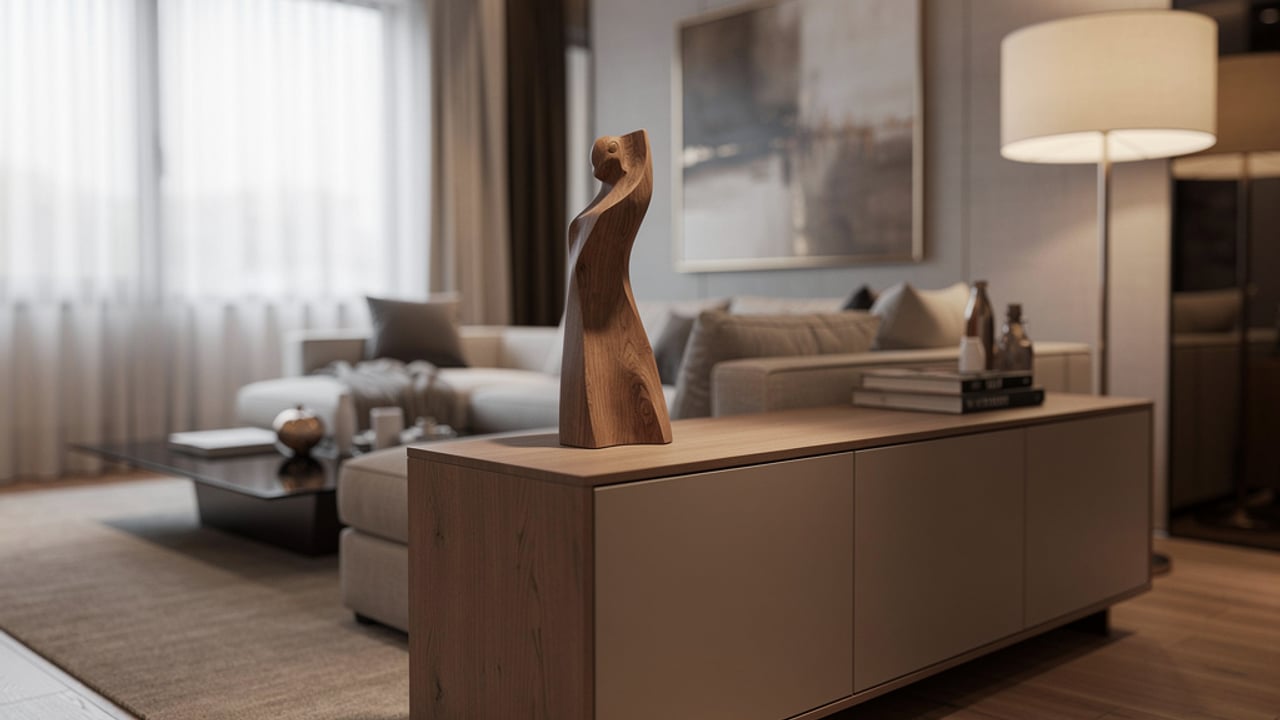
A Brief History of wooden figurine
The carved wooden figurine emerged as a serious object of design discourse during the postwar decades, roughly 1950 through 1980. Where prewar carving traditions had been rooted in folk craft and religious iconography, the mid-century iteration was reshaped by Modernist principles: reduction of ornament, emphasis on material truth, and a renewed interest in the human or animal form as pure geometry.
Scandinavian countries — Sweden, Denmark, Finland — led this reappraisal. Designers trained in applied-arts academies brought the sculptor’s sensibility to objects intended for domestic interiors. Teak, birch, and rosewood became the preferred substrates: woods with pronounced grain patterns that the maker could work with rather than against. The resulting objects occupied an uncertain, productive space between fine art and decorative object, a tension that continues to define their critical reception today.
Italian and German workshops followed distinct trajectories. Italian production, centred in Tuscany and the Veneto, tended toward more expressive figurative distortion. German studio work, influenced by the residual legacy of the Bauhaus, inclined toward geometric abstraction rendered in figurative silhouette. Both traditions produced objects of considerable formal intelligence.
Notable wooden figurine of the Era
Several designers produced work in this category that warrants particular attention. Kay Bojesen’s animal series, produced from the late 1930s and continuing through the 1950s, established a vocabulary of simplified, jointed forms that influenced a generation of Scandinavian studio makers. His monkey and bear remain reference points for anyone researching the period.
In the German context, Wilhelm Wagenfeld’s circle produced tabletop objects — including the occasional carved wooden figurine — that applied rigorous industrial logic to handmade processes. Italian sculptor and designer Gio Ponti, though primarily known for furniture and ceramics, also engaged with small carved forms during his most productive years.
Less celebrated but equally significant are the anonymous workshop productions from cooperative studios in Oberammergau and the Swedish province of Dalarna, where regional carving traditions were reinterpreted through Modernist formal language to produce work now highly regarded by specialist collectors.
Where to Find Authentic wooden figurine
Authentication is the central challenge for any collector entering this field. The market for mid-century carved objects has expanded significantly since the early 2000s, and with that expansion has come a corresponding increase in misattributed and reproduction work.
Reliable sources include specialist auction houses with documented provenance chains, estate sales from original owners with verifiable purchase records, and curated marketplaces — such as mid-centurydesigns.com — that apply structured authentication protocols before listing. Dealer invoices, exhibition labels, and period catalogue appearances all constitute material evidence worth requesting before any acquisition.
Geographic origin can sometimes be read from the wood species employed: teak and rosewood suggest Scandinavian workshop production; walnut and fruitwood point more often toward Central European or Italian provenance. These are not absolute rules but useful preliminary indicators.
Caring for Your wooden figurine
Properly maintained, a carved wooden figurine from this period will remain stable for generations. The primary adversaries are low humidity, direct sunlight, and inappropriate surface treatments applied after acquisition.
Relative humidity should be maintained between 45 and 55 percent. Rapid fluctuations cause wood to expand and contract, stressing joints and surface finishes. UV exposure bleaches natural pigmentation and degrades original oil or wax coatings. When cleaning is necessary, a dry or very lightly dampened lint-free cloth is appropriate; solvent-based products risk stripping period-correct finishes that contribute materially to an object’s authenticity and value.
Storage and display surfaces should be non-reactive. Avoid direct contact with rubber or certain synthetic materials, which can cause localised staining over time. Periodic application of a period-appropriate wax — beeswax or carnauba — will maintain surface integrity without altering the original character of the piece.