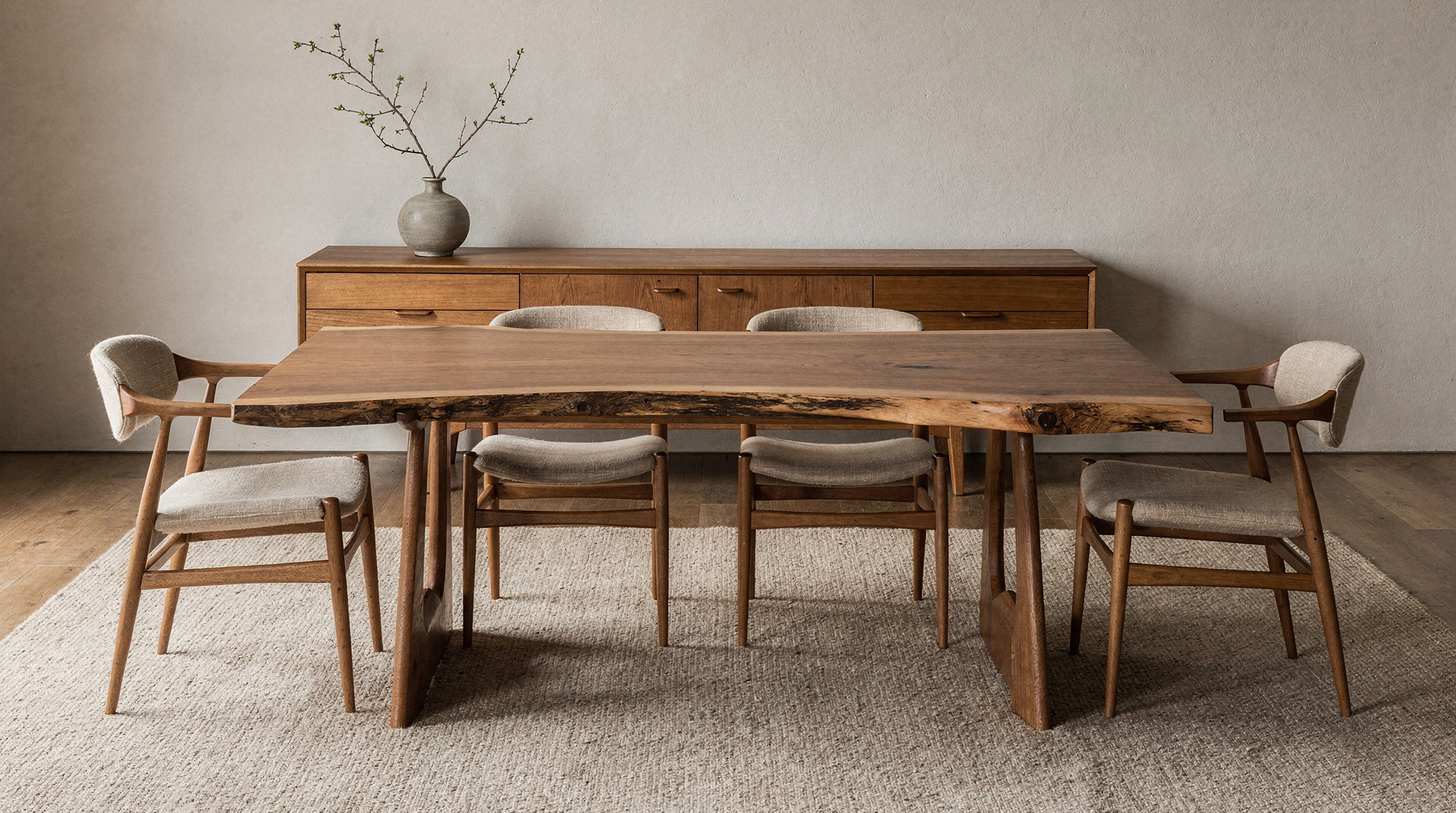
DESIGNER · GEORGE NAKASHIMA

George Nakashima: The Wood Artist and His Philosophy of Living Wood

Organic table forms and artisanal precision from New Hope

George Nakashima (1905–1990) combined his training as an architect with a deep respect for the grown material. In his workshop in New Hope, Pennsylvania, he created from 1946 onwards tables whose free live edges, butterfly joints and readable grain patterns preserved the story of each individual trunk. For him, every piece of wood deserved a second life that the designer does not dictate, but reveals. On mid-centurydesigns.com you will find curated originals whose provenance and artisanal origins are documented.

mid-century·designs

George Nakashima

ESSAY · 01

Work & Context

mid-century·designs

George Nakashima and the Philosophy of Living Wood

George Nakashima (1905–1990) is one of the defining figures of American Studio Craft, uniting in his work Japanese craft tradition, modernist clarity and a deeply felt relationship with material. After studying architecture at MIT, years in Paris, Tokyo and a collaboration with Antonin Raymond in India, 1942 brought internment at the Minidoka camp in Idaho, where the Japanese-born carpenter Gentaro Hikogawa introduced him to traditional wood joinery and a mindful approach to the craft. This experience became the foundation of the workshop established in 1946 in New Hope, Pennsylvania.

Nakashima’s outlook, recorded in his book The Soul of a Tree (1981), understands design as a dialogue with the tree. It is not the will of the designer that shapes the furniture, but the structure inherent in the wood — the cracks, the knots, the free edges. The characteristic free edge, the retained natural boundary stabilised with butterfly joints at drying cracks, and the tension-filled book-matched slabs are not a decorative vocabulary but the expression of a material-ethical practice. For collectors and designers this means: every authentic Nakashima piece is a one-of-a-kind object whose value derives from provenance, choice of wood and the consistent realisation of this philosophy.

Materials: Walnut, Cherry and the Language of Grain

Nakashima’s preferred wood was the American black walnut (Juglans nigra), often sourced from Pennsylvania and surrounding states. The workshop air-dried large-format planks over many years in order to have slabs ready for Conoid, Minguren and Frenchman’s Cove tables. Alongside walnut, the range includes wild cherry, English oak, Persian walnut and rare woods such as redwood burl, buckeye burl and East Asian keyaki slabs, which Nakashima used selectively for exceptional commissioned works.

Structurally, he joins these slabs with exposed butterfly joints in contrasting rosewood or walnut, with dowelled aprons and with the characteristic turned spindles of the Conoid and Mira chairs. Bases of solid walnut or, for larger conference tables, black-lacquered steel (as in the Minguren tables) remain deliberately restrained so that the slab takes centre stage. Surfaces are traditionally hand-oiled rather than high-gloss lacquered, preserving the tactile quality of the open grain.

Regional School: New Hope, Companions and Legacy

The workshop in New Hope on the Delaware River became the centre of its own school within the American Studio Craft movement. In close artistic kinship stood Wharton Esherick in Paoli, Pennsylvania, as well as the somewhat younger Sam Maloof (California) and Wendell Castle (New York). What they share is the insistence on keeping design, material selection and execution in a single hand, and on distinguishing themselves from the industrial serial production taking place simultaneously at Herman Miller or Knoll.

Nakashima himself, however, also worked with industry: from 1957 into the late 1960s he designed the Origins series for Widdicomb-Mueller, and in the early 1940s he produced designs for Knoll, including the Straight Chair. These production pieces are collectable, but clearly distinct from the studio pieces handcrafted in New Hope. After Nakashima’s death in 1990, his daughter Mira Nakashima has continued the workshop, developing her own designs such as the Keisho table while still producing work to the original drawings. Pieces by Mira Nakashima have by now established their own independent market.

Authenticity and Condition: What Collectors Should Look For

The authoritative proof of authenticity is the original shop order card, filed in the archive of Nakashima Studios in New Hope. On request, the workshop issues confirmations for many pieces, including the client’s name, date, wood specification and sketch. Early works are occasionally signed on the underside in black ink with the name of the first owner; no consistent workshop signature or brand mark exists. The absence of a signature is therefore not a disqualifying criterion — archival research, on the other hand, is central.

Regarding condition: drying cracks, small knots and a slightly deepened walnut patina are intentional and value-enhancing, not defects. What must be critically examined are subsequent resurfacing that break the free edge, aggressive refinishing that seals the oiled surface, and replaced butterfly joints or spindles. On Conoid and Mira chairs, the connection between the seat shell and spindles is worth examining closely — this is where signs of use appear first. Production pieces from the Widdicomb Origins line typically carry a paper label or a stamped model number, the presence of which significantly influences market value.

At mid-centurydesigns.com we curate works by George Nakashima and his circle with the commitment to examine every piece for provenance, archival reference and condition. Where available, we document the shop order card, the first owner and the restoration history transparently, so that you as a collector can make a decision on a reliable basis.

FAQ · 02

Frequently asked about George Nakashima

5 Answers

01
Why are George Nakashima's tables so expensive when they look relatively simple?
Nakashima's prices result from several factors: First, he used exclusively high-quality, often rare wood species such as black walnut or plum from deliberately selected stocks. Second, every piece was a handcrafted one-off, not a production item — work on a single table could take weeks. Third, his design is rooted in a philosophy: the wood was meant to preserve its natural structure, grain and even cracks rather than concealing them, which demands the greatest care in material selection. And finally: his works have long been established as collectibles with documented provenance. An authentic Nakashima is not merely furniture but an investment with recognised iconic status in mid-century design.
02
What does 'living wood' mean in Nakashima's design philosophy?
By 'living wood' Nakashima did not mean that the wood is still growing, but that its original organic form should remain visible. He left live edges, irregularities and natural cracks intact rather than working them away. He calls these features the 'wounds of the tree', which tell a story. The wood retains its individuality: no two tables are identical. This philosophy is rooted in Japanese aesthetic principles that Nakashima knew well, and in wabi-sabi, which honours imperfection and naturalness. A Nakashima table is therefore not merely an object but a dialogue between craftsman and material.
03
How do I distinguish a genuine Nakashima from a copy or follower work?
Authentic Nakashimas have documented provenance, ideally supported by a statement from the Nakashima Foundation or a reputable auction house. The original often bears a characteristic signature or marking, although not all early pieces are marked. Decisive is the craftsmanship quality of the execution and the intuitive selection of walnut or hardwood. Nakashima's students and later workshops have continued similar work but are by now established as such and considerably less expensive. An expert appraisal is advisable: check whether the seller provides documentation and whether the piece number can be traced in the archives.
04
Which wood species did Nakashima prefer and do they influence the price?
Nakashima worked primarily with black walnut, which he valued for its colour tones, workability and durability. He also used cherry, ash, oak, persimmon and rare species such as rosewood and teak. The wood species does genuinely influence price: black walnut pieces are considered particularly valuable and characteristic of his early work. Works in rarer woods or large-format slabs can be valued considerably higher because they were also more demanding to craft. The quality of the grain and the presence of visible growth rings or colour variations also play a role. Importantly: an apparently 'simple' ash piece can be just as valuable as a walnut table if the provenance and craftsmanship are right.
05
Are Nakashima pieces high-maintenance or can they be used in daily life?
Nakashima tables are robust and were conceived for daily use, not as pure display objects. The solid wood construction and the natural oil surface treatment make them long-lasting. They do, however, require care: the open natural edges and cracks can collect dust, and the wood needs occasional treatment with natural oil. Direct sunlight should be avoided to prevent uneven discolouration. Large temperature fluctuations or extreme dryness can cause the wood to move. Collectors often avoid intensive use in order to minimise scratches and preserve provenance. For an authentic collector's piece, regular gentle cleaning with minimal water and occasional re-oiling is recommended rather than daily dining use.

GLOSSARY · 03

Related Terms

8 Entries

Organic Table Form
A furniture form that moves away from geometric shapes and emulates natural contours. In Nakashima's work characterised by free edges, asymmetric floor plans and the emphasis on the live edge as a design element. Reflects the living material as the starting point of form-finding.
Live Edge
The retained natural tree edge in furniture pieces, particularly on tabletops. Nakashima used the live edge not as a flaw but as a qualitative feature that emphasises the rawness and authenticity of the material and respects the original form of the tree.
Butterfly Joint
A butterfly-shaped wood joint that holds two pieces of wood together while simultaneously serving as an aesthetic design element. Nakashima developed this technique to stabilise cracks in wide wood slabs without concealing or manipulating the material.
Wood Character
The individual expression of a piece of wood through colour tones, grain, knotholes and organic growth patterns. In Nakashima's philosophy an irreducible quality of the living material that shapes the aesthetic of the object and determines its uniqueness.
Artisanal Perfection
The highest standard in the execution, processing and hand-finishing of handcrafted furniture. For Nakashima, the expression of a philosophy that understands perfection not as flawlessness but as the precise realisation of a concept in respectful observance of material truth.
Japanese Wood Culture
The traditional Japanese appreciation for natural materials, their beauty and ephemeral quality. Nakashima was shaped by his time in Japan and his encounter with this culture, which manifests in his reverence for wood character and naturalness.
Mid-Century Modern
A design movement of the 20th century (1933–1965) that united functionality, innovative materials and organic forms. Nakashima's works are central to this movement, combining a modernist formal language with craft tradition and natural materials.
Material Truth
A design principle that presents materials in their original nature and character rather than concealing or artificially altering them. Central to Nakashima's aesthetic: the wood remains visible in all its properties, imperfections and beauty.