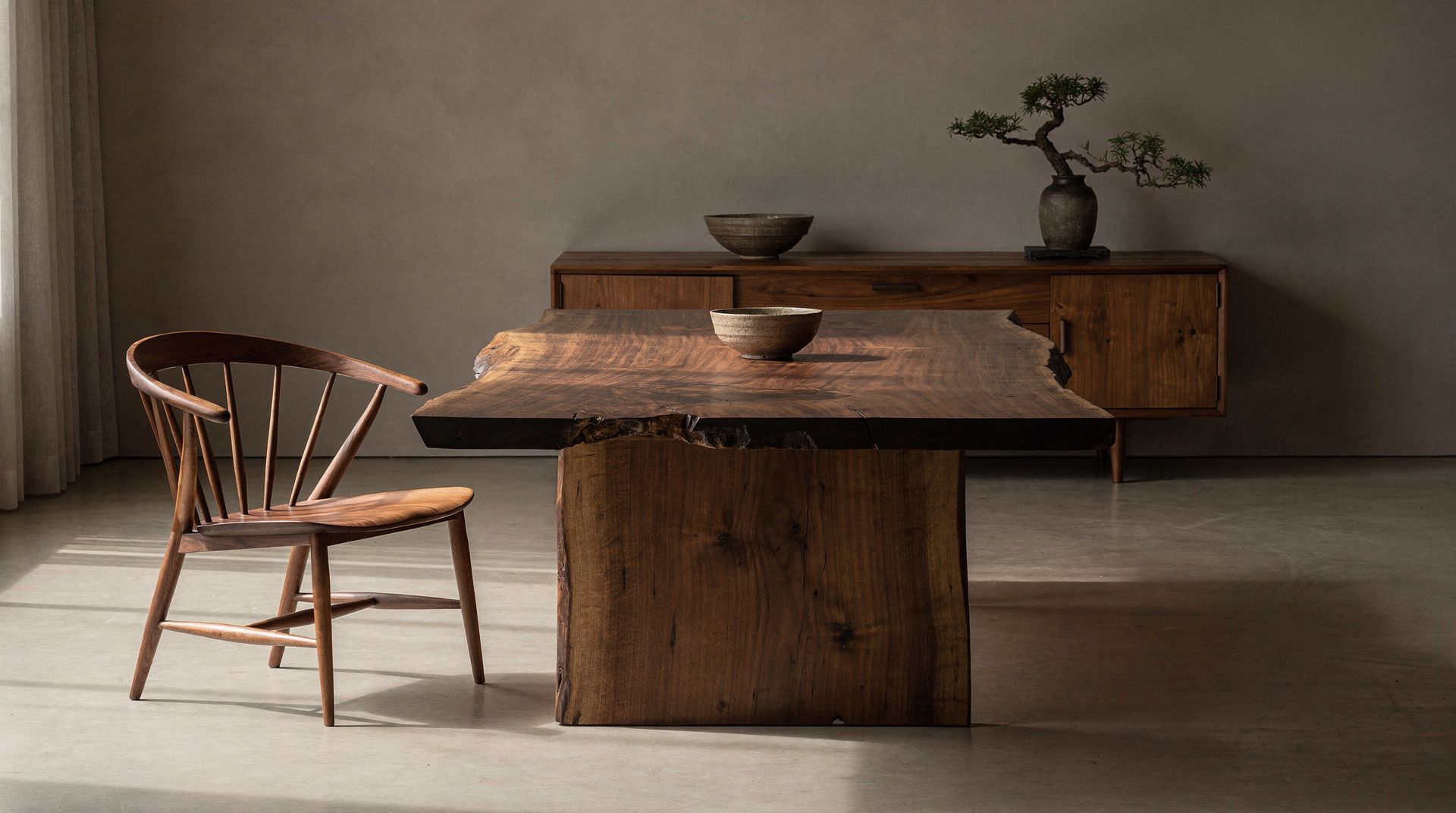
George Nakashima and the Tree-First Philosophy
George Nakashima (1905–1990) is one of those figures of modernism who cannot be seamlessly fitted into the narrative of industrial progress. Trained as an architect at MIT and shaped by stays in France, Japan, and India — where he worked as a carpenter at Sri Aurobindo’s ashram in Pondicherry — Nakashima returned to the United States in 1940. The internment of Japanese-American citizens brought him in 1942 to the Minidoka camp in Idaho, where he studied traditional Japanese woodworking under issei carpenter Gentaro Hikogawa. After being released through the sponsorship of architect Antonin Raymond, he settled in 1943 in New Hope, Pennsylvania. There he created the body of work that continues to define organic modernism in North America: furniture that regards the tree as a co-author, bridging the gap between Japanese sashimono precision and American studio craft.
Nakashima’s approach was programmatic. In his book “The Soul of a Tree” (1981), he articulated the craftsman’s obligation to give wood a second life. Live-edge slabs, natural cracks stabilized with butterfly joints (chigiri), oiled surfaces rather than high-gloss finishes: this is not rustification, but a deliberate counterpoint to the anonymous mass production of the postwar years. To collect Nakashima is to collect an ethic.
1. Characteristic Materials and Construction
At the center stands the American black walnut (Juglans nigra), mostly sourced from stands in the eastern United States. Nakashima favored wide, untrimmed planks with the live edge intact, often sawn from a single trunk so that the grain is preserved as an independent drawing. Cherry and hickory were added for seat surfaces and finer work, dark rosewood for contrast, and occasionally buckeye burl with its characteristic cloud-like figure, or English walnut.
Structurally, he combined Japanese carpentry logic with American material thicknesses. The butterfly keys in rosewood are not ornamental but serve as structural clamps for growth cracks; the live edges are not straightened but carefully freed of sapwood and bark and treated with tung oil. The Conoid Chair (from 1960) is characteristic: its namesake studio in New Hope is a hyperbolic concrete shell — a free-standing chair on two runner-like legs whose backrest is fashioned from hickory spindles. The Conoid Table, in turn, rests on two angular walnut trestles that support the heavy slab top without visible hardware. Other central models include the Minguren I and II, the Frenchman’s Cove Table, the Origins series, and the Straight-Backed Chair, which draws on Windsor traditions.
2. Regional Schools and the Orbit of Organic Modernism
Nakashima never operated in a vacuum. New Hope, Pennsylvania, was a hub of the American Studio Craft movement in the postwar decades. Working in parallel, Wharton Esherick — often called the “Dean of American Craftsmen” — developed an expressionist and sculptural vocabulary in Paoli. Phillip Lloyd Powell and Paul Evans ran their joint studio in New Hope, supplementing Nakashima’s material culture with metalworking and modernist forms. This loose grouping is sometimes referred to as the “New Hope School.”
Internationally, Nakashima is in dialogue with the Scandinavian modernism of Hans J. Wegner and Finn Juhl, sharing their appreciation for solid wood, yet distinguished by his rejection of any formal idealization of the material. In California, Sam Maloof and J. B. Blunk worked in a kindred spirit, though Maloof’s chairs are more indebted to sculptural curvature. Nakashima’s commissions for the Rockefeller family at Pocantico Hills (from 1973), for the Christ Church monastery in Rochester, and the late “Altars for Peace” mark the reach of his work beyond the domestic sphere. After his death, his daughter Mira Nakashima continues to run the studio in New Hope, producing to this day authorized pieces based on her father’s drawings as well as her own designs.
3. Authenticity, Provenance, and Condition for Collectors
Nakashima sold the majority of his production directly from the studio in New Hope. For each piece of furniture an order card was created, recording the client’s name, dimensions, wood species, and often a sketch. These cards are archived at the studio and are the central reference point for any attribution. Serious provenance research begins with an inquiry to the Nakashima Studio, which can issue a confirmation for a fee if the piece can be found in the records.
Signatures are not a consistent criterion for Nakashima. Earlier works often bear no signature at all; from the late 1950s onward, client names are sometimes written in black marker on the underside, corresponding to the order cards. A missing inscription does not disqualify a piece; a present one proves nothing without documentary backing. For the period since 1990, the market draws a clear distinction between lifetime works by George, authorized posthumous productions by the studio under Mira Nakashima, and the numerous “in the manner of” copies that the price appreciation of the 2000s has generated.
Caution is advised regarding condition. Nakashima’s surfaces are treated with tung oil, not lacquered; refinishing with sandpaper destroys the patina and significantly reduces value. Small cracks, movement along the live edge, and minor staining are inherent to the material and not a defect. What should be critically examined are the butterfly keys for later additions, the leg joints for loosening, and, on Conoid Chairs, the spindles for breaks or replacements.
At mid-centurydesigns.com, every attributed piece is cross-referenced against the available studio records, the surface history is documented, and the constructive details are photographically evidenced. For each object you will find a traceable chain of ownership, an honest condition report, and, where available, a reproduction of the original order card. What we cannot substantiate, we do not sell as Nakashima.
This article was generated automatically by an AI system. Disclosure pursuant to Article 50 of the EU AI Act.