Refreshing Shellac Polish: A Matter of Approach
A shellac surface is not a varnish in the modern sense, but a thin skin built up from many layers of resin from the lac beetle dissolved in ethanol. It lives by its depth, its silky sheen, and a patina that has been written in over decades. Anyone who owns a vintage piece of furniture with an original shellac polish is stewarding a piece of craft history that dates back to the 18th century and was part of the standard craftsman’s repertoire in German-speaking countries well into the mid-20th century.
The goal of refreshing is therefore not a flawlessly new surface, but the gentle revitalization of what is already there. Unlike nitro or polyurethane lacquers, shellac can be “re-dissolved” and bonded with itself, which allows for material-preserving repairs. Those who understand this property work with the material rather than against it. The following sections outline which materials are involved, which regional traditions have shaped the practice, and what collectors should look for when assessing condition.
1. Characteristic Materials and Their Interaction
Shellac is fundamentally composed of the natural resin of the lac beetle (Kerria lacca), which is traded in various degrees of purity: from dark ruby shellac to orange shellac to bleached, light shellac, often referred to as “flake shellac” or in a dewaxed variant. The resin is dissolved in ethanol, typically at concentrations of between around eight and fifteen percent, depending on the stage of application.
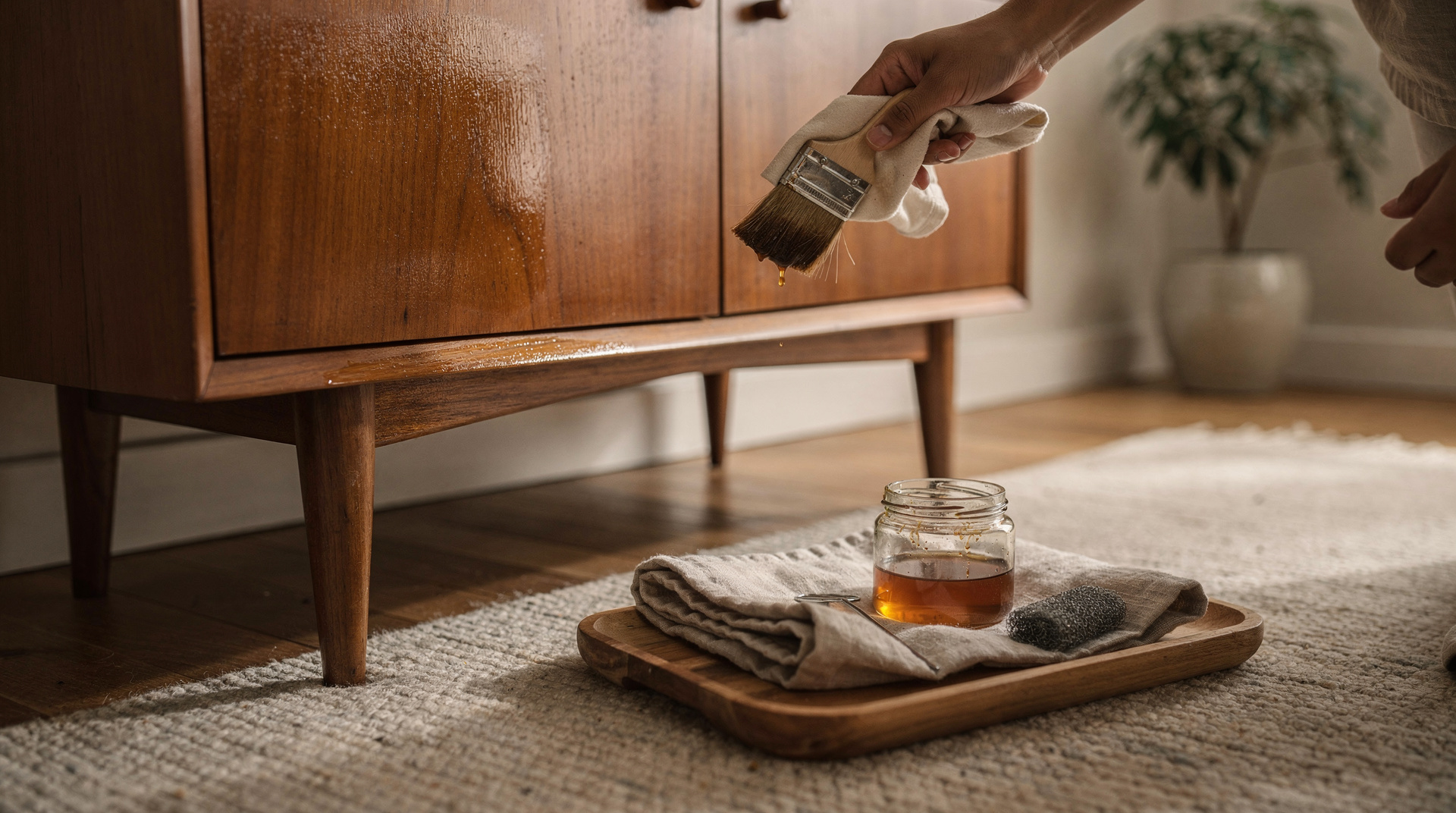
The classic tools of the trade include a polishing pad made from a wool core with a linen cover, a drop of polishing oil (traditionally paraffin or linseed oil) as a lubricant, and pumice powder as a pore filler for open-grained woods such as walnut, mahogany, or rosewood. For refreshing itself, a heavily diluted shellac is often sufficient, applied in thin circular motions. Importantly, dull spots, white hazing (blushing) caused by moisture, or fine scratches can often be remedied simply by re-dissolving with ethanol and applying a fresh coat. Waxes based on carnauba or beeswax serve as a final care step, but do not replace polishing.
To be avoided are silicone-based furniture polishes, aggressive solvents such as acetone, and abrasive pastes. They destroy the surface irreversibly or make future restoration considerably more demanding.
2. Regional Schools and Designers in Context
Shellac polishing, known in French-speaking regions as “vernis au tampon”, was systematized in France and England in the early 19th century and quickly spread to Central European cabinetmaking workshops. The Viennese workshops and the furniture makers of the Biedermeier period elevated it to a master discipline, shaping the handling of cherry, birch, and walnut to this day.
During the transition to modernism, shellac long remained the standard finish, even as the Bauhaus and the Ulm School, with their material honesty, increasingly turned to open or oiled surfaces. Nevertheless, shellac-polished surfaces continued to appear in post-war furniture from Danish, German, and Italian manufacturers, frequently in combination with rosewood or teak veneers. Scandinavian workshops often worked with a reduced, less high-gloss finish, while Italian manufacturers of the 1950s and 1960s, particularly in the Milan area, cultivated the deep, mirror-like sheen of classical polishing. Those who know the provenance of a piece therefore usually also know how much sheen is historically appropriate and where restraint is called for.
3. Authenticity and Condition: What Collectors Should Look For
You can identify an original shellac polish by several characteristics: it reacts to a cotton swab lightly moistened with ethanol applied to a hidden spot by becoming tacky. Modern synthetic lacquers do not do this. Under raking light, it shows fine, barely visible wipe marks from the polishing pad, not a spray mist texture. Its color ages warmer, often towards amber, and settles around edges and profiles with varying layer thickness.
For the value of a vintage piece, a well-maintained, aged original polish is generally preferable to a newly built-up one, even if the latter appears more flawless. Collectors assess documented, minimally invasive refreshing more favorably than complete stripping. Critical points to examine include large-scale overcoating with modern materials, deep water stains reaching into the veneer, and heat damage that causes the shellac to blister. Smaller cloudiness, fine crazing, and localized wear at handles or table edges, on the other hand, are considered authentic signs of use that tend to support rather than diminish provenance.
A good restorer documents their interventions, uses reversible materials, and deliberately leaves in place what carries character. This approach — doing less, but doing the right thing — is what distinguishes careful refreshing from value-diminishing reworking.
At mid-centurydesigns.com, pieces with original shellac surfaces are carefully examined, described in terms of their condition, and, where necessary, gently refreshed by experienced restorers. Each polish is documented for authenticity, age, and depth of intervention, so that you as a collector or designer can understand exactly what you are acquiring. This preserves the substance of the furniture and keeps the story told by its surface legible.