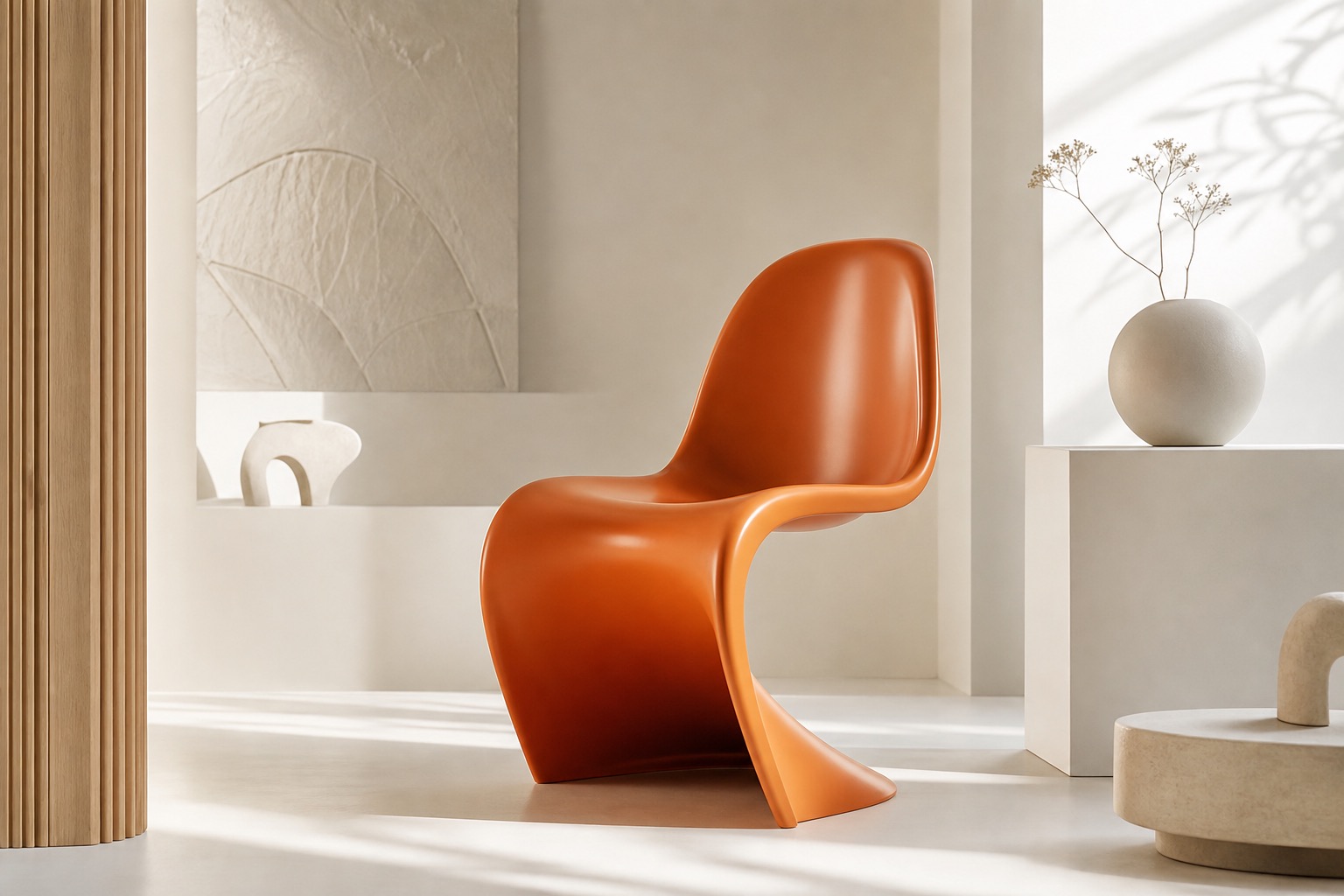
With the Panton Chair, production history matters more than instant recognisability
Many introductions treat the Panton Chair mainly as a pop icon defined by its S-shaped form. For trade and for dating individual pieces, something else matters more: material and production history. Vitra states that Verner Panton designed the chair in 1960 and developed it to serial maturity with Vitra in 1967. The official Verner Panton site adds that the idea had earlier roots and that the later production story ran through several versions in different plastics.
That makes the chair especially useful on mid-century·designs. Anyone who already knows our page on Verner Panton or mid-century modern interior can see more clearly here how strongly a single object can be read through material questions. In the wider shop context, that matters too: with plastic classics, colour and profile are not enough unless they are matched by maker, material and production period.
1960 is the design year, but not the whole story
The sources fit together well. Vitra gives 1960 as the design date and 1967 as the point of serial maturity. The Victoria and Albert Museum explains why there was a gap: although the chair was designed as early as 1960, suitable materials and techniques were not immediately available. That point adds real value for buyers, because it explains why Panton Chairs should not be dated too casually.
The official Verner Panton site then becomes very concrete about production history. It identifies a serial production model from 1967, documents multiple versions in different plastic types, and notes production in different periods by Vitra and Herman Miller. For collectors, that matters because the same basic silhouette does not imply one single, unchanging material reality.
For vintage buying, the material generation matters more than the silhouette
The V&A also notes that Vitra has produced an injection-moulded polypropylene version since 1999, characterised by flexibility, durability and lightness. That makes the practical lesson clear: if you want to assess or place a specific example, the right question is not simply whether it is “a real Panton”, but which production phase it belongs to.
That is the real shop-level takeaway. A Panton Chair is only properly described when material, maker and date align. The form remains iconic, but objective dating starts not with the curve itself, but with the chair’s documented material history.