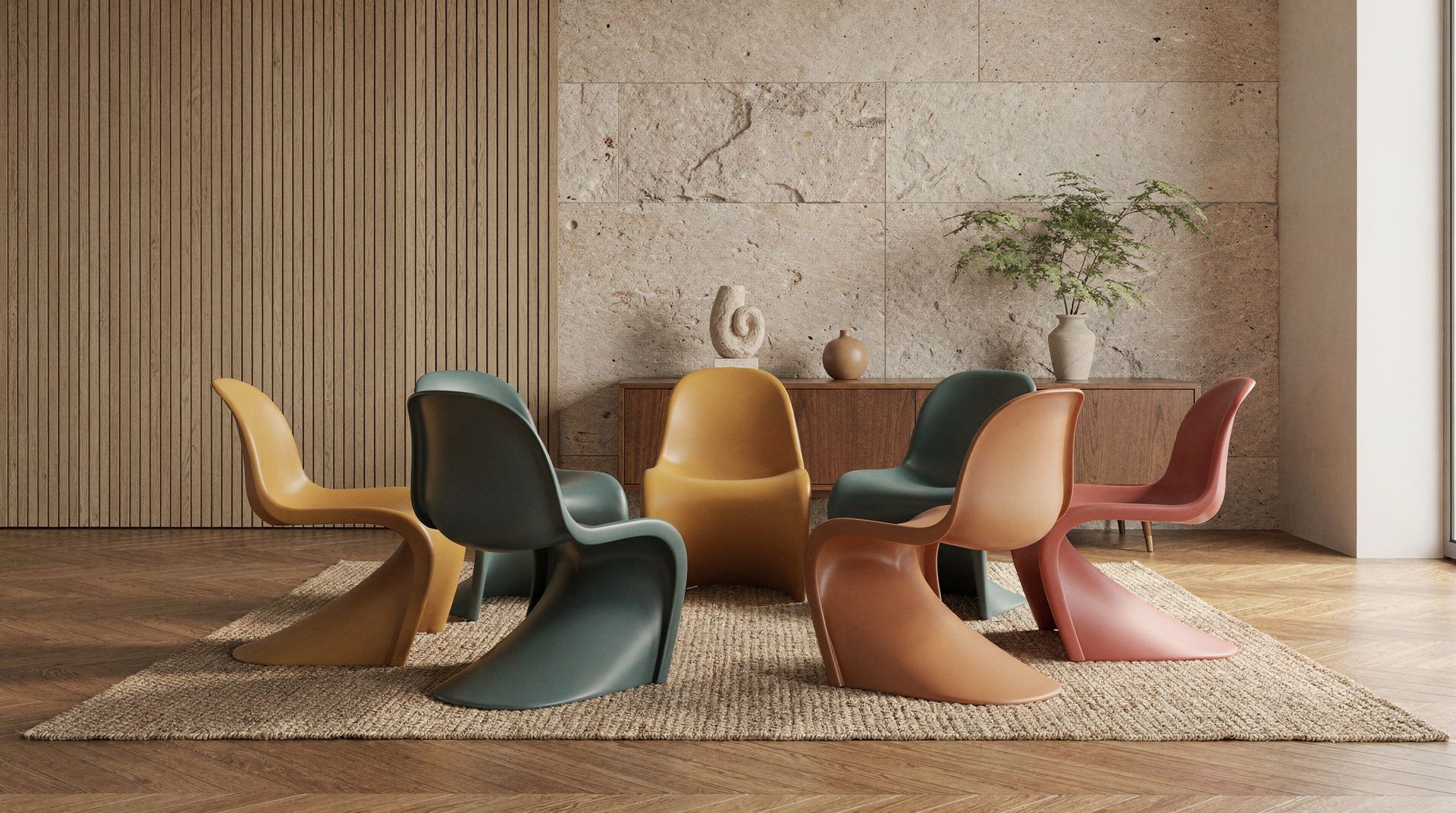
Verner Panton: The Visionary of Color and Plastic Innovation
Verner Panton (1926 to 1998) is considered the radical among Danish Modernists. While his compatriots Wegner, Juhl and Mogensen refined the language of wood, Panton had already left the craft workshop behind by the late 1950s, turning instead to plastics, foamed materials, metal mesh and an almost synesthetic world of color. His work is not a continuation of Scandinavian restraint, but its productive antithesis: a vision of living as a total spatial experience, in which floor, wall, ceiling and furniture merge into a single chromatic landscape.
Anyone engaging with Panton today enters two spheres simultaneously. The first is that of product design, shaped by icons such as the Panton Chair (developed 1959 to 1967, produced in series from 1968 by Vitra and Herman Miller), the Cone Chair (1958) and the lighting families for Louis Poulsen and Fritz Hansen. The second is that of installations and interiors, which Panton conceived as total works of art — among them the restaurant Varna in Aarhus (1970), the exhibitions “Visiona 0” and “Visiona 2” for Bayer AG (1968, 1970), and the editorial offices of Spiegel-Verlag in Hamburg (1969). This dual track — serial object and immersive space — is the key to any serious Panton collection.
Characteristic Materials and Manufacturing Techniques
Panton thought in material systems, not in furniture typologies. The Panton Chair is the most prominent example: as the first cantilevered chair produced in a single piece from plastic, it went through several production phases that are decisive for dating a piece. The early series were manufactured by Vitra from 1968 in cold-pressed, fiberglass-reinforced polyester; from 1971, thermoplastic Baydur (rigid polyurethane foam) followed, and later Luran-S. Only in 1999, after Panton’s death, was the current version in polypropylene created in collaboration with Vitra. Each of these phases has its own surface texture, its own weight and characteristic signs of aging, such as hairline cracks at the runner or yellowing of light color tones.
Beyond plastic, further materials define the work. Chrome-plated steel tube and color-lacquered steel wire form the skeleton of the Cone Chair, Heart Cone Chair and Wire Cone (1959 to 1960), produced by Plus-linje. Textile upholstery in strong wool qualities — frequently from Kvadrat or Unika Vaev — gives the series their depth of color. For luminaires, Panton worked with enamel, chromed and lacquered sheet metal (Flowerpot, 1968, for Louis Poulsen), as well as acrylic glass and mouth-blown opal glass (Fun series with mother-of-pearl discs, VP Globe, 1969). In the textile works and carpets of the Geometri series for Mira-X (from 1969), he translated his thinking on color into repeat patterns that to this day measurably transform the spatial effect of an interior.
Regional Positioning: Danish Origins, European Production
Panton was born in 1926 on the island of Funen, studied architecture at the Royal Danish Academy of Arts in Copenhagen, and worked between 1950 and 1952 in the office of Arne Jacobsen. From this studio came his understanding of serial production and his interest in the Ant Chair and Series 7 chair, whose formal principle he later carried into the age of plastics. In 1955 Panton moved to Binningen near Basel, where he designed the greater part of his work. The geographic shift is significant: Panton belongs to the Danish school, but his production is Central European. Vitra in Weil am Rhein, Fritz Hansen in Allerød, Louis Poulsen in Copenhagen, Plus-linje in Denmark, Mira-X in Switzerland and Bayer in Leverkusen form the industrial backbone of his work.
Compared with contemporaries such as Poul Kjærholm or Nanna Ditzel, Panton appears less tectonic but more scenographic. Affinities exist with the Italian radicals around Joe Colombo and Gaetano Pesce, with English Pop design and with Eero Aarnio’s Finnish plastic experiments. For collectors this means: a Panton object can rarely be read in isolation. It unfolds its quality in dialogue with other positions of late Modernism — whether a Bocca sofa by Studio 65, a Sacco by Zanotta or a Ball Chair by Aarnio.
Authenticity, Condition and Provenance for Collectors
With hardly any other designer of the era is the question of dating so closely tied to material as it is with Panton. A Panton Chair from the early 1970s in Baydur differs considerably in value and collector relevance from a current polypropylene edition. Always check the manufacturer’s marking on the underside (Vitra or Herman Miller, sometimes with year of production), the material structure on the inside of the runner and the characteristic reinforcement ribs of each production phase. Color deviations are normal in early series, as are fine crazing in the lacquer; structural cracks, however, significantly reduce value, since the load is concentrated in the runner area.
For Louis Poulsen luminaires, the key factors are original enamel condition, intact cable routing and the presence of embossed stamps. For seating from the Cone family, check original upholstery, the manufacturer’s label from Plus-linje or later licensees (Polythema, Vitra), and the condition of the swivel plate. Textiles and carpets from the Mira-X series are frequently underestimated, but gain considerably in significance when color brilliance is intact and provenance is documented. Exhibition or interior provenances — for example from Visiona, Varna or Spiegel-Verlag — are exceptional cases and require unbroken documentation through photographs, invoices or estate certificates.
At mid-centurydesigns.com we curate Panton objects with precisely these criteria in mind. Every piece is examined for material phase, manufacturer’s marking and condition, documented and placed in the context of its production history. This allows you to make a decision based not on surface appearance, but on verifiable substance.
This article was generated automatically by an AI system. Disclosure pursuant to Article 50 of the EU AI Act.