Isamu Noguchi: Between Sculpture and Function
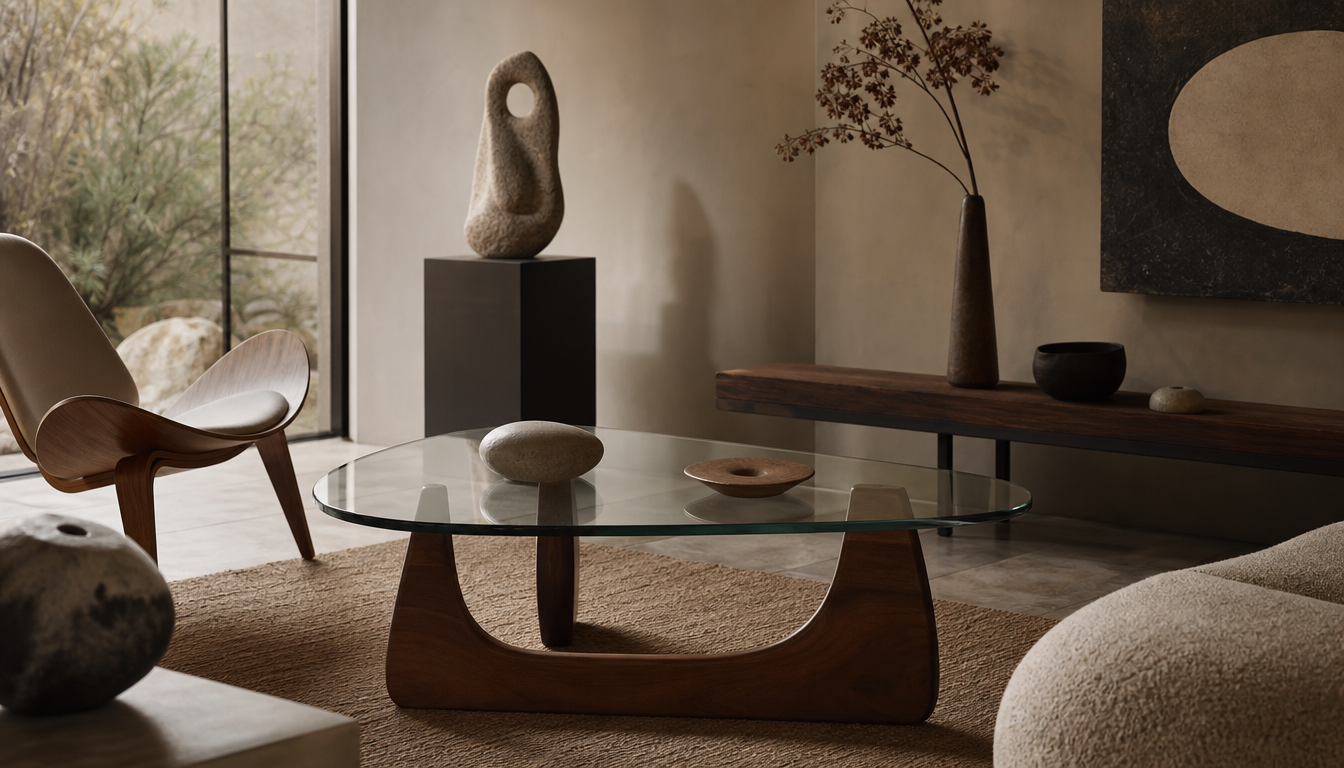
Isamu Noguchi (1904–1988) resists any simple categorization. He was a sculptor who designed furniture, and a furniture designer who never stopped thinking as an artist. His best-known work, the Noguchi Coffee Table of 1944, which he brought to market together with Herman Miller, is today one of the most recognized pieces of furniture of the 20th century. And yet he remains a singular figure: not the product of a school, not the representative of a single stylistic direction, but the result of a biography that encompasses Tokyo, Paris, New York and Kyoto as much as the studios of Constantin Brâncuși and Buckminster Fuller. Those who seek a Noguchi piece are not looking for furniture in the conventional sense. They are looking for an object that reorders space, that holds light, and that deliberately blurs the boundary between applied art and free sculpture. For collectors who value depth and conviction in their interiors, Noguchi is one of the most compelling positions in the entire Mid-Century Modern canon.
Characteristic Materials and Formal Language
Noguchi never worked with a single material. His formal language lives precisely from the tension between the organic and the industrial, between the raw and the polished. The Noguchi Coffee Table combines a free-form, biomorphic glass top with two interlocking wooden elements in walnut or ebony that support each other without any metal fittings. This constructive elegance was no coincidence, but the result of Noguchi’s deep understanding of load, balance and proportion, developed through his sculpture practice.
For his Akari lamps, which he began developing in 1951 in Gifu, Japan, he turned to Washi – the traditional Japanese paper made from mulberry tree fibres, stretched over bamboo frames. Akari is not an industrial product in the modern sense: each lamp was and continues to be made by hand, the forms varying between spherical, cylindrical and lanceolate. The quality of light produced by the fibred paper cannot be replicated by other materials. Noguchi described Akari as “light sculptures” – a term that is programmatic: the light is not function, but form.
In his garden sculptures and occasional table works, he returned again and again to basalt, marble and granite – stones he personally selected at quarries in Japan, Mexico and Italy. The surfaces of his stone sculptures often display deliberate contrasts: one side remains rough-hewn, the other is polished to a mirror-like high gloss. This juxtaposition of worked and unworked states is a central motif of his œuvre and immediately distinguishes his works visually from those of his contemporaries.
Influences, Schools and the Network of His Time
Noguchi is not the child of a single region or movement, but he touched formative circles of 20th-century design history in a way that few other designers can claim. His early studies under Gutzon Borglum in New York and the decisive years in Constantin Brâncuși’s studio in Paris between 1927 and 1928 shaped his conviction that volume, silence and material can speak for themselves. Brâncuși’s influence is perceptible throughout Noguchi’s entire body of work: the reduction to the essential, the dignity of untreated material, the interest in archaic forms.
In New York during the 1930s and 1940s, he moved in a milieu that united the avant-garde, stage design and the design industry. His long-standing collaboration with choreographer Martha Graham produced stage sets that were furniture objects, and furniture that read like stage sets. This osmotic relationship between performance space and living space is a unique hallmark of his career.
His connection to Herman Miller, where he was represented alongside George Nelson and Charles Eames in parallel programmes, placed him at the institutional centre of American Mid-Century design. And yet he remained conceptually separate from the systemic rationality of an Eames or the democratic product philosophy of a Nelson. Where they aimed for scalable mass production, Noguchi insisted on the singularity of the design. The Coffee Table is a production piece, but it does not look like one.
In Japan during the 1950s and 1960s he formed close ties with ceramicists, papermakers and stonemasons, particularly in Gifu and on the island of Shikoku, where his studio in Mure remains accessible today as the Isamu Noguchi Garden Museum. This geographic and craft-based rootedness in Japan gives his work a texture that has no direct parallel in Western Modernism.
Authenticity and Condition: What Collectors Should Look For
The market for Noguchi objects is complex because several of his designs – above all the Coffee Table and the Akari lamps – continue to be produced in authorised new editions. The Vitra reissue of the Coffee Table and the ongoing production of the Akari lamps by Ozeki & Co. in Gifu are legitimate and licensed by the Noguchi Foundation. For collectors seeking an original vintage piece, the distinction between an early Herman Miller production from the 1940s to 1970s and a later licensed reproduction is therefore crucial.
For early Herman Miller Coffee Tables, the following points should be examined: original models from the 1940s and early 1950s often carry no visible manufacturer’s label, as labelling practices of the era were inconsistent. Walnut wood with a warm, honey-coloured patina and natural weathering of the wood grain are indicators of age. The glass tops of period pieces are frequently slightly thicker and display marginal irregularities in their cut that industrially manufactured plates of more recent date do not show.
With Akari lamps, early examples are often identifiable by their specific folding and the quality of the Washi. Original pieces from the 1950s and 1960s display a characteristic yellowing of the paper resulting from natural ageing, which has a different quality from artificial ageing processes. The bamboo structure of older examples is hand-tied, not machine-made.
Provenance documentation is particularly valuable with Noguchi pieces, as the market is characterised by reproductions of every quality level. Purchase receipts, auction records, gallery documentation or records from design collections significantly increase the value and security of an acquisition. Pieces with a verifiable chain of first ownership from the American or European post-war design milieu enjoy particular trust among collectors.
Condition assessment for Noguchi follows different criteria than for conventional furniture. An even patina on the wooden elements of the Coffee Table is not considered a flaw but rather evidence of authenticity and life. Scratches on the glass top, however, noticeably reduce value, as glass cannot develop further over time. With Akari lamps, minor cracks in the Washi are often accepted, while deep holes or missing structural areas significantly diminish both aesthetic and material value.
The Noguchi pieces available at mid-centurydesigns.com are examined and curated according to these criteria. Every object is assessed for period of manufacture, material condition and provenance before being included in the collection. Wherever documentation exists, it is communicated transparently. The goal is not a broad offering but a reliable one: pieces where you know what you are getting, and where the history of the object is as present as its form.