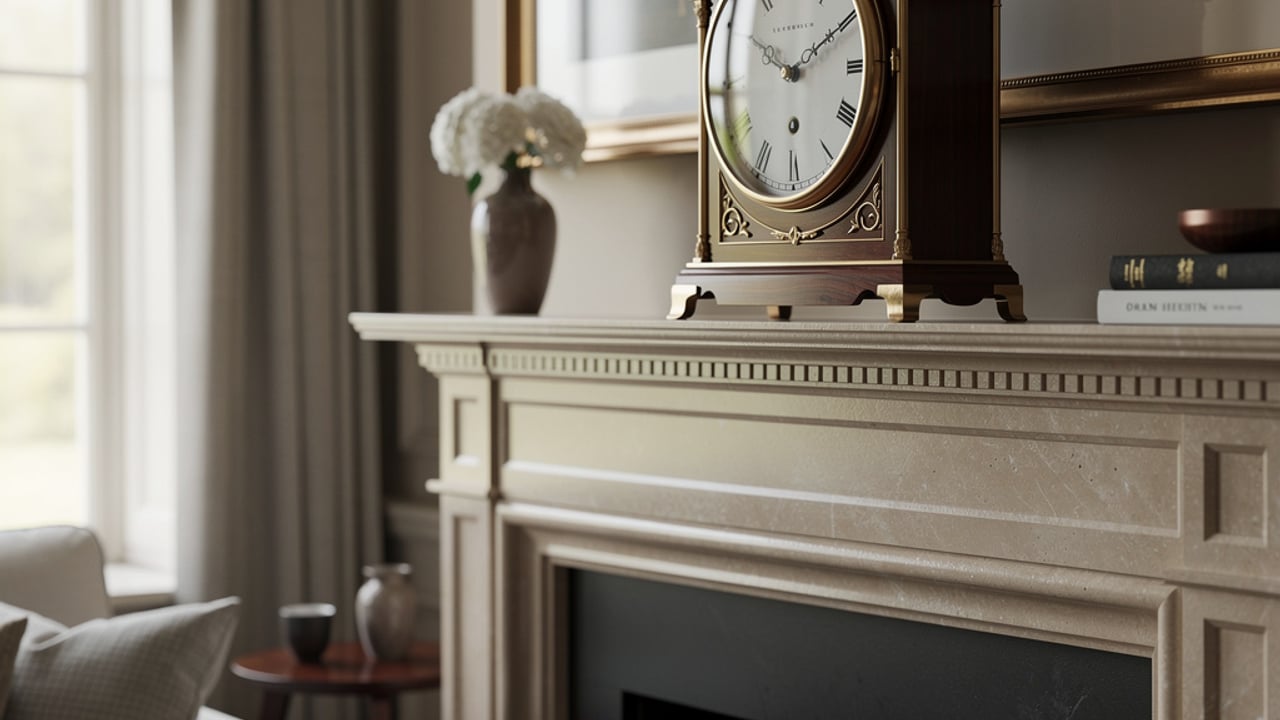
CATEGORY · VINTAGE MANTEL CLOCKS

Time, Objectified

The mantel clock as sculptural argument

From the spare geometry of Scandinavian modernism to the polished excess of Hollywood Regency, the finest vintage mantel clocks of the postwar decades treat timekeeping as a secondary virtue. Form came first, and it shows.

mid-century·designs

vintage mantel clocks

ESSAY · 01

Work & Context

mid-century·designs

A Brief History of vintage mantel clocks

The mantel clock underwent its most radical transformation between 1950 and 1980, when industrial manufacturing, new synthetic materials, and a generation of formally trained designers converged to question everything the Victorian bracket clock had assumed. Where nineteenth-century examples were ornamental confections of gilded ormolu and porcelain, vintage mantel clocks of the mid-century period submitted to the same reductive discipline that was simultaneously reshaping chairs, lamps, and buildings.

The shift was not merely aesthetic. Quartz movement technology, commercially available from the late 1960s onward, liberated case designers from the mechanical tolerances that had previously dictated proportion. A movement could now be miniaturised, tucked into almost any sculptural form the designer imagined. The result was a proliferation of case vocabularies — teak and rosewood housings in Scandinavia, lacquered steel and acrylic in Italy, brushed aluminium and smoked glass in the United States — each nationality inflecting the object with its own postwar preoccupations.

Collectors today recognise this period as the decisive moment when the clock ceased to be furniture accessory and became, irrevocably, a designed object in its own right.

Notable vintage mantel clocks of the Era

Certain examples from this period have achieved canonical status in the auction and collecting markets. Howard Miller’s output under the art direction of George Nelson stands as perhaps the most studied body of work: the Ball Clock aesthetic migrated, in modified form, into mantel formats that balanced playfulness with structural rigour. Arne Jacobsen’s collaborations with Braun-adjacent workshops produced cases of almost aggressive minimalism, their dials reduced to pure graphic fields.

Italian manufacturers — Solari di Udine foremost among them — brought a theatrical sensibility to flip-disc and split-flap mechanisms, producing vintage mantel clocks that performed time rather than merely displaying it. These kinetic examples occupy a distinct sub-category, prized as much for acoustic character as visual presence.

Nordic atelier pieces in solid teak, often unmarked or carrying only a country-of-origin stamp, represent perhaps the most undervalued segment of the current market: rigorously beautiful, materially honest, and still accessible to collectors at non-trophy price points.

Where to Find Authentic vintage mantel clocks

Provenance is the primary discipline of clock collecting, and it demands patience. Auction records from Christie’s, Sotheby’s, and specialist houses such as Wright in Chicago provide benchmark pricing and authentication precedent. Estate sales in Scandinavia, Germany, and the American Midwest continue to surface important examples, often in original working condition.

Online marketplaces have democratised access considerably, but they have equally democratised misattribution. Buyers seeking authentic vintage mantel clocks should insist on period photographs, original receipts or exhibition records where available, and — for any example attributed to a named designer — cross-reference against published catalogues raisonnés or manufacturer archives.

Mid-Century-Designs.com applies a three-stage vetting process to every listed example: material analysis, movement examination, and attribution review against primary documentary sources. Only pieces that satisfy all three criteria are offered for sale.

Caring for Your vintage mantel clocks

The longevity of vintage mantel clocks depends on measured intervention rather than aggressive restoration. Mechanical movements benefit from cleaning and lubrication on a cycle of roughly seven to ten years; quartz conversions, while functionally convenient, permanently compromise collector value and should be avoided in any piece of auction significance.

Wood cases — teak, walnut, rosewood — respond well to occasional treatment with a non-silicone furniture wax applied sparingly. Acrylic and lucite housings require only a soft dry cloth; abrasive compounds will cloud surfaces that cannot be refinished without specialist equipment.

Temperature stability matters more than most collectors initially appreciate. Sustained exposure to direct sunlight or radiator heat will check wood cases, yellow acrylic, and — in mechanical examples — alter the viscosity of lubricating oils. A stable interior environment, 18–21 °C with moderate humidity, will preserve both material and mechanism indefinitely.

FAQ · 02

Frequently asked about vintage mantel clocks

5 Answers

01
How do I authenticate a vintage mantel clock attributed to a named designer?
Authentication requires cross-referencing the piece against the designer's published catalogue raisonné, known production records, and period exhibition documentation. Physical evidence — correct materials, appropriate movement type for the date, consistent finishing methods — must align with documentary evidence. For significant attributions, a specialist appraiser familiar with the specific atelier should be consulted before purchase.
02
Are quartz replacements acceptable in vintage mantel clocks intended for collection?
From a collector-value standpoint, quartz replacements are generally unacceptable in named or documented examples. They constitute an irreversible alteration to the object's integrity. For decorative use without resale intention, a sensitively fitted quartz module may be pragmatic, but the modification should be disclosed in any future sale description without exception.
03
What price range should a serious collector expect for mid-century examples?
The market spans a considerable range. Unsigned Nordic teak examples regularly sell at auction between £200 and £800. Documented George Nelson or Arne Jacobsen attributions command £1,500 to £12,000 or beyond depending on condition and provenance. Italian kinetic examples by Solari occupy a middle tier, typically £600 to £4,000, with condition of the flip mechanism critical to valuation.
04
What materials are most commonly found in postwar mantel clock cases?
Teak, walnut, and rosewood dominated Scandinavian and American production through the 1950s and 1960s. The 1970s introduced lacquered steel, acrylic, and composite materials, particularly in Italian and German manufacture. Marble and onyx bases appeared in luxury segments across all decades. Each material carries distinct conservation requirements and contributes differently to the object's formal character.
05
How does movement type affect the value of a vintage mantel clock?
Original mechanical movements, when functional and unmodified, consistently command premiums over period quartz examples, reflecting both technical complexity and historical authenticity. However, for certain Italian flip-mechanism clocks, the movement is itself the design statement, and original mechanical integrity is absolutely essential to value. Mixed assessments apply to battery-quartz examples produced in period — these are authentic if unaltered.

GLOSSARY · 03

Related Terms

8 Entries

Ormolu
Gilded bronze or brass used extensively in pre-modernist European clock cases and decorative mounts. Its rejection by mid-century designers marked a decisive break from historicist ornament, though ormolu details persist in some Hollywood Regency production of the 1960s and 1970s.
Flip-Disc Mechanism
A kinetic time-display system using rotating discs or split-flap cards to present numerals sequentially. Associated primarily with Solari di Udine and Cifra product lines. Prized by collectors for both visual drama and the characteristic soft mechanical sound accompanying each minute change.
Hollywood Regency
An American decorative idiom of the 1960s and 1970s combining Regency-period formalism with high-gloss materials, lacquer, mirrored surfaces, and theatrical scale. Produced a distinct category of luxury mantel objects that now commands serious collector attention in its own right.
Catalogue Raisonné
A comprehensive scholarly publication documenting the complete authenticated output of a designer or manufacturer. The primary reference tool for attribution and authentication in the decorative arts market; absence of a piece from a relevant catalogue raisonné raises significant provenance questions.
Teak
A dense tropical hardwood extensively used in Scandinavian mid-century furniture and object design for its fine grain, natural oils, and dimensional stability. Now subject to import restrictions due to sustainability concerns, increasing the material significance of period examples incorporating original teak.
Escapement
The mechanical assembly in a clock movement that regulates the release of stored energy in controlled increments, producing the characteristic ticking sound. Escapement design is central to horological scholarship and a key consideration when assessing the technical quality of a mechanical mantel clock.
George Nelson
American designer and design director at Herman Miller from 1945 to 1972. His clock designs for Howard Miller — particularly the Ball Clock — are among the most recognised mid-century American objects. Nelson's broader output spans furniture, graphics, and exhibition design of sustained canonical importance.
Bauhaus Inheritance
The formal and pedagogical influence of the Dessau Bauhaus school (1919–1933) on postwar design, transmitted through émigré faculty and students dispersed across Europe and North America. Visible in mid-century clocks as an emphasis on geometric reduction, honest materials, and the elimination of applied ornament.