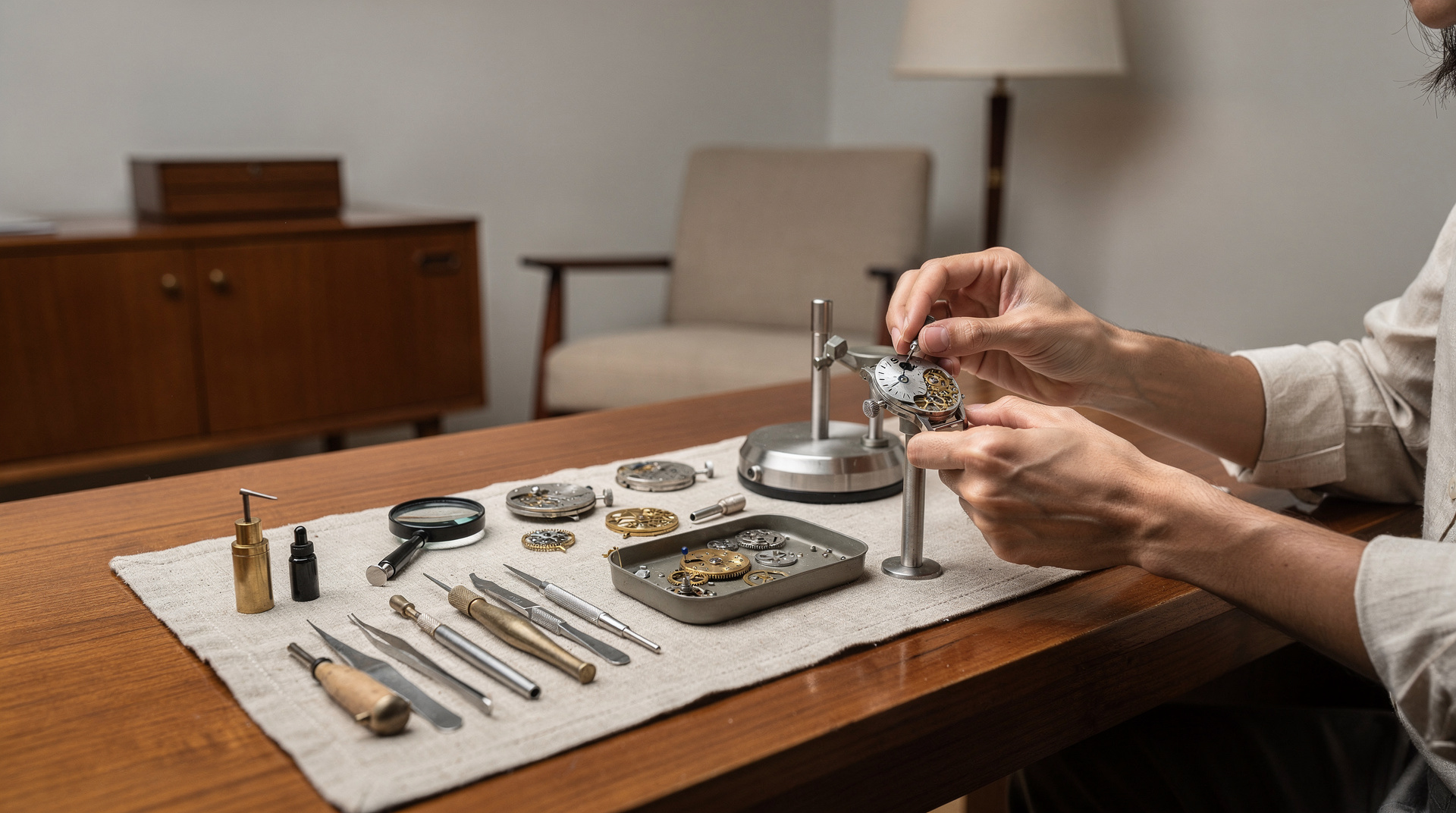
Servicing and Oiling Mechanical Watches: Expert Preservation of Vintage Movements
A mechanical watch from the 1950s or 1960s is a precisely calibrated system of hundreds of individual parts that only runs reliably when lubrication, cleaning, and adjustment are carried out professionally at regular intervals. The frequency at which such a watch should be overhauled, according to manufacturer recommendations and the prevailing practice of independent watchmakers, is between four and seven years, depending on the calibre, how often it is worn, and ambient conditions. If this interval is exceeded, the oils congeal, pivots run dry, and wear on jewel bearings, the escape wheel, and the mainspring barrel increases exponentially. What follows is usually no longer a simple cleaning but the replacement of original parts — parts that are not always available for vintage calibres.
Anyone who lives with mid-century timepieces — whether on the wrist, on a desk, or as a wall clock in a collection — should therefore understand servicing as the preservation of substance. It safeguards not only timekeeping accuracy but also provenance: a movement that has been maintained over decades with the correct oils and without aggressive intervention retains its original surfaces, its stamps, and thus its value to collectors.
Characteristic Materials and Lubricants
Vintage movements from the 1940s to the 1970s typically consist of brass plates and brass wheels — often gold-plated or rhodium-plated — combined with hardened steel pivots and synthetic ruby jewel bearings. The lever escapement works with ruby pallet stones, and the balance spring is usually made of Nivarox or comparable temperature-compensated alloys, which replaced the earlier steel springs from the 1930s onwards.
For lubricating these movements, a clearly differentiated range of oils has become established. Moebius from Switzerland has been the reference standard for decades: Moebius 9010 for fast-moving pivots such as the balance and escape wheel, Moebius HP-1300 for slow-moving gear train bearings, Moebius 9415 as a thixotropic grease for pallet stones, and greases such as Moebius 9501 or Kluber P125 for the mainspring barrel and winding mechanism. These oils differ in viscosity, creep behaviour, and ageing resistance. Reaching for a universal sewing machine or general-purpose precision oil is one of the most common reasons why vintage movements suffer lasting damage after improper servicing.
Cleaning today is predominantly carried out in ultrasonic baths using movement-specific cleaning fluids from Elma or L&R, followed by rinse baths and controlled drying. The actual application of oil takes place under a microscope using calibrated oilers, often in the range of just a few microlitres per bearing point. Too much oil is more harmful than too little: it creeps into areas where it has no place and attracts dust.
Regional Schools and Defining Calibres of the Mid-Century Era
Servicing practice cannot be separated from the origin of the movement. The Swiss manufactures — above all Zenith with calibre 135, Omega with calibres 30T2 and 321, Longines with the 30L, and Jaeger-LeCoultre with the 480 calibre family — defined a standard in the 1950s and early 1960s that the entire industry followed. These movements are well documented, spare parts are still available through specialist dealers and estates, and technical documentation is held in manufacturer archives.
The German school, shaped by Lange in Glashütte until 1948 and subsequently by GUB (Glashütter Uhrenbetriebe), favoured three-quarter plates, screwed gold chatons, and its own manufacturing tolerances. For watchmakers, this means a different disassembly logic, a different spare parts situation, and often more demanding sourcing. The French tradition, particularly in mantel clocks and Comtoise movements of the post-war period, works with more robust tolerances but sensitive mainsprings. American production from Hamilton, Elgin, and Bulova, in turn, produced highly industrialised calibres that were technically accomplished, but whose spare parts situation today is more difficult than that of their Swiss counterparts.
Anyone entrusting a vintage watch to a watchmaker for servicing should verify that the watchmaker is familiar with the relevant school. A workshop specialising in modern ETA calibres is not automatically the right address for a chronograph calibre from the 1960s or a Glashütte pocket watch.
Authenticity and Condition for Collectors
For the collector’s value of a mechanical watch, the service history is at least as decisive as the outward appearance. Service booklets, receipts, and — where available — archive extracts from the manufactures (Omega Extract of the Archives, Zenith Archives, Longines Archives) document the original calibre, delivery date, and first market. Where such records are absent, a careful look inside the movement remains: are the plates, bridges, gear train, and balance untampered, do they carry the correct calibre stamps, and were screws undone with properly fitting blades and without burring?
Typical warning signs include clumsily re-tightened screws, blued marks on pivots (an indication of friction without oil), polished movement surfaces that have destroyed the original perlage or Côtes de Genève finishing, and non-original replacement parts — such as hands, crown, or balance wheel. The dial also deserves a collector’s attention: original patina that has developed evenly over decades is preferable to a re-lacquered dial, even if the latter appears more pristine at first glance.
For buyers in the higher price segment, the combination of documented provenance, an untampered movement, original dial patina, and a recent, professionally executed service is the most reliable value anchor. A watch that has recently been overhauled, handed over with a measured amplitude and rate log, and whose repair history is traceable represents what the market today understands as collector-grade quality.
On mid-centurydesigns.com, watches and movements from the mid-century era are individually curated. Each piece is examined for the originality of its movement, dial, and case, the current condition of the movement is documented, and where possible archive extracts and service records complement the provenance. This allows you to find objects whose mechanical substance and historical integrity follow the same collector’s rigour as the furniture design for which the platform stands.