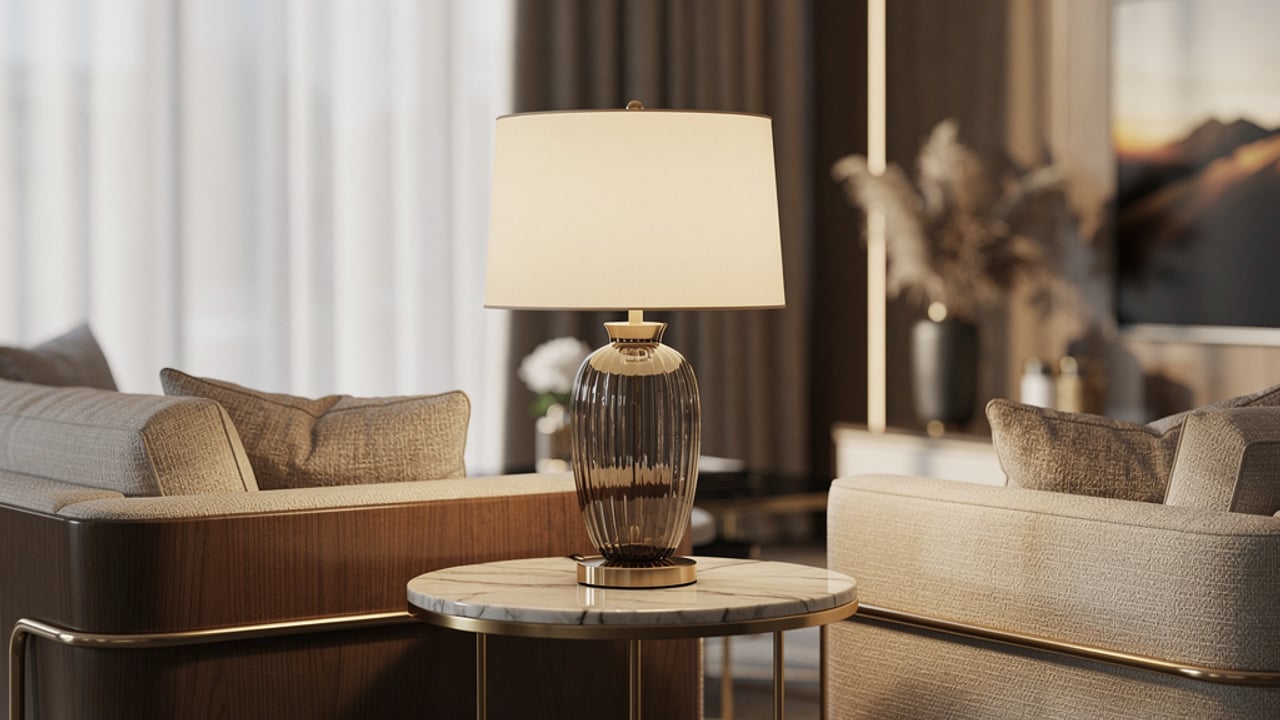
A Brief History of the table lamp
The postwar period transformed domestic lighting from a purely utilitarian concern into a discipline as rigorous as furniture design or architecture. Between 1950 and 1980, manufacturers across Italy, Scandinavia, and Germany began commissioning industrial designers and architects to reimagine the relationship between light source, shade, and base. The result was a generation of objects that operated simultaneously as functional equipment and autonomous sculpture.
The Italian manufacturers were particularly consequential. Arteluce, founded by Gino Sarfatti in 1939 but reaching full creative maturity in the 1950s, treated the table lamp as a system of components rather than a single resolved form. Sarfatti’s approach was engineering-led: the mechanism was the aesthetic. Simultaneously, Danish firms such as Louis Poulsen pursued a more humanist philosophy, engineering shades to eliminate glare while producing a warmth of diffusion that complemented the natural materials central to Scandinavian interiors.
German design, shaped by the residual influence of the Bauhaus and later by the Hochschule für Gestaltung Ulm, favoured geometric austerity and industrial materials — aluminium, lacquered steel, and early plastics. These objects remain among the most collectible of the era precisely because their formal discipline has not dated.
Notable designers of the table lamp
Gino Sarfatti’s Model 600 series, Isamu Noguchi’s Akari paper lanterns for Ozeki, and Gio Ponti’s collaborations with Fontana Arte each represent a distinct philosophical position. Sarfatti prioritised adjustability and mechanical ingenuity. Noguchi sought to dissolve the boundary between East Asian lantern traditions and Western modernism. Ponti treated glass as an architectural material, achieving translucency effects that remain technically demanding to reproduce.
Angle-poise mechanisms, articulated arms, and counterweight systems developed during this period were not merely ergonomic solutions; they introduced kinetic qualities that made each object subtly different with every adjustment. Collectors should note that original adjustment mechanisms are frequently damaged through use and that intact, fully functional examples command significant premiums.
Provenance and authentication of the table lamp
Authentication requires attention to several categories of evidence. Manufacturer’s marks — typically stamped or engraved on the base or canopy — should correspond to documented production periods. Electrical components, while often replaced for safety compliance, can themselves serve as dating evidence when original; pre-1965 Italian fittings differ materially from those produced after EEC harmonisation. Material analysis is occasionally necessary for pieces attributed to lesser-documented workshops.
This collection presents only examples for which documentary provenance — original invoices, exhibition records, or continuous ownership histories — has been established or for which physical evidence is conclusive. Condition reports note all restorations transparently.
Caring for your table lamp
Preservation of mid-century lighting requires restraint. Original lacquer finishes should not be polished with abrasive compounds; a dry microfibre cloth removes surface dust without compromising patina. Brass components develop natural oxidation that is historically consistent and should not be reversed unless specifically requested. Electrical rewiring, when necessary, should be entrusted to a conservator familiar with period fittings, as incorrect gauge wiring can alter the visual profile of exposed cables — a detail significant in designs where cabling is intentionally visible.