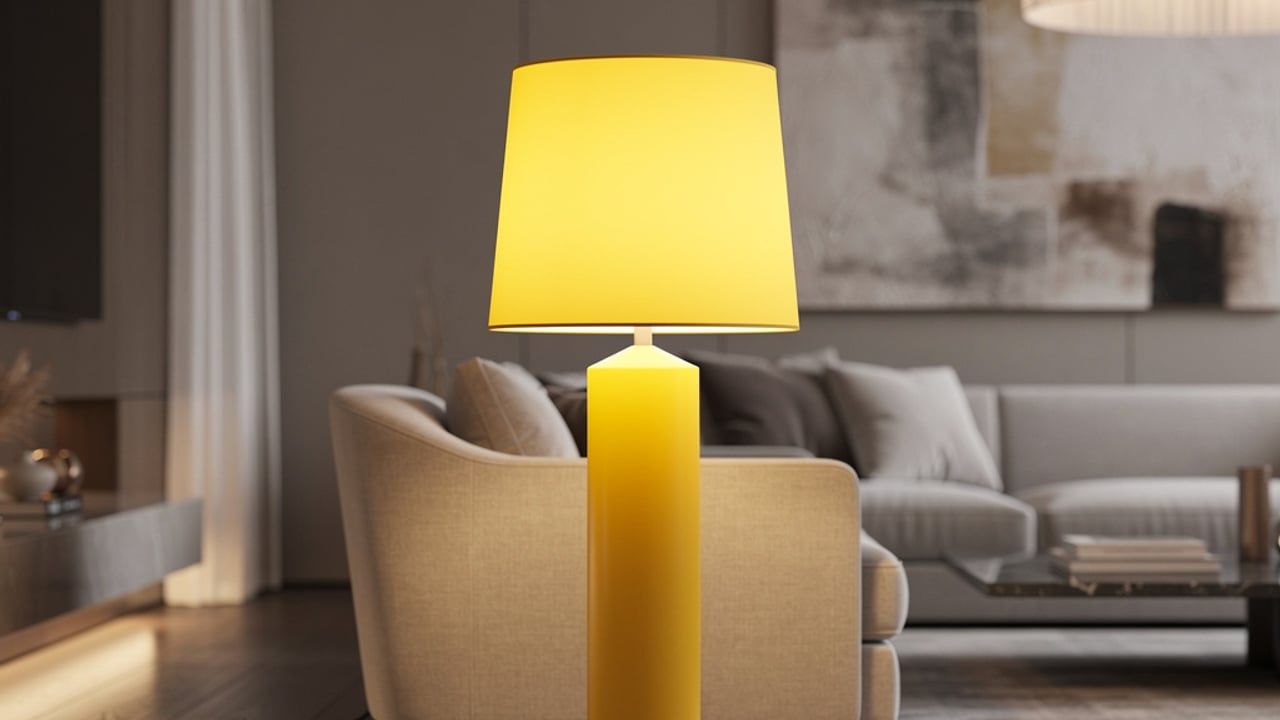
CATEGORY · YELLOW LAMP

The Yellow Lamp, Reconsidered

Chromatic confidence in mid-century lighting.

From Italian rationalism to Scandinavian craft, the yellow lamp occupied a singular place in postwar interiors — neither purely functional nor purely decorative, but a considered object that shaped atmosphere with deliberate, sustained intelligence.

mid-century·designs

yellow lamp

ESSAY · 01

Work & Context

mid-century·designs

A Brief History of the yellow lamp

Yellow entered the designer’s palette with urgency in the postwar decades. As Europe reconstructed and America suburbanized, colour ceased to be a luxury reserved for textiles or ceramics. Industrial designers, freed by new lacquers, enamels, and injection-moulded plastics, began applying saturated hues to objects that had previously been consigned to black, white, or metallic neutrality.

The yellow lamp emerged within this context not as whimsy but as statement. It drew on a lineage that included the Bauhaus’s primary-colour exercises, the Memphis group’s later chromatic provocations, and the sober Scandinavian tradition of using warm tones to counter long northern winters. In each genealogy, yellow carried specific connotations: light itself, optimism calibrated by restraint, and a refusal to subordinate the designed object to its architectural surround.

Italian studios proved especially fertile ground. Manufacturers such as Arteluce and Artemide collaborated with architects trained in rationalist principles who understood that a lamp’s colour was inseparable from its emitted light. A yellow body modifies the perceived warmth of the bulb within; the object and its illumination become a unified chromatic event.

Notable Designers of the yellow lamp

Vico Magistretti’s work for Artemide in the 1960s repeatedly engaged yellow as a structural colour, most notably in lacquered metal shades where the hue unified form and function. Gino Sarfatti, founder of Arteluce, produced editions in which yellow powder-coated arms and canopies set against polished aluminium created disciplined contrasts rather than decorative noise.

In Denmark, Poul Henningsen’s multi-shade system lent itself naturally to coloured variants. His layered geometry, engineered to eliminate glare, took on an entirely different character when rendered in yellow: the stacked planes acquired an almost solar quality, the shade becoming a lantern rather than a reflector.

Beyond these canonical figures, smaller studios in Germany and the Netherlands produced table and floor lamps in which yellow enamel on pressed steel reflected a functionalist economy — colour as the only ornament, applied with precision and purpose.

Where to Find an Authentic yellow lamp

Authenticity in mid-century lighting depends on a convergence of evidence: original manufacturer’s labels or stamps, period-appropriate hardware (sockets, cords, dimmer mechanisms), and a surface patina consistent with the claimed decade. For a yellow lamp specifically, provenance matters more than condition. A lamp retaining its original finish — even if slightly oxidised or chipped — carries more historical integrity than one that has been re-lacquered in a similar but unverified tone.

Reputable sources include specialist auction houses with dedicated decorative arts departments, estate clearances documented through probate inventories, and curated marketplaces such as this one, where each piece undergoes independent authentication before listing. Certificates of provenance, when available, should reference original purchase receipts, exhibition records, or period publication appearances.

Ask vendors directly about the origin of any replacement components. A rewired lamp retaining all original metalwork is generally preferable to one with structural parts substituted.

Caring for Your yellow lamp

Preservation of a yellow lamp requires attention to both surface and structure. Lacquered or enamelled finishes are vulnerable to UV exposure, which causes gradual fading and chalking; display away from direct sunlight wherever possible. Dust with a soft, dry microfibre cloth; avoid solvent-based cleaners, which strip original finishes irreversibly.

For lamps with painted wooden or resin components, relative humidity should remain stable — ideally between 45 and 55 percent — to prevent expansion, contraction, and eventual cracking. Electrical rewiring, when necessary, should be undertaken by a conservator familiar with period fittings, using period-correct or sympathetic replacement components. Original bulb holders, even if non-functional, should be retained rather than discarded.

FAQ · 02

Frequently asked about yellow lamp

5 Answers

01
How do I verify that a yellow lamp is genuinely from the mid-century period?
Examine the underside or base for manufacturer stamps, patent numbers, or country-of-origin markings consistent with the claimed decade. Original wiring insulation — fabric-braided or early PVC — and period-appropriate plug fittings also indicate age. Cross-reference any model number against documented catalogue editions held by design museums or specialist archives.
02
Does the specific shade of yellow affect a lamp's value?
Yes, significantly. Certain hues are documented to specific production runs or designer commissions. A saturated chrome yellow associated with a known 1965 Arteluce catalogue will carry different market weight than an ambiguous ochre of uncertain origin. Colour matching against period photographs or surviving catalogue swatches forms part of serious authentication practice.
03
Is rewiring a vintage lamp acceptable for collectors?
Rewiring for safety is broadly accepted, provided original sockets, shade hardware, and structural components remain intact. Collectors and conservators distinguish between sympathetic rewiring — using period-appropriate cable and fittings — and invasive modifications that alter the object's material character. Always retain and document any original wiring removed during the process.
04
Which mid-century designers most frequently worked with yellow as a primary colour in lighting?
Gino Sarfatti, Vico Magistretti, and Joe Colombo in Italy; Poul Henningsen in Denmark; and Achille Castiglioni across multiple decades are among the most documented. German functionalist studios at Braun also explored yellow in smaller domestic lamp formats, influenced by the Ulm School's colour theory curriculum.
05
What materials were most commonly used for yellow lamp shades in the 1950s through 1970s?
Pressed steel with enamel or lacquer finishes dominated the 1950s and early 1960s. From the mid-1960s onward, injection-moulded ABS and polycarbonate plastics became prevalent, allowing thinner profiles and greater formal complexity. Fibreglass appeared in limited studio editions, valued for its translucency when backlit.

GLOSSARY · 03

Related Terms

7 Entries

Arteluce
Milanese lighting manufacturer founded by Gino Sarfatti in 1939. A primary vehicle for Italian rationalist lamp design, producing works that treated the electrical fixture as a precision instrument rather than a decorative object. Absorbed by Flos in 1974.
Powder Coating
Electrostatically applied dry paint cured under heat, producing a durable, even finish on metal substrates. Widely adopted in mid-century industrial design for coloured lamp housings; more resistant to chipping than conventional liquid lacquer but identifiable by its characteristically matte or semi-matte surface texture.
ABS Plastic
Acrylonitrile butadiene styrene, a thermoplastic polymer extensively used in 1960s and 1970s lamp production. Valued for impact resistance and ease of pigmentation. Ages with surface yellowing under UV exposure, which can complicate authentication of originally white or pale-coloured examples.
Ulm School (HfG Ulm)
West German design institution operating from 1953 to 1968, successor in spirit to the Bauhaus. Its systematic approach to colour, form, and industrial process influenced an entire generation of European product designers, including those working in lighting for manufacturers such as Braun and Erco.
Rationalism (design)
An Italian architectural and design tendency of the 1930s–1960s holding that form should derive from function, material logic, and structural honesty. In lighting, rationalism manifested as exposed mechanisms, geometric shades, and the elevation of industrial materials to aesthetic status.
Poul Henningsen
Danish designer (1894–1967) whose multi-shade PH lamp system, developed for Louis Poulsen from 1926, remains a canonical achievement in glare-free lighting design. His layered geometry was produced in coloured variants that substantially altered the lamp's perceptual and atmospheric character.
Enamel (vitreous)
Powdered glass fused to metal under high heat, producing a hard, glass-like coloured surface. Used on pressed-steel lamp shades from the early twentieth century onward. Distinguished from lacquer by its gloss, weight, and characteristic chipping pattern at edges and impact points.