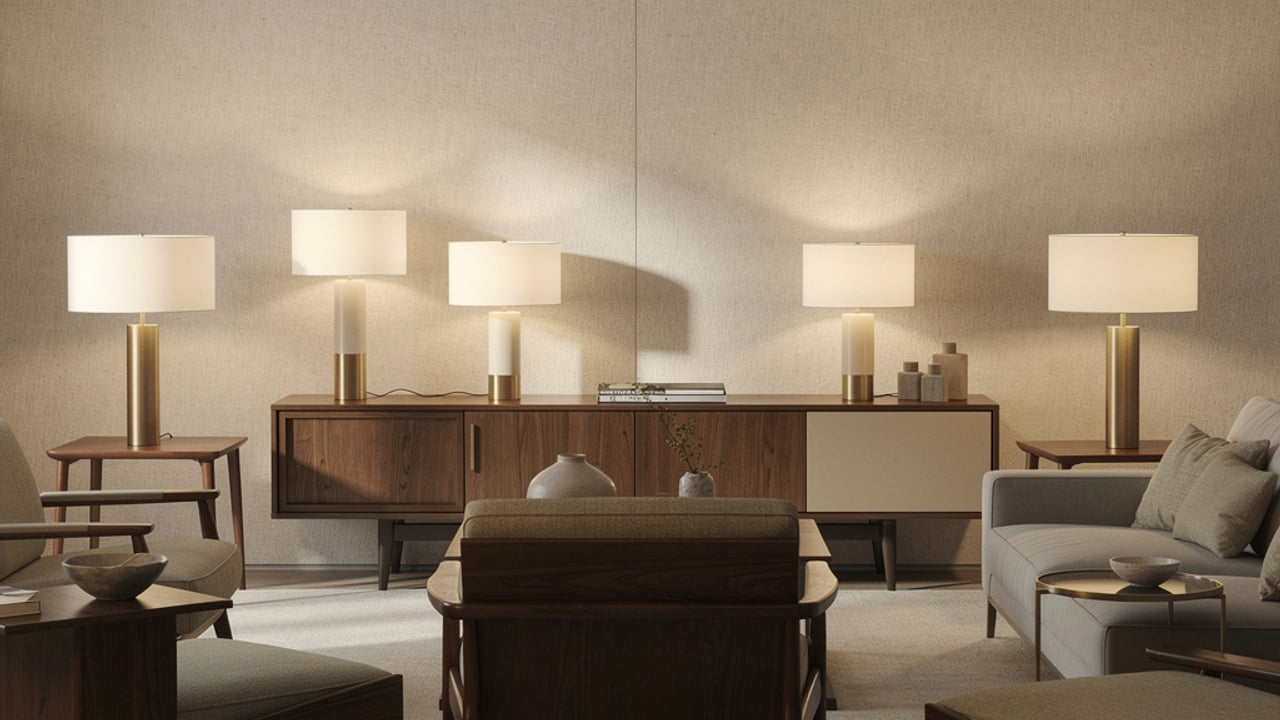
A Brief History of lamps mid century
The postwar decades produced a revolution in domestic light. Between 1950 and 1980, designers working across Italy, Scandinavia, the United States, and Japan reconceived the luminaire as an object of intellectual seriousness — part optical instrument, part sculpture, part manifesto. The emergence of new aluminium alloys, fibreglass, and later polycarbonate resins gave form-makers materials that previous generations could not have imagined. Concurrently, advances in low-voltage and fluorescent technology freed shades from the tyranny of heat management, permitting forms of radical thinness and translucency.
The lamps mid century collectors seek today were rarely conceived as decorative accessories. Gino Sarfatti approached each commission as an engineering problem; Isamu Noguchi treated paper and bamboo as philosophical statements about the interpenetration of Eastern and Western spatial thought; Poul Henningsen’s multi-shade system was a precise optical instrument designed to eliminate glare at every angle. These were functional objects elevated by rigorous intellectual intention.
Notable lamps mid century of the Era
Certain works have achieved canonical status within the broader field of twentieth-century design. Arteluce’s Model 2042 by Gino Sarfatti, with its articulated spun-aluminium diffusers, remains one of the most technically adventurous floor lamps of the period. Stilnovo’s production from the early 1950s — particularly the brass and opaline glass pendants assembled in Milan — defined a specifically Italian mode of elegant restraint. In Denmark, Louis Poulsen’s collaboration with Henningsen produced the PH series, a family of lamps mid century that resolved the contradiction between efficiency and warmth with singular completeness.
American contributions were equally significant. The table lamps produced by Gerald Thurston for Lightolier demonstrated that the contract-market idiom could achieve genuine elegance. Meanwhile, George Nelson’s Bubble lamps — spun over wire armatures in self-webbing polymer — brought a biomorphic sensibility to mass-market production without sacrificing formal integrity.
Where to Find Authentic lamps mid century
Authenticity is the central concern for any serious collector. The lamps mid century market is populated with later reissues, unlicensed reproductions, and composite pieces assembled from salvaged components. Distinguishing an original from a reissue demands attention to manufacturing evidence: hand-filed casting marks, period-correct wiring harnesses, original manufacturer labels applied before the age of polyester-laminate printing, and patination consistent with decades of ambient oxidation.
Mid-century-designs.com sources exclusively from documented collections. Every lamp offered carries a condition report, photographic archive of distinguishing marks, and, where available, original purchase receipts or auction provenance. We work with a closed network of specialist restorers who consolidate structural integrity without erasing the material biography of each object.
Caring for Your lamps mid century
Ownership of lamps mid century entails a responsibility toward material preservation. Opaline glass shades should be cleaned only with distilled water and a lint-free cloth; alkaline domestic cleaners accelerate surface crazing. Brass components benefit from occasional application of microcrystalline wax rather than abrasive polish, which strips the lacquer applied at manufacture and exposes base metal to accelerated tarnish. Rewiring — almost always necessary in pieces that predate modern safety standards — should be entrusted to electricians with demonstrable experience in heritage lighting; incorrect gauge wire fundamentally alters the thermal characteristics of the fitting.
Storage in direct sunlight degrades both polymer shades and period-correct textile cords. A stable environment of 45–55 percent relative humidity and consistent temperature prevents the micro-fracturing that afflicts lacquered metal bases over time. Treated correctly, these objects will outlast any contemporary equivalent by generations.