CATEGORY · KIENZLE CLOCK

The Kienzle Clock: Precision as Form

German horological modernism, rigorously curated.

From the workshops of Schwenningen, the kienzle clock represents the apex of postwar German industrial design — where mechanical exactitude and sculptural restraint converge into objects that remain as compelling today as at their inception.

mid-century·designs

kienzle clock

ESSAY · 01

Work & Context

mid-century·designs

A Brief History of the kienzle clock

Founded in 1822 in Schwenningen am Neckar, Kienzle Uhren developed over more than a century into one of Germany’s most technically accomplished and commercially significant clockmakers. The postwar decades — roughly 1950 through 1980 — mark the period in which the kienzle clock achieved its most distinctive formal character. Under the influence of the Ulm School’s rigorous functionalism and the broader Wirtschaftswunder aesthetic, Kienzle’s designers moved decisively away from ornamental historicism toward objects defined by geometric clarity, honest materials, and legible mechanism.

The company’s collaborations with trained industrial designers yielded housings in brushed aluminium, teak, and matte-lacquered steel — materials chosen for their visual sobriety as much as their durability. Battery-powered quartz movements, introduced progressively through the late 1960s, allowed cases to become flatter and more architectonic, freeing the kienzle clock from the spatial demands of wound spring or pendulum mechanisms. The result was a lineage of objects that sit comfortably alongside furniture by Dieter Rams-era Braun or ceramics from the Rosenthal Studio-Linie — artefacts of a cultural moment in which German manufacturing staked its identity on disciplined good taste.

Notable kienzle clock Designs of the Era

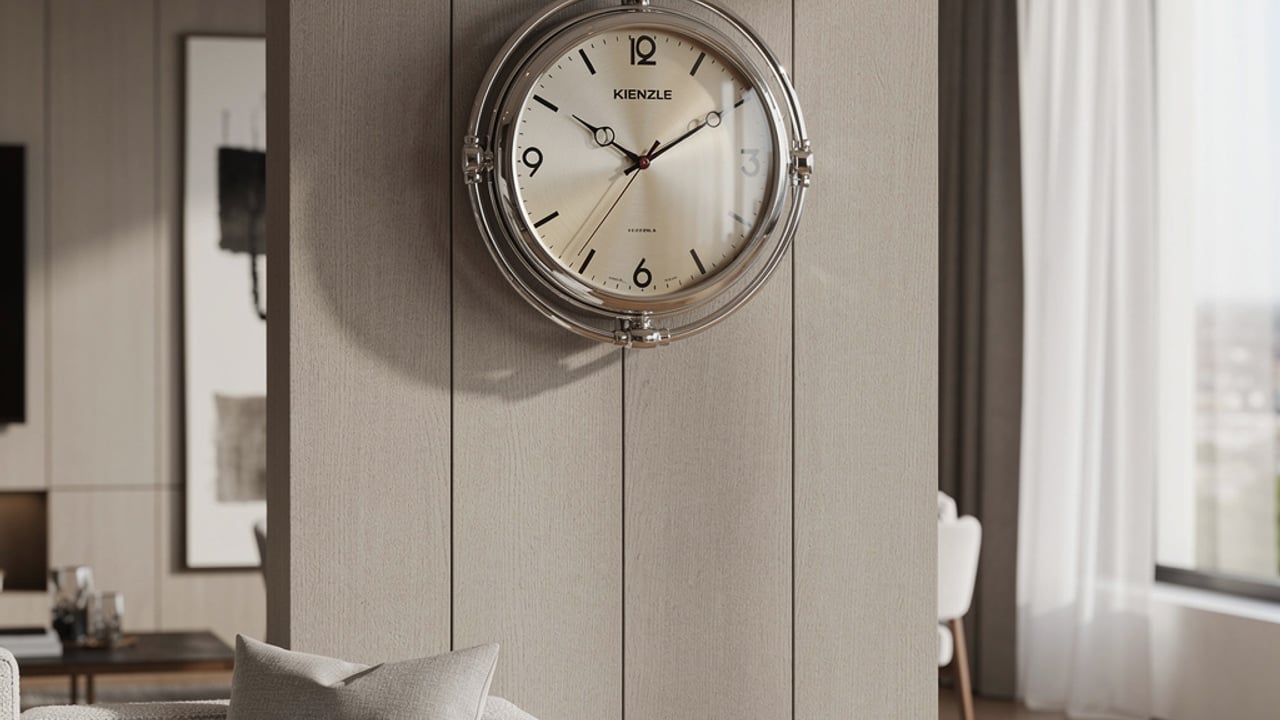
Several models from this period warrant particular attention from the serious collector. The so-called “Disc” wall clocks of the early 1960s — circular aluminium faces suspended on minimal wall brackets — distil the kienzle clock’s design philosophy to its essence: the dial as pure graphic event, unencumbered by surround or decoration. Table clocks produced through the late 1960s frequently employed teak or walnut bases paired with chrome bezels, a material pairing that locates them firmly within the northern European modernist tradition shared by Danish and Finnish contemporaries.

Automatic car-dashboard clocks produced under Kienzle’s automotive division represent a parallel strand: precision instruments designed for glove-compartment installation in premium German vehicles, their miniaturised movements and anti-vibration cases reflecting engineering priorities seldom visible in domestic horology. Each variant of the kienzle clock rewards close examination — the tolerances, the typography of the chapter ring, the quality of the surface treatments all speak to a manufacturing culture that regarded finish as inseparable from function.

Where to Find an Authentic kienzle clock

Authenticity is the paramount concern when acquiring any vintage German timepiece of this period. At mid-centurydesigns.com, every kienzle clock offered for sale has been assessed for originality of movement, case, and dial. Documentation — original receipts, period catalogues, or export markings — is noted where present. Condition gradings follow a consistent internal protocol, distinguishing between untouched patina and later intervention. Prospective buyers are encouraged to request detailed movement photographs and to verify that the chapter-ring typography matches period catalogue references before committing to purchase.

Caring for Your kienzle clock

Preservation of a kienzle clock requires modest but consistent attention. Mechanical movements benefit from servicing every eight to ten years; quartz movements should have batteries replaced before leakage risk emerges, typically at the three-year mark. Cases in teak or walnut respond well to occasional treatment with a non-silicone furniture wax; aluminium and chrome surfaces should be cleaned only with a soft dry cloth to avoid micro-abrasion of original finishes. Storage in stable humidity — ideally 45–55% relative humidity — prevents both wood movement and dial foxing. A properly maintained example will function and display without compromise for generations.

FAQ · 02

Frequently asked about kienzle clock

5 Answers

01
How do I distinguish an authentic vintage kienzle clock from a later reproduction?
Examine the movement through the case back: period movements carry stamped batch codes and country-of-origin markings consistent with West German manufacture. Dial typography should match Kienzle catalogue references from the stated year. Case materials — particularly teak grain, aluminium alloy composition, and bezel fit — differ perceptibly from later mass-produced imitations. Provenance documentation, where available, is the most reliable corroboration.
02
What price range should a collector expect for a kienzle clock from the 1960s?
Condition, model rarity, and documented provenance determine value. Common battery wall clocks in average condition trade between €80 and €250. Rarer design-forward models — particularly those with identifiable designer attributions or unusual case materials — regularly achieve €400 to €900 at specialist auction. Exceptional or documented examples can exceed €1,200. Prices have risen steadily as mid-century German industrial design attracts broader collector interest.
03
Can a vintage kienzle clock movement be serviced today?
Yes. Both mechanical and early quartz movements from this period remain serviceable. Several specialist watchmakers in Germany, the Netherlands, and the United Kingdom hold appropriate tooling and replacement parts. For common calibres, new-old-stock components are still available through horological supply networks. It is advisable to source a repairer with documented experience in mid-century German horology rather than a general watch-repair workshop.
04
Which kienzle clock models are considered most collectible?
Among collectors, the flat aluminium disc wall clocks of 1958–1965, the teak-based table alarm series of the early 1970s, and the automotive dashboard instruments produced for Mercedes-Benz and BMW are consistently sought after. Models bearing documented designer attributions command premiums. Limited production runs and export variants — those made specifically for Scandinavian or British markets — also attract specialist interest due to their relative scarcity.
05
Does mid-centurydesigns.com guarantee the authenticity of every kienzle clock listed?
Every piece offered on mid-centurydesigns.com undergoes a structured authentication review covering movement originality, case integrity, and dial condition before listing. Where documentation exists, it is reproduced in full within the item record. We operate a transparent returns policy for any piece that a qualified independent expert determines to be misrepresented. Our editorial standards reflect those of the specialist auction market rather than general resale platforms.

GLOSSARY · 03

Related Terms

7 Entries

Ulm School (Hochschule für Gestaltung)
West German design academy operational 1953–1968, whose systematic functionalism profoundly shaped postwar product and industrial design. Its influence on consumer electronics, household goods, and timepiece aesthetics is traceable across multiple German manufacturers of the period.
Junghans
Rival Schwenningen clockmaker, established 1861, notable for mid-century collaborations with Max Bill and the development of radio-controlled timekeeping. A direct market contemporary of Kienzle, Junghans occupies an overlapping collector category within postwar German horology.
Ato-Mat Movement
A category of self-winding clock mechanism employing environmental motion or temperature variation to maintain mainspring tension. Several European clockmakers, including German manufacturers, integrated ato-mat principles into mid-century domestic and office clock production.
Chapter Ring
The annular band on a clock dial bearing hour numerals or indices. In mid-century German design, chapter-ring typography — typeface selection, index weight, and spatial rhythm — functioned as a primary vehicle of aesthetic identity and period attribution.
Wirtschaftswunder
The West German postwar economic recovery of the 1950s and 1960s. The period generated significant consumer demand for well-designed domestic objects and underpinned investment in industrial design education, directly enabling the formal evolution visible in German horology of the era.
Metamec
British mid-century clock manufacturer producing battery-operated wall and mantel clocks in teak, brass, and enamel. A useful comparative reference point when contextualising German kienzle production within the broader European mid-century market for designed domestic timepieces.
Lacquered Brass Bezel
A case component formed from brass and finished with clear or tinted lacquer to retard oxidation while preserving metallic warmth. Common in mid-century European clock production, the lacquered bezel distinguishes period manufacture from later chrome-plated or anodised aluminium alternatives.