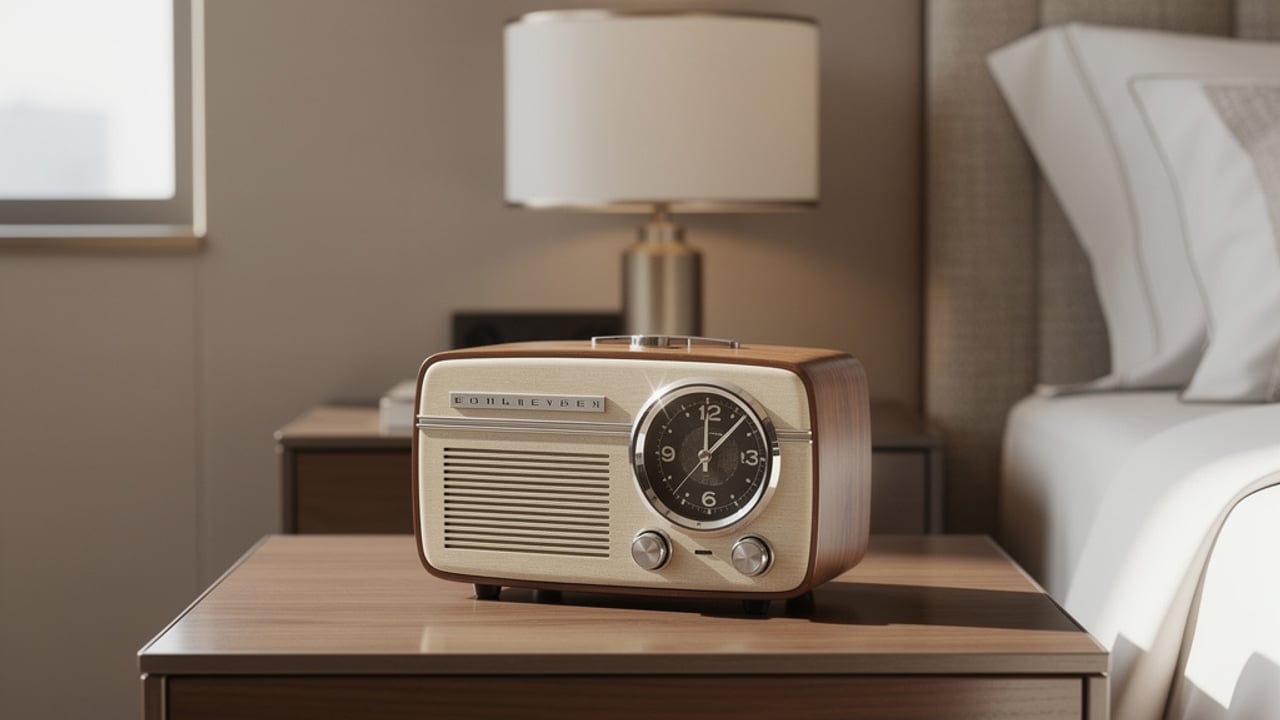
A Brief History of vintage alarm radio
The intersection of timekeeping and broadcast reception produced some of the twentieth century’s most compelling domestic objects. Beginning in the early 1950s, manufacturers in West Germany, Japan, and the United States began integrating clock mechanisms with AM receivers, creating a category that sat at the confluence of utility and aesthetic ambition. Early models from Telefunken and Grundig established the vocabulary: analogue dials, backlit faces, and the satisfying mechanical click of an alarm engagement. By the mid-1960s, transistor technology had liberated designers from the constraints of valve circuitry, enabling the compact, sculptural forms that now define the field. The vintage alarm radio thus became a laboratory for formal experimentation, its small scale permitting risks that larger furniture could not easily absorb.
The decade between 1965 and 1975 is widely regarded as the apex of the form. Japanese manufacturers — Panasonic foremost among them — introduced injection-moulded ABS housings in chromatic sequences that read as pure Pop Art. Simultaneously, Dieter Rams at Braun was refining the analogue clock radio to its irreducible geometry. These parallel trajectories, the exuberant and the austere, give the category its enduring critical tension.
Notable vintage alarm radio Designs of the Era
Certain objects have achieved canonical status. The Panasonic RC-7903, with its spherical white housing and single-hand clock face, distils the space-age sensibility into a bedside object of disarming elegance. Braun’s AB 21, designed under Rams’s supervision, demonstrates how strict functionalist principles could produce warmth rather than coldness when applied at intimate scale. The Weltron 2001, shaped as a truncated sphere, references Stanley Kubrick as readily as it does consumer electronics. Each of these examples rewards close examination: tolerances, material choices, and typographic decisions reveal the seriousness with which designers approached the vintage alarm radio as a cultural artefact rather than a commodity.
Less celebrated but equally worthy of attention are the European mid-range producers — Tefal, Ingersoll, and Roberts Radio among them — whose objects demonstrate how mainstream manufacture absorbed avant-garde formal lessons with surprising fidelity.
Where to Find Authentic vintage alarm radio Pieces
Authenticity is the governing concern for any serious acquisition. Mid-century-designs.com presents only objects that have passed provenance review: original documentation, period-appropriate patina, and unmodified electronic architecture where possible. Each listing includes condition reports prepared according to auction-house standards, noting dial fading, housing integrity, and mechanical function. The vintage alarm radio market has matured considerably since the early 2000s; institutional collectors and design museums now compete with private buyers, and the premium for documented examples has risen accordingly. Buyers are advised to scrutinise seller provenance claims and to request photographs of internal components, where period-correct capacitors and transformers serve as reliable dating evidence.
Caring for Your vintage alarm radio
Preservation requires restraint. Electrolytic capacitors in sets manufactured before 1975 are subject to leakage and should be assessed by a qualified restorer before the object is powered. Housing materials — predominantly ABS and early polystyrene — are sensitive to ultraviolet exposure; display away from direct light sources. Dial faces, particularly those with luminous radium or tritium compounds, should be handled according to current safety guidance. Beyond these precautions, the vintage alarm radio demands little: occasional contact-cleaner application to tuning potentiometers and light mechanical lubrication of clock movements will maintain function across decades. Resist the impulse toward cosmetic restoration; honest patina constitutes a significant portion of the object’s historical value.