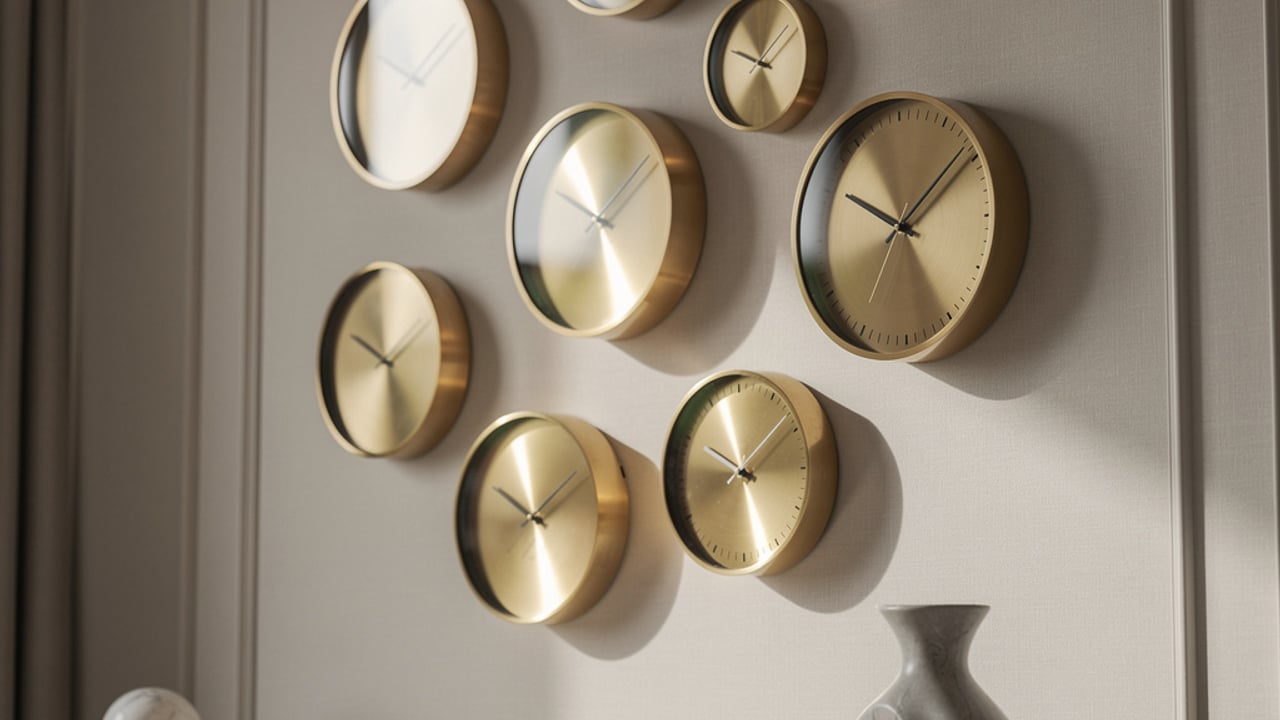
CATEGORY · BRASS WALL CLOCKS

Brass Wall Clocks, 1950–1980

Timekeeping as sculptural object.

The wall clock occupied a singular position in mid-century interior design — neither pure ornament nor mere utility. In brass, it became something else entirely: a statement of material intelligence, crafted by designers who understood that timekeeping could be an act of aesthetic conviction.

mid-century·designs

brass wall clocks

ESSAY · 01

Work & Context

mid-century·designs

A Brief History of brass wall clocks

The postwar decades produced an extraordinary convergence of industrial material and domestic ambition. Brass — long associated with nautical instruments and architectural fittings — migrated into the domestic interior as Scandinavian, German, and Italian designers sought warmth without sentimentality. The result was a body of work that treated the clock face as a composition: hands, numerals, and chapter ring arranged with the same rigour applied to furniture and ceramics of the period.

By the late 1950s, leading workshops in Denmark, Austria, and northern Italy were producing timepieces that referenced both Bauhaus economy and the organic expressionism emerging from studios in Gothenburg and Copenhagen. The material properties of brass — its malleability, its capacity to be spun, cast, or beaten — invited formal experimentation that chrome or steel did not permit with equal generosity.

The 1960s brought further refinement. Movement housings became thinner; dial treatments grew more abstract. Some designers dispensed with numerals altogether, relying instead on applied brass indices or bare hands rotating against a lacquered field. These pieces occupy the intersection of horology and sculpture, and they remain among the most sought-after objects in the mid-century secondary market.

Notable brass wall clocks of the Era

Certain pieces define the category. The Junghans models produced under the art direction of Max Bill in the early 1960s established a formal vocabulary — clarity, proportion, the rejection of ornament — that influenced manufacturers across Europe. Contemporaneously, the Viennese firm of Kienzle produced brass wall clocks with a distinctly architectural character, their cases recalling the proportions of load-bearing columns.

In Scandinavia, designers associated with the cooperative workshops of the period contributed timepieces whose dials referenced folk tradition while their cases embraced fully industrial production. These hybrid objects — traditional craft sensibility, modern fabrication — are particularly valued by collectors who approach the period through its contradictions rather than its certainties.

Where to Find Authentic brass wall clocks

Authenticity in this category is a precise matter. Mid-century brass wall clocks attract a significant volume of reproduction, and the distinctions between an original Junghans movement and a later Asian-market facsimile are not always legible to the untrained eye. Provenance documentation — original receipts, period catalogues, exhibition records — is the primary instrument of verification.

At mid-centurydesigns.com, every object is examined by category specialists before listing. Movement condition, case patina, and dial integrity are assessed against period documentation. Where restoration has occurred, it is disclosed with full transparency: materials used, craftsperson engaged, date of intervention.

Caring for Your brass wall clocks

Brass is a living surface. Its patina — the progressive oxidation that shifts the alloy from bright gold toward amber and, eventually, a deep ochre — is not a defect but a record. Collectors who value this natural ageing should resist the impulse to polish. A soft, dry cloth to remove dust is the appropriate intervention for a piece whose patina is stable and desirable.

For movements, annual servicing by a horologist familiar with mid-century mechanisms is advisable. The platform escapements and anchor lever systems common to German and Austrian movements of the period are robust but benefit from periodic cleaning and re-oiling. Do not attempt movement cleaning without specialist knowledge; mid-century clock oils are specific in viscosity and incompatible with modern substitutes.

Storage, when necessary, should be in a stable environment: temperature variation accelerates brass oxidation unevenly, producing tide-marks that are difficult to reverse without intervention that risks the patina itself.

FAQ · 02

Frequently asked about brass wall clocks

5 Answers

01
How do I verify the age of brass wall clocks purchased on the secondary market?
Cross-reference the movement serial number against manufacturer production records, where these survive. Junghans, Kienzle, and several Scandinavian makers maintained detailed archives. Period trade catalogues — many now digitised by design museums in Stuttgart, Vienna, and Stockholm — provide visual confirmation of model variants and original retail dates.
02
Is a patinated finish on a vintage brass clock desirable, or should it be restored to brightness?
Within the collector community, original patina is almost universally preferred. It constitutes material evidence of age and use. Polishing removes this evidence irreversibly. Restoration to brightness is appropriate only where the surface has suffered uneven corrosion, active verdigris, or mechanical damage — and then only under specialist guidance.
03
What movement types are most commonly found in mid-century European wall clocks?
German manufacturers favoured anchor lever escapements in both eight-day weight-driven and spring-driven formats. Platform escapements — compact, self-contained mechanisms — were widely used in thinner case designs. Battery-driven movements were introduced from the late 1950s onward; these are generally less valued by collectors focused on mechanical integrity.
04
Which designers are most closely associated with the mid-century clock aesthetic?
Max Bill's consultancy work with Junghans is foundational. Georg Jensen's silversmiths produced clock cases of considerable refinement. In Italy, the studio of Gio Ponti engaged with timekeeping as part of a broader programme of domestic object design. Austrian firms worked closely with architects trained in the Viennese tradition of applied arts.
05
What is a reasonable price range for authenticated mid-century examples?
The range is wide. Unsigned production pieces in good condition begin at several hundred euros. Works with documented designer attribution, original packaging, or exhibition history command considerably more — sometimes exceeding four figures. Condition, provenance quality, and designer association are the principal value determinants in every transaction.

GLOSSARY · 03

Related Terms

7 Entries

Anchor Escapement
A mechanical regulating device in which a pivoted anchor engages a toothed escape wheel, controlling the release of energy from the mainspring. Predominant in European mantel and wall clock movements from the eighteenth century onward and standard in mid-century German production.
Junghans
German clock manufacturer founded in Schramberg in 1861. Under the art direction of Max Bill in the early 1960s, Junghans produced timepieces that became canonical examples of Ulm School design philosophy applied to domestic objects.
Kienzle
Austrian-German clockmaking firm with roots in the late nineteenth century. Known during the mid-century period for architecturally proportioned cases and movements of reliable quality, often specified for public buildings and domestic interiors of the period.
Patina
The surface transformation of brass and other alloys through progressive oxidation over time. In the collector context, natural patina constitutes material evidence of age and is treated as a positive attribute, distinguishing original pieces from reproductions or heavily restored examples.
Ulm School (HfG Ulm)
The Hochschule für Gestaltung, founded in Ulm in 1953, which extended Bauhaus methodology into postwar industrial design. Its faculty and graduates shaped the visual language of German product design throughout the 1960s, including clock and instrument design.
Chapter Ring
The circular element of a clock dial bearing the hour numerals or indices. In mid-century design, chapter rings were frequently treated as compositional elements — minimised, abstracted, or eliminated entirely to produce dials of deliberate visual economy.
Platform Escapement
A compact, self-contained escapement module mounted on a platform above the main clock movement. Widely used in travel and wall clocks requiring thin cases; its modularity simplified production and servicing in mid-century European manufacturing.