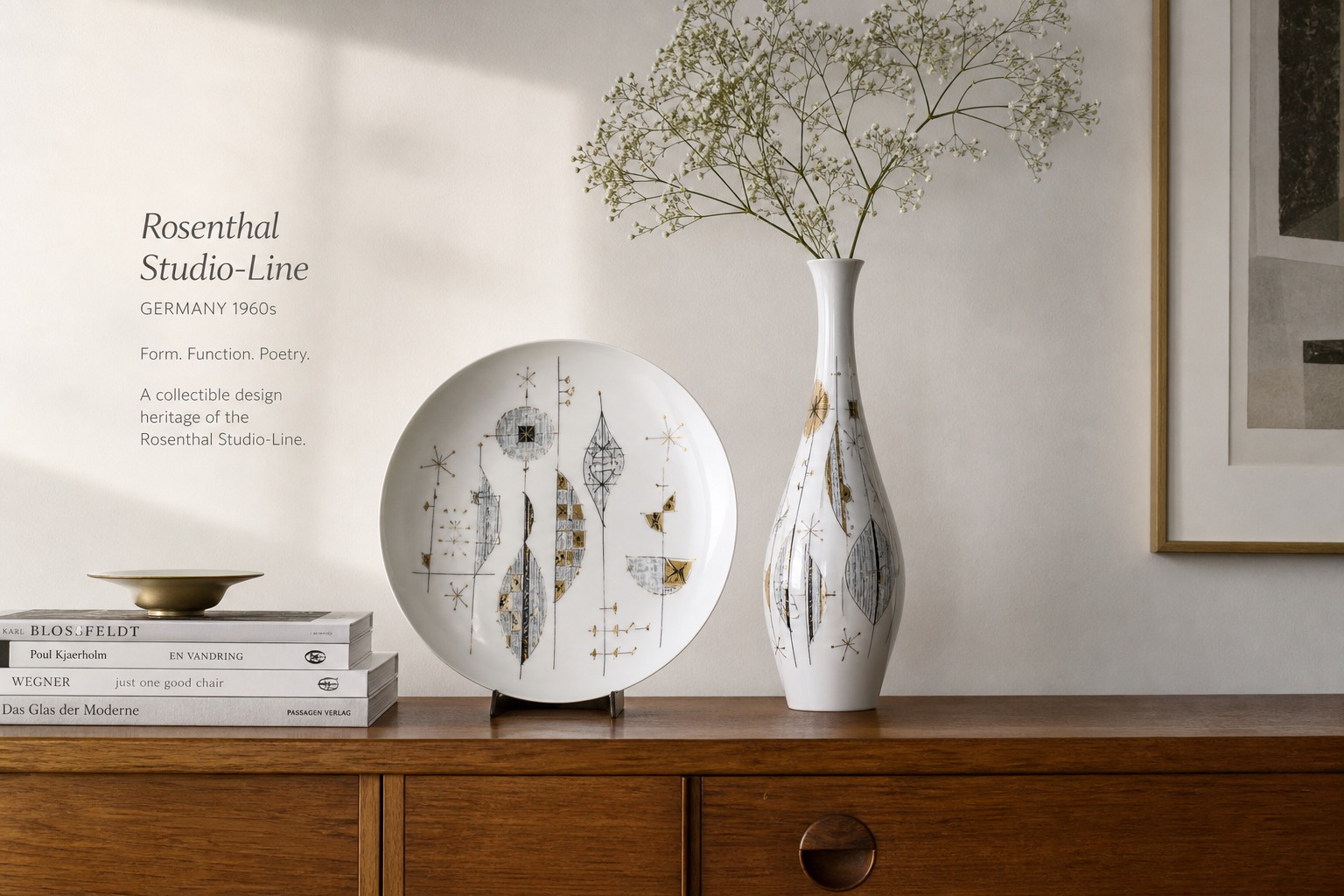
Rosenthal Studio-Line is, in factual terms, a documented design programme rather than a vague collector keyword
With Rosenthal Studio-Line, primary sources matter because the name is often used too loosely in the market. The official page “Rosenthal studio-line: Design icons of modern porcelain” dates the launch explicitly to 1961 and states that Philip Rosenthal Jr. intended it as a signal for the future of porcelain design. Rosenthal does not describe Studio-Line as a single collection, but as a platform for collaborations with renowned designers, creators and architects. The page specifically names figures including Raymond Loewy, Walter Gropius, Tapio Wirkkala and later additional international designers.
That matters for buyers because it corrects a common shortcut: Studio-Line is not simply “nice mid-century Rosenthal”, but a curated author-driven programme with a clear brand strategy. Rosenthal further states that more than 150 creative minds have developed collections for Studio-Line and that the programme is associated with around 500 international design awards and museum exhibitions. That makes it more meaningful for collectors than undecorated dealer shorthand or unassigned giftware.
Tapio Wirkkala and Björn Wiinblad show how broad the Studio-Line language could be
Rosenthal’s own designer pages are especially useful here. On the page devoted to Tapio Wirkkala, the collaboration is described as a meeting of Scandinavian elegance and German porcelain production. Rosenthal highlights Variation and Polygon in particular; Variation is dated to 1962 and described through a clear reduced design language and a distinctive vertical groove structure. Details like that matter more for object identification than a vague statement that a piece “looks Scandinavian”. If you want to attribute an object seriously, you need series names and formal markers.
The page on Björn Wiinblad reveals another side of the same programme. Rosenthal presents the collaboration as a long one and singles out Romance (1961) and Magic Flute (1969) as especially important. Where Wirkkala tends to be read through reduction and disciplined form, Wiinblad stands within Studio-Line for ornament, narrative decoration and relief surfaces. That range is precisely what makes Studio-Line compelling: very different design attitudes could exist under one recognisable production and branding framework.
In the shop, the series name and the underside usually tell you more than the front view alone
This becomes practical immediately in a buying context. A Rosenthal object may look refined at first glance, but its real collector value becomes clearer only when line, designer, form and production context can be read more precisely. Museum Boijmans Van Beuningen also lists Rosenthal Studio Line as its own collection entry, which is a useful reminder that the term is not just dealer language but a museum-recognised production and design category.
When browsing porcelain, ceramics or decorative mid-century pieces at mid-century·designs, it is therefore more useful to compare base marks, series names, designer attributions, relief structure and form logic than to rely on pattern alone. Relevant contexts appear in our Decoration category and on related pages such as wall plate. With Rosenthal Studio-Line especially, a beautiful object becomes a properly described collector’s piece only when form history and maker evidence line up.