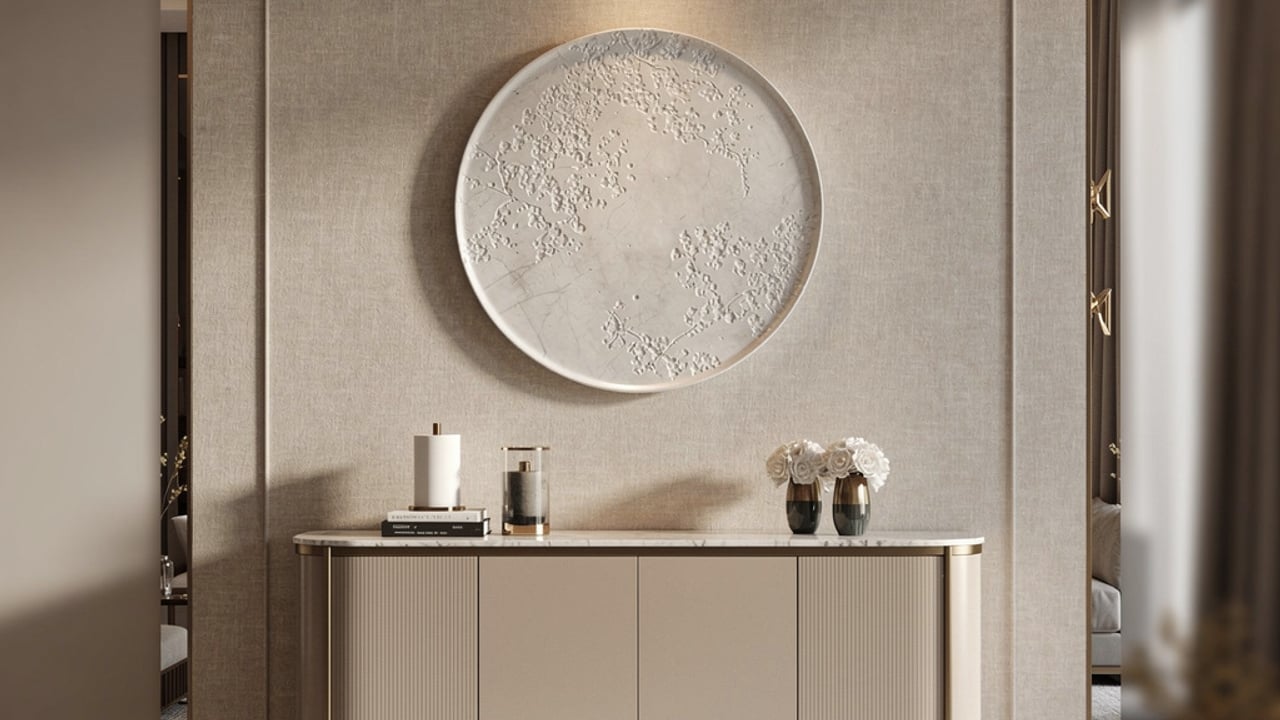
A Brief History of wall plate
The decorative wall plate emerged as a serious collector’s object during the early 1950s, when manufacturers and independent studio artists across Europe began treating the circular ceramic form as a canvas rather than a vessel. Unlike tableware, these objects were conceived exclusively for display — hung singly or arranged in compositions that brought rhythm and colour to otherwise austere postwar interiors.
In Scandinavia, producers such as Arabia of Finland and Rörstrand of Sweden approached the format with the same rigour applied to sculptural ceramics. Designers worked in close collaboration with in-house painters, producing limited runs in which each piece was individually decorated. The result was an object that straddled the boundary between industrial craft and fine art.
In Italy and Germany, the mid-century period saw ceramic workshops experimenting with abstracted motifs — geometric fields, stylised fauna, and architectonic patterning influenced by the broader language of postwar modernism. By the 1960s the format had become genuinely international, with studios in Denmark, the Netherlands, and the United Kingdom all contributing distinguished examples to the canon.
The decades between 1950 and 1980 represent the defining period for this object type: a moment when craft, design theory, and the democratisation of art collecting converged around a form at once humble and remarkably expressive.
Notable wall plate designers of the Era
Several figures are indispensable to any serious survey. Birger Kaipiainen at Arabia produced works of extraordinary painterly density, his surfaces populated with birds, botanical forms, and Byzantine ornament rendered in rich, layered glazes. His pieces command significant attention at auction and represent the upper register of the medium.
In Germany, the Rosenthal Studio-Linie programme brought internationally recognised artists — among them Tapio Wirkkala and Björn Wiinblad — into dialogue with industrial ceramic production. The resulting editions combined the scalability of manufacture with genuine artistic ambition.
Bjørn Wiinblad deserves particular attention: his figurative compositions, characterised by a distinctive graphic linearity and warm palette, appear across multiple media, and his ceramic output remains among the most immediately recognisable of the era.
Where to Find Authentic wall plate Examples
Authenticity is the central consideration for any serious acquisition. Genuine mid-century examples will carry back-stamp marks identifying the manufacturer, often accompanied by a pattern number, date code, and — in the case of studio pieces — the decorator’s monogram or signature.
Our catalogue at mid-centurydesigns.com presents each wall plate with full provenance documentation, high-resolution imagery of the reverse, and condition notes prepared by our curatorial team. We source through established European specialist dealers, private estates, and vetted auction houses, declining any example where the chain of ownership cannot be satisfactorily established.
Buyers are encouraged to review the accompanying certificates and, where relevant, to request additional photography before confirming a purchase.
Caring for Your wall plate Collection
Ceramic objects of this period are generally robust, but surface glazes — particularly those incorporating overglaze enamels or gilded detail — benefit from careful handling. Display away from prolonged direct sunlight, which can cause gradual fading in painted decoration.
For cleaning, a lightly dampened soft cloth is sufficient for dust removal. Avoid abrasive materials and immersion in water, particularly for pieces with any visible restoration or hairline crazing. When hanging, use purpose-made plate hangers with protective padding at all contact points to prevent rim stress.
Properly maintained, a well-chosen wall plate will retain both its aesthetic presence and its long-term value as a collectible object.