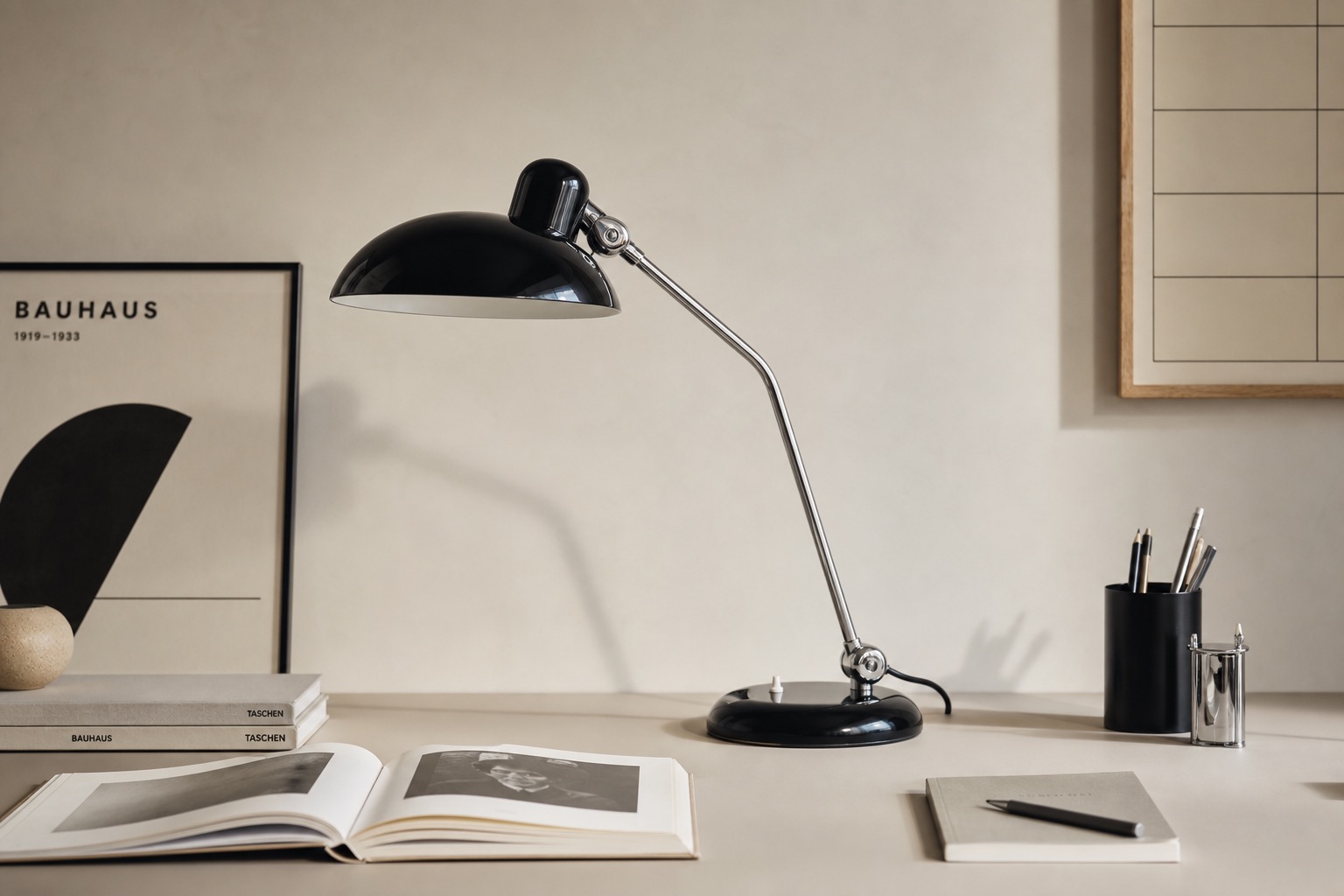
CATEGORY · KAISER IDELL

Kaiser Idell – Christian Dell, Gebr. Kaiser & Co. and the sober precision of an early serial lamp

From 1926 onward Christian Dell designed lamps for Gebr. Kaiser & Co.; in 1936 the 6631 Luxus appeared in the first catalogue

The source base for Kaiser Idell is unusually useful: Fritz Hansen names Christian Dell, Gebr. Kaiser & Co. in Neheim-Hüsten, the start of his lamp designs from 1926 and the first 1936 catalogue containing the 6631 Luxus. Wiesbaden places Dell at once as a Hanau-trained Bauhaus master and a formative lighting designer. The V&A adds, through a Frankfurt Dell lamp from around 1930, how consistently materials, joints and adjustability had already been resolved before the later series icon emerged.

mid-century·designs

Kaiser Idell

ESSAY · 01

Work & Context

mid-century·designs

Kaiser Idell only becomes a serious buying subject once you move beyond the generic Bauhaus label

With Kaiser Idell, the useful move is to read the maker and designer sources together. Fritz Hansen states that Christian Dell began designing lamps from 1926, usually for Gebr. Kaiser & Co. in Neheim-Hüsten, and that the first catalogue appeared in 1936. According to the same source, the 6631 Luxus table lamp appeared there for the first time. Fritz Hansen also explains the name directly: “idell” combines idea with Dell, while “Kaiser” points back to the original manufacturer.

That matters far more in a shop context than simply calling the lamp “Bauhaus”. A Kaiser Idell is not just black lacquered metal with an iconic profile; it is a documented industrial product with a traceable serial history. On mid-century·designs, anyone browsing table lamps, Mid-Century lamps or Bauhaus can use Kaiser Idell as a practical lesson in how authorship and form belong together.

Christian Dell was not a floating style name but a technically trained lighting designer

The City of Wiesbaden describes Dell as a designer trained in Hanau, a Bauhaus master in Weimar, a teacher at today’s Städelschule in Frankfurt and a figure who shaped generations particularly in lighting design. Its exhibition text also stresses the range of his output: from early silver objects to mass-produced lamps now shown in design museums around the world.

That helps correct a recurring mistake in the vintage market. Kaiser Idell should not be treated like an anonymous desk lamp. It belongs to a clearly legible authorship. Dell came out of metalworking and silversmithing, which helps explain why even the most familiar models feel controlled rather than ornamental. That discipline is exactly what lets them sit so naturally in Mid-Century interiors, even though their origins precede the postwar boom.

The V&A shows, through an earlier Dell lamp, what buyers should inspect in materials and construction

The Victoria and Albert Museum lists the Dell-Lampe Type K as a desk lamp from Frankfurt, around 1930, designed by Christian Dell and made by Chr. Zimmermann GmbH. The museum gives the materials as brass, nickel, lacquer and chrome and explicitly connects Dell to the Bauhaus metal workshop. For buyers of historical lighting, that is useful because it makes Dell’s lamp language legible through materials and workshop logic, not through brand aura alone.

In practical terms, a historical Kaiser Idell deserves close attention to the rim of the shade, joints, stem sections, weight of the base, lacquer finish and surviving marks. If you only look at the silhouette, you miss the fact that Dell’s quality lies in the restrained precision of the details. Related context on our site includes Wagenfeld lamp, table lamp and the main shop.

Sources

FAQ · 02

Frequently asked about Kaiser Idell

5 Answers

01
How early does the Kaiser Idell story begin?
Fritz Hansen states that Christian Dell began designing lamps from 1926, usually for Gebr. Kaiser & Co. in Neheim-Hüsten. The manufacturer also says the first catalogue appeared in 1936, introducing the 6631 Luxus table lamp.
02
What does the name “Kaiser Idell” mean?
According to Fritz Hansen, “idell” refers to the word idea and to Dell’s surname. “Kaiser” refers to the original manufacturer, Gebr. Kaiser & Co.
03
Why does Christian Dell matter to Mid-Century buyers if the series begins before the war?
Because the lamps anticipate the restrained industrial language that continued to work beautifully in postwar interiors. Wiesbaden explicitly presents Dell as a designer who shaped generations, especially in lighting design.
04
Which features should buyers verify on a historical Kaiser Idell lamp?
Useful evidence includes the shade, joints, stem, base, underside and any surviving maker’s labels. In practice, material consistency and the logic of the adjustment mechanism matter more than generic “Bauhaus” sales language.
05
How does the V&A help clarify Dell’s design language?
The museum lists the Dell-Lampe Type K from Frankfurt, around 1930, in brass, nickel, lacquer and chrome, while also stressing Dell’s Bauhaus metal workshop background. That makes the later Kaiser Idell lamps easier to read as part of a longer technical design vocabulary.

GLOSSARY · 03

Related Terms

6 Entries

Christian Dell
German silversmith and designer (1893–1974) identified by Fritz Hansen as the author of the Kaiser Idell series and described by Wiesbaden as a major twentieth-century lighting designer.
Gebr. Kaiser & Co.
Lamp manufacturer in Neheim-Hüsten for whom Dell designed lamps from 1926 onward according to Fritz Hansen; the company name supplies the “Kaiser” part of Kaiser Idell.
6631 Luxus
Table lamp model first shown in the 1936 catalogue according to Fritz Hansen and widely regarded as the best-known Kaiser Idell model.
Bauhaus metal workshop
Workshop context highlighted by the V&A and Wiesbaden in relation to Dell; essential for understanding the functional clarity of his lamps.
Type K
Dell desk lamp documented by the V&A as made in Frankfurt around 1930 in brass, nickel, lacquer and chrome; a helpful comparison point for Dell’s technical lamp language before the later serial icons.
Ball joint
Adjustable joint principle that matters in historical task lighting because it reveals both ergonomic intention and the physical integrity of a surviving lamp.