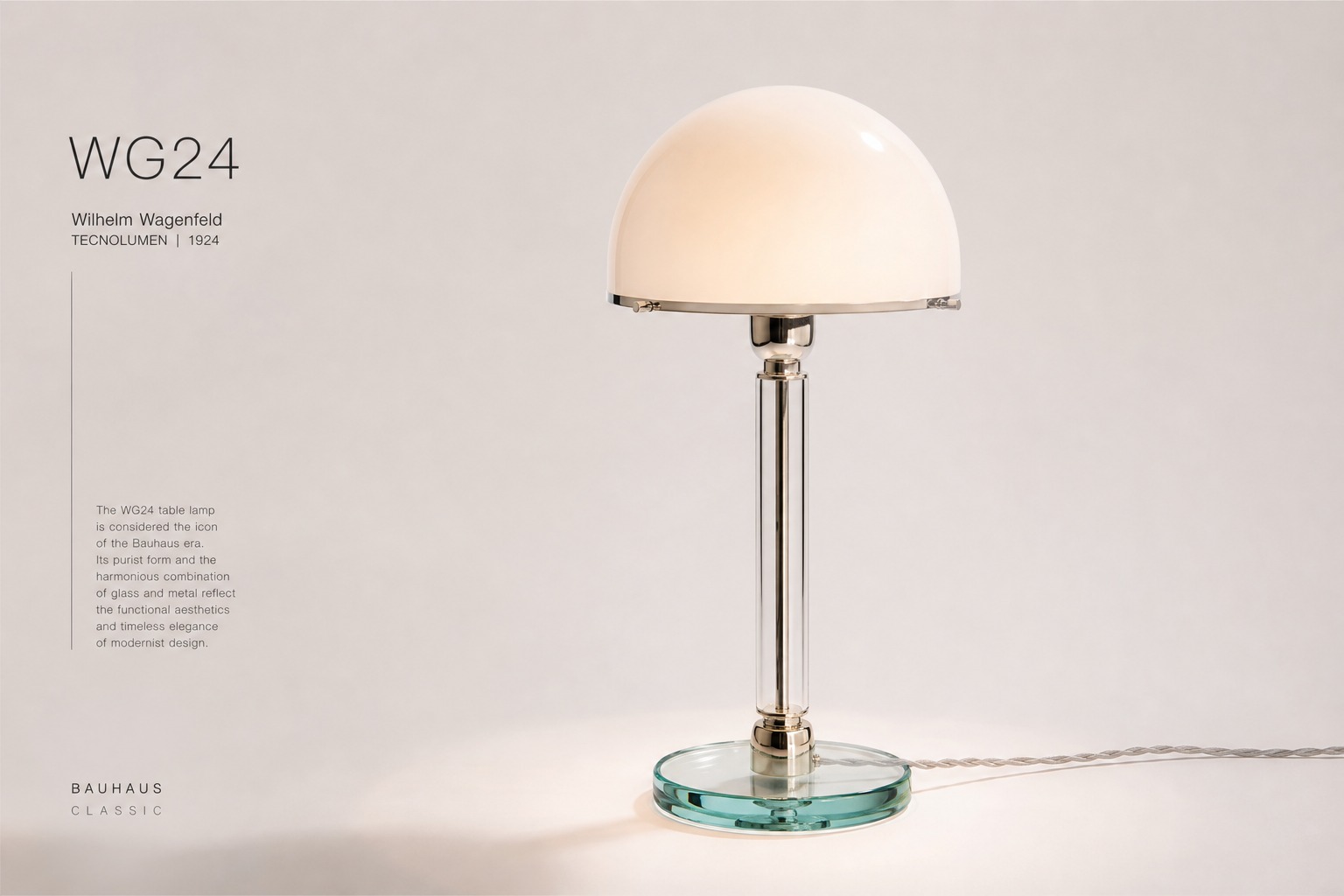
The Wagenfeld lamp is better understood as a documented workshop object, not just a design cliché
The Wagenfeld lamp is often reduced to a shorthand for Bauhaus taste, but the better sources are more precise. MoMA dates the celebrated table lamp to 1923–1924, credits Wilhelm Wagenfeld and Carl Jakob Jucker, and names the Bauhaus Metal Workshop, Germany as manufacturer. The Saint Louis Art Museum supports that reading, listing the object as a 1923–24 lamp made in Weimar from glass and nickel-plated brass. That is useful because it shifts the conversation away from generic “Bauhaus style” language and back toward verifiable workshop history.
MoMA also explains why the lamp became so canonical. Its composition reduces the object to elemental geometry: a circular base, cylindrical shaft, and spherical or near-hemispherical shade. This is exactly the kind of legible formal economy that made the lamp a textbook example of the Bauhaus claim that form should serve function. For readers browsing related material on Bauhaus, the WG 24 is one of the clearest object-level demonstrations of that idea.
Its early production story was less seamless than the legend suggests
One of the most valuable details comes from MoMA: initial attempts to market the lamp in 1924 were unsuccessful, largely because so many components were still assembled by hand at the Bauhaus. The object already looked like an industrial product, yet it had not fully solved the manufacturing realities of industrial production. The Saint Louis Art Museum makes a similar point in different language, noting that apparently simple forms were not automatically easy to realize technically.
That tension is part of what makes the lamp historically rich. It sits between workshop craft and industrial ambition rather than cleanly on one side. A recent explanatory piece from the University of Wuppertal reinforces this reading: the WG 24 became one of the best-known Bauhaus objects, but its first incarnation was relatively costly and not immediately aligned with the Bauhaus dream of inexpensive serial production.
What to verify when you encounter one on today’s market
For present-day buyers, documentation matters more than atmosphere. TECNOLUMEN describes the authorized WG 24 with a clear glass base, clear glass tube, nickel-plated metal parts, and an opal glass shade. Each lamp is, according to the company, consecutively numbered under the base and marked with both the Bauhaus and TECNOLUMEN logos. The same source also states plainly that the lamp is copied and faked very often.
That makes the Wagenfeld lamp genuinely useful as a benchmark for evaluating vintage or Bauhaus-adjacent lighting. Instead of relying on silhouette alone, buyers can compare museum dating, workshop attribution, exact material descriptions and maker’s marks. For a broader survey of collectible objects, see the shop at mid-centurydesigns.com/en/shop.