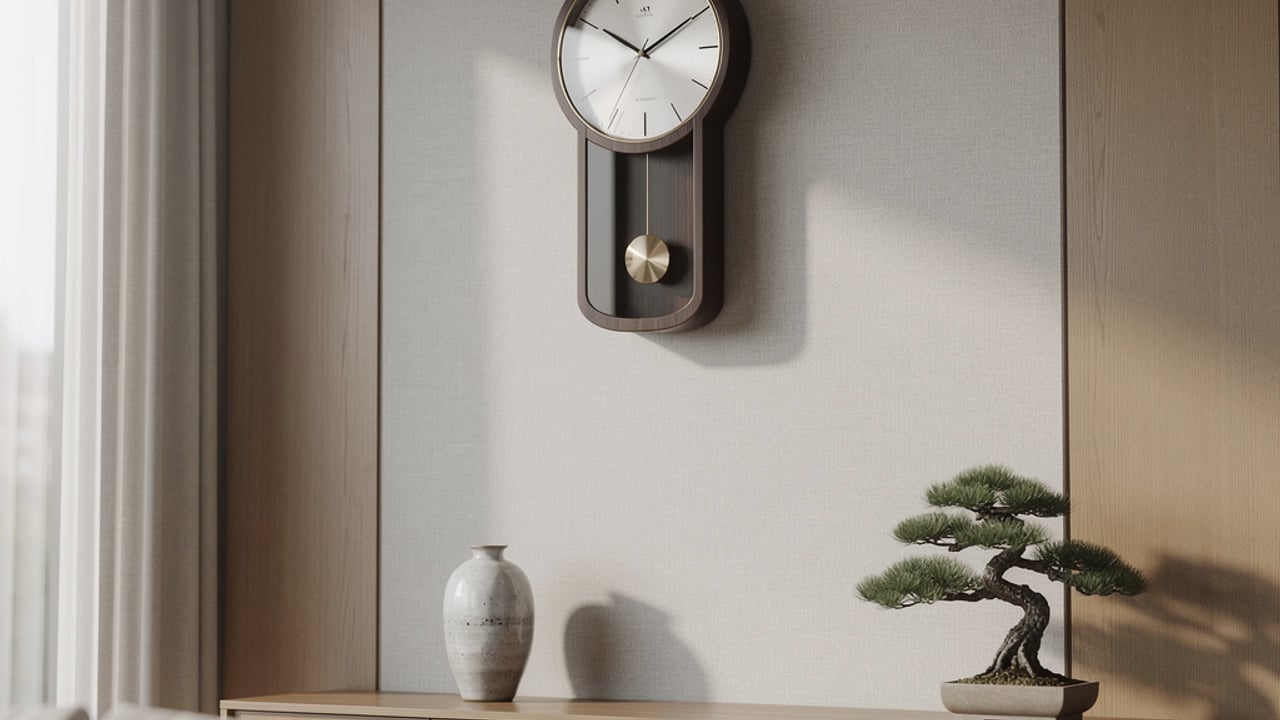
A Brief History of the japanese clock
The modern japanese clock emerged from a precise confluence of industrial ambition and deeply rooted aesthetic tradition. Following Japan’s postwar reconstruction, domestic manufacturers—most notably Seiko, Citizen, and Rhythm—invested heavily in precision horology, competing directly with Swiss and German rivals on the international stage. By the mid-1950s, the japanese clock had shed its imitative tendencies and established a distinct formal vocabulary: spare dials, restrained numerals or pure index markers, and cabinet materials drawn from indigenous lacquer and joinery traditions.
The influence of Mingei—the folk-craft philosophy championed by Sōetsu Yanagi—could be felt even in mass-produced mantel pieces, where an unpretentious honesty of material and form distinguished Japanese output from European contemporaries. Concurrently, the industrial design faculties at Tokyo University of the Arts began producing a generation of designers conversant in both Bauhaus methodology and traditional Japanese spatial theory. The resulting objects occupy a compelling middle ground: rigorously functional yet quietly meditative.
During the 1960s, the japanese clock became a site of formal experimentation. Wall-mounted examples grew larger and more architectural, functioning as room-defining objects rather than mere timekeepers. Teak and walnut housings gave way to brushed aluminium and smoked acrylic as the decade progressed, reflecting a broader shift in Japanese industrial culture toward high-technology materials.
Defining Characteristics of the japanese clock
Authentic mid-century examples share several identifying features that collectors and scholars use to establish provenance and period. The dial treatment is perhaps the most instructive: genuine pieces from the 1950s favour applied brass or gilt indices over printed numerals, while 1960s and 1970s examples often employ silk-screened minimalism influenced by graphic design movements in Tokyo and Osaka.
Movement quality is equally diagnostic. A japanese clock produced for the export market between 1955 and 1975 typically carries a jewelled lever escapement of measurable precision—many examples from Seiko’s Seikosha division were chronometer-rated to standards that challenged Swiss competitors. Case construction follows Japanese joinery principles even in metal examples: flush surfaces, concealed fixings, and an absence of applied ornament that Western consumers sometimes mistook for austerity but which reflects a considered philosophy of visual silence.
Colour is restrained throughout the period. Ivory, off-white, and warm grey dominate dial palettes, with occasional use of lacquered black for high-contrast compositions. Housing finishes run to natural teak oil, matte walnut, anodised aluminium in charcoal or champagne, and, by the early 1970s, smoked perspex constructions of considerable sculptural interest.
Notable Examples of the japanese clock in Our Collection
Our current holdings include a 1962 Seiko wall clock in original teak with a brass-indexed ivory dial, its eight-day spring-driven movement maintaining accuracy to within thirty seconds per month. A 1968 Citizen mantel piece in brushed steel with a sunburst walnut surround represents the transitional moment when japanese clock design absorbed Space Age formal language without sacrificing its characteristic restraint. A rare 1974 Rhythm floor clock in smoked acrylic and chrome demonstrates the late-period turn toward material transparency and structural legibility.
Each piece in this category has been inspected by a specialist in Japanese horology, serviced where required, and documented with period catalogue references where available. Condition reports detail movement performance alongside surface condition and any restoration history.
Caring for Your japanese clock
Mid-century japanese clock mechanisms reward attentive but minimal intervention. Spring-driven movements should be wound on a consistent schedule—typically every seven or eight days for eight-day movements—without over-winding, which strains the mainspring. Battery-converted examples, a common alteration in subsequent decades, can usually be returned to original specification by a competent horologist.
Case materials require period-appropriate care. Teak and walnut housings benefit from occasional application of a non-silicone oil, applied sparingly with a lint-free cloth. Lacquered surfaces should be kept from direct sunlight, which causes irreversible fading and crazing. Aluminium and acrylic cases are best cleaned with a dilute solution of mild soap and distilled water; avoid abrasive compounds, which scratch anodised finishes permanently.
Storage between display periods should prioritise stable humidity—between forty and sixty percent relative humidity is ideal—as fluctuations cause wood housings to expand and contract, eventually loosening movement mounts and distorting dial surrounds.