DESIGNER · CHARLES EAMES

Charles Eames: Form Follows Process

Architecture, industry, and the domestic interior, reconciled.

Few figures in twentieth-century design command the sustained critical attention that Charles Eames does. His work dissolved disciplinary boundaries, producing objects that are simultaneously ergonomic instruments and sculptural statements — as rigorous in manufacture as they are generous in use.

mid-century·designs

Charles Eames

ESSAY · 01

Work & Context

mid-century·designs

The Design Legacy of Charles Eames

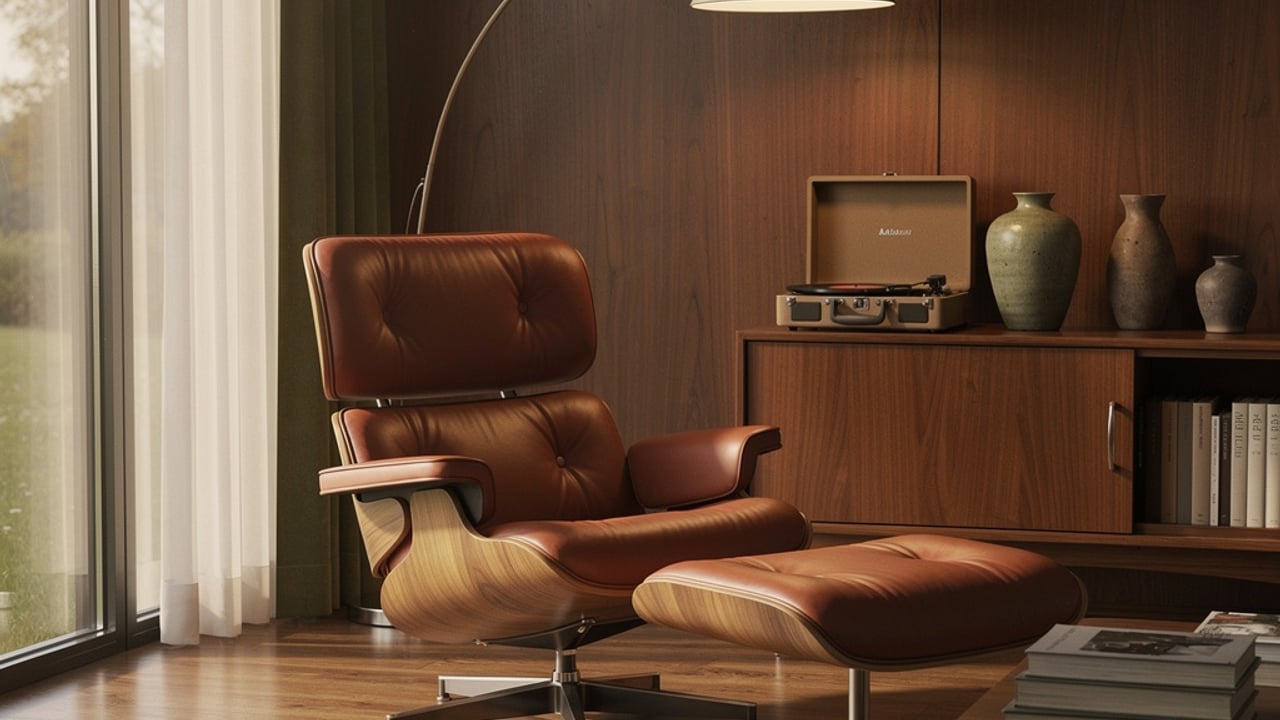
To collect the work of Charles Eames is to engage with one of the most consequential design intelligences of the postwar era. Working in partnership with his wife and collaborator Ray Kaiser Eames, he approached the domestic object not as decoration but as a problem in materials science, manufacturing logic, and human anatomy. The furniture that resulted from their Santa Monica studio — itself an experiment in prefabricated construction — continues to define the parameters of what industrial design can accomplish when rigour and warmth are held in equal measure.

The period between 1950 and 1980 represents the canonical arc of production: from the early shell chairs manufactured by Herman Miller to the mature refinements of the lounge chair and ottoman, the tandem sling seating, and the case study shelving systems. Each object in this range rewards close examination. Joinery, material selection, and the articulation of structural members all bear the evidence of sustained prototyping — a process that Charles Eames and his studio documented obsessively through film, photography, and model-making.

The Material Innovations of Charles Eames

No account of the studio’s achievement is complete without attention to process. The pressed-fibreglass shell chairs of the early 1950s were among the first mass-produced plastic seating forms, their compound curves derived directly from the moulded plywood leg splints developed for the United States Navy during the Second World War. Later, when fibreglass fell from favour on environmental grounds, the shells were reissued in polypropylene — a distinction that carries significant consequences for authentication and valuation.

Moulded plywood remained central throughout. The LCW (Lounge Chair Wood) and DCW (Dining Chair Wood) exploited the technique of three-dimensional ply bending that the studio had pioneered, producing forms that distribute body weight across a continuous curved surface rather than concentrating it at conventional pressure points. The rosewood and walnut veneers applied to the 670 lounge chair represent a further refinement: warm, tactile, and subject to the natural variation that distinguishes genuine vintage examples from later reissues.

Authenticating Works by Charles Eames

For the serious collector, provenance and manufacturer’s marks are the primary instruments of verification. Herman Miller labels — their typography, adhesive, and placement varying systematically by decade — provide a reliable chronological index. Vitra production, which commenced for the European market in the 1950s under licence, carries its own distinct stampings. Early examples exhibit construction details that later standardised manufacture gradually eliminated: hand-applied rubber shock mounts, individually drilled and countersunk hardware, and slight asymmetries in veneer grain that no contemporary CNC process would permit.

Condition assessment must account for the behaviour of specific materials over time. Fibreglass shells develop surface crazing and pigment fade in a characteristic pattern; moulded plywood occasionally delaminated at stress points along the seat-to-back junction; original leather upholstery on the 670 acquires a patina — a darkening and surface consolidation — that is wholly absent from replacement hides. Each of these material histories constitutes evidence, not imperfection.

Collecting Charles Eames: A Considered Approach

The secondary market for this body of work is mature, liquid, and attentive to condition gradations that might appear marginal to the uninitiated. A first-year production LCW with intact original finish commands a substantially different price than a structurally identical example refinished in the 1970s. Documentation — exhibition labels, original receipts, period photographs — elevates works of all types and is increasingly expected at the upper end of the market.

Collectors entering this field are advised to prioritise breadth of study before commitment to purchase. The studio’s output is extensively documented in primary sources, including the Herman Miller archives and the Library of Congress collection, and a working familiarity with these materials will prove more reliable than condition reports alone. Authenticity, here as elsewhere, is a discipline.

FAQ · 02

Frequently asked about Charles Eames

5 Answers

01
How do I distinguish an original Eames shell chair from a later reissue?
Original fibreglass shells produced between 1950 and the mid-1980s exhibit a slightly translucent quality in strong light, visible glass-fibre weave, and period-correct base stampings. Polypropylene reissues, introduced after 1994, have a denser, more opaque surface and carry contemporary Vitra or Herman Miller branding with updated typefaces. Cross-referencing base type with documented production years is essential.
02
What years of production are considered most collectible?
First-decade examples — roughly 1950 to 1960 — attract the strongest collector interest and the highest valuations, principally because they document early material and manufacturing decisions before production was fully standardised. Within this window, works with verifiable institutional or notable private provenance command a further premium. Condition relative to age remains the dominant pricing variable.
03
Are Herman Miller and Vitra pieces equivalent in value?
Both manufacturers produced under licence with the studio's direct involvement, and neither is categorically superior. Geographic market context influences relative demand: Vitra examples circulate more freely in European collections, Herman Miller in North American ones. For a given model and year, the more significant variables are condition, completeness of original components, and the presence of period labels or stampings.
04
How should vintage fibreglass seating be preserved?
Fibreglass shells are vulnerable to prolonged ultraviolet exposure, which accelerates pigment fade and surface crazing. Storage or display away from direct sunlight is the primary conservation measure. Cleaning should be limited to mild, pH-neutral solutions applied with soft cloth. Avoid abrasive compounds, which remove the oxidised surface layer that contributes to period character and is irreplaceable once lost.
05
What documentation should accompany a significant purchase?
At minimum: a condition report prepared by a qualified conservator, clear photographs of all manufacturer's marks and labels, and any available ownership history. For works expected to exceed four figures, a written attribution letter from a recognised specialist or auction house specialist adds meaningful security. Original purchase receipts, period exhibition labels, and correspondence with the manufacturer are exceptional but not uncommon in established collections.

GLOSSARY · 03

Related Terms

9 Entries

Ray Eames
Born Ray Kaiser, she was the co-designer and intellectual partner in the Eames studio from 1941 until her death in 1988. Her background in abstract painting and textile design shaped the studio's approach to surface, colour, and compositional balance across the entire output.
Herman Miller
Michigan-based American furniture manufacturer that held the primary production licence for Eames designs from 1946 onward. The company's archives constitute one of the most significant primary sources for dating and authenticating works from the canonical mid-century period.
Vitra
Swiss manufacturer licensed to produce Eames designs for European and Middle Eastern markets since the 1950s. Vitra's production history runs parallel to Herman Miller's, with distinct label typography and base stampings that allow trained specialists to separate the two manufacturer streams.
Moulded Plywood
A manufacturing process in which thin wood veneers are laminated with adhesive and pressed into three-dimensional forms using heat-shaped moulds. The Eames studio's wartime research into this technique directly produced the LCW, DCW, and the celebrated plywood folding screen.
Fibreglass Reinforced Plastic (FRP)
A composite material consisting of a polymer resin matrix reinforced with woven glass fibres, used for the Eames shell chair from approximately 1950 to the mid-1980s. Period FRP shells are distinguishable from later polypropylene versions by surface translucency and visible fibre texture.
George Nelson
American designer and Herman Miller design director from 1945 to 1972, whose tenure coincided directly with the Eames studio's most productive decades. Nelson's own output — platform benches, bubble lamps, the Marshmallow sofa — represents a complementary strand of postwar American design.
Case Study House Programme
An experimental American architectural initiative, sponsored by Arts & Architecture magazine from 1945 to 1966, that commissioned leading modernist architects to design affordable prototype residences. The Eames House (Case Study House No. 8) remains its most celebrated and studied commission.
Shock Mount
A rubber-and-metal connector used to join the seat and back shells of Eames chair variants to their bases, absorbing vibration and permitting slight flex. Original hand-applied mounts on first-generation examples are a key authentication marker; their condition significantly affects structural integrity.
Mid-Century Modernism
A broad design and architectural tendency spanning approximately 1945 to 1975, characterised by the integration of industrial materials and manufacturing methods with humanist spatial and ergonomic concerns. The period's furniture output — American, Scandinavian, and Italian — forms the primary focus of the secondary collector market.