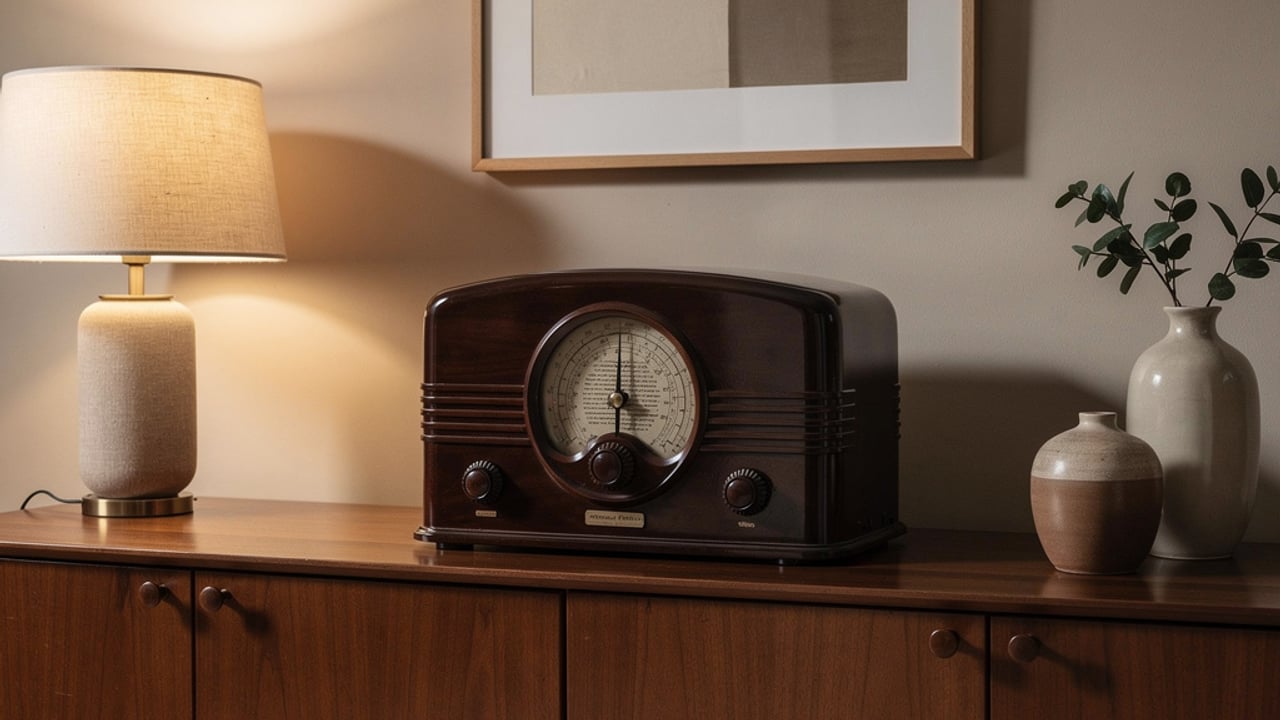
A Brief History of bakelite radio
The emergence of the bakelite radio as a domestic object coincides almost exactly with the consolidation of broadcast culture in Europe and North America. From the early 1930s through the late 1950s, manufacturers including Ekco, Murphy, Philco, and Emerson translated the functional demands of radio receiver technology into sculptural housings that expressed the full ambition of early industrial modernism. Bakelite — the phenol-formaldehyde resin patented by Leo Baekeland in 1907 — proved an ideal medium: thermally stable, electrically non-conductive, and amenable to compression moulding in forms that wood or metal could not easily achieve. The result was a generation of objects that remain among the most collectible artefacts of the mid-century domestic sphere.
Designers approached the bakelite radio as a genuine problem of form. Wells Coates’s AD65 for Ekco (1934) remains perhaps the most cited example: a circular cabinet of brown Bakelite that owed more to the geometry of the Bauhaus than to the cabinet-making tradition it displaced. Serge Chermayeff, E. K. Cole, and later Raymond Loewy each brought distinct formal sensibilities to the object, encoding within its housing the competing values of streamlining, functionalism, and popular modernism.
By the late 1950s, the advent of transistor technology and injection-moulded polystyrene gradually displaced Bakelite from production. The bakelite radio thus occupies a precise historical window — bounded on one side by the medium’s cultural emergence, on the other by material obsolescence — that lends surviving examples both their rarity and their documentary weight.
Notable bakelite radio Designs of the Era
Any serious consideration of the bakelite radio catalogue must account for a handful of pivotal designs. The Ekco AD65 and its successor the AD36 established circular and elliptical geometries that influenced continental manufacturers throughout the 1930s and 1940s. Philco’s “People’s Set” brought Bakelite receivers to mass-market audiences in the United States while retaining considered proportional relationships. In Germany, the Volksempfänger series — state-commissioned and produced in enormous quantities — offers a sobering study in how the same material and formal language could serve radically different ideological programmes.
French manufacture, particularly through Sonora and Clarville, introduced a warmer palette — cream, ivory, and marbled caramel — that anticipated the pastel sensibilities of post-war consumer culture. Each of these objects rewards close examination: mould lines, dial typography, grille cloth, and hardware finish all constitute a period record as legible as any document.
Where to Find Authentic bakelite radio Sets
Authenticity assessment for the bakelite radio depends on a convergence of material, mechanical, and documentary evidence. Genuine Bakelite may be distinguished from later thermoplastics by its characteristic phenolic odour when gently warmed, its weight, and the particular depth of its moulded surface. Period chassis, valves, and capacitors should correspond to manufacturer records; replacement components, while sometimes necessary for electrical safety, require disclosure and do not preclude collection value when properly documented.
Provenance — auction records, estate inventories, retailer stamps on chassis bases — substantially elevates both confidence and valuation. Every bakelite radio offered through this collection has been assessed against available production and sales records, with condition reports prepared to auction-house standards.
Caring for Your bakelite radio
Bakelite is chemically stable under normal domestic conditions but susceptible to specific agents. Avoid alcohol-based cleaners, which strip surface lustre and can initiate crazing. A microfibre cloth dampened with distilled water, followed by a light application of Renaissance Wax, remains the conservator’s preferred maintenance protocol. Store away from prolonged ultraviolet exposure, which causes colour shift — particularly in cream and ivory examples. Electrical restoration, where desired, should be entrusted only to technicians experienced with vintage valve equipment; original capacitors frequently require replacement as a safety precaution, and this work should be documented and reversible wherever possible.