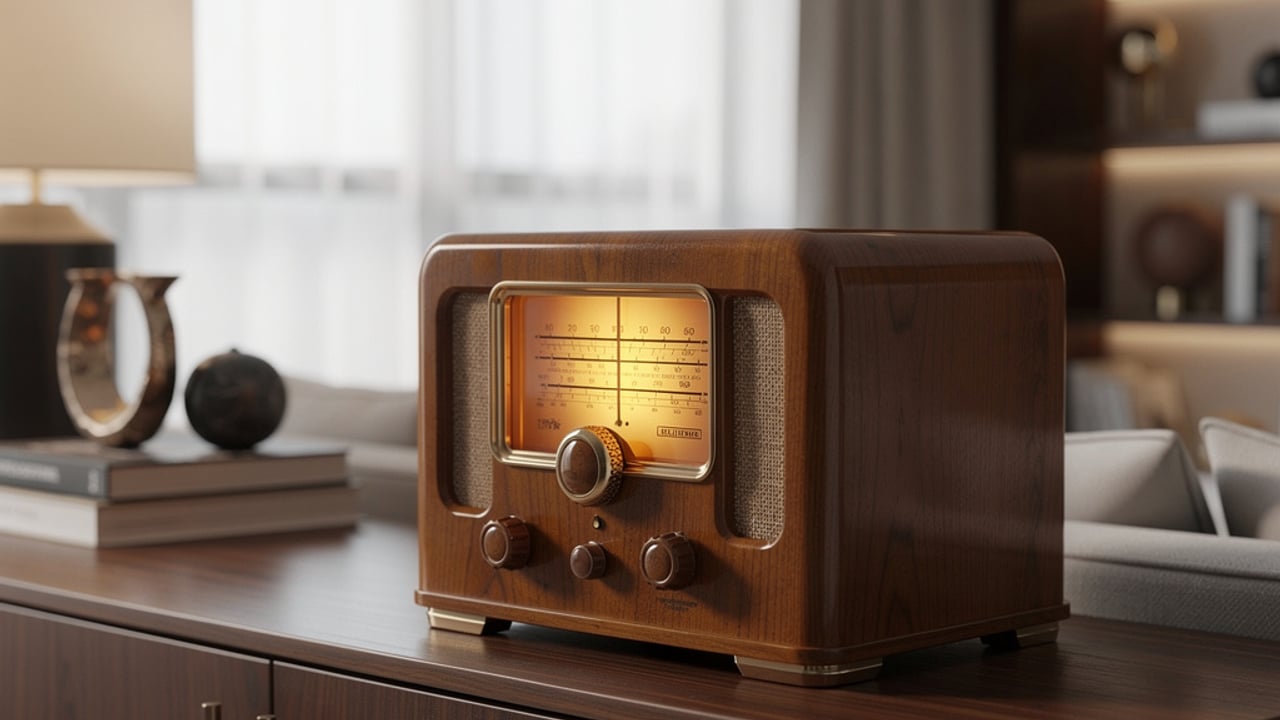
CATEGORY · ANTIQUE RADIO

The Art of the Antique Radio

Where acoustic engineering meets sculptural form.

From streamlined Bakelite consoles to teak-veneered hi-fi cabinets, the finest broadcast receivers of the mid-twentieth century occupy a singular position in design history — functional objects elevated, without apology, to the status of domestic sculpture.

mid-century·designs

antique radio

ESSAY · 01

Work & Context

mid-century·designs

A Brief History of antique radio

The domestic receiver arrived in European and American households during the 1920s, but it was the three decades spanning 1950 to 1980 that produced the objects collectors prize most acutely today. Manufacturers across West Germany, Scandinavia, Japan, and the United States competed not merely on frequency range or selectivity, but on the visual language of the cabinet itself. Braun in Frankfurt, Grundig in Nuremberg, and Bang & Olufsen in Struer each staked an aesthetic position — rationalist, expressive, or quietly luxurious — that transformed a piece of electronic apparatus into a considered object of interior design.

Post-war material optimism encouraged experimentation. Bakelite gave way to high-pressure laminates and polished aluminium fascias. Dial glasses were screen-printed with cartographic frequency bands in ochre, sienna, and cobalt. Walnut, teak, and rosewood veneers dressed the flanks of floor-standing consoles intended to anchor a living room rather than merely furnish it. By the late 1960s, designers such as Dieter Rams had codified a severe, grid-based vocabulary that continues to influence consumer electronics to this day.

Understanding this context is essential when acquiring an antique radio at the level this catalogue addresses. Provenance, original components, and the integrity of the cabinet finish are the criteria that separate a collected object from a repaired appliance.

Notable antique radio Designers and Manufacturers

Certain names recur in any serious survey of the field. Braun’s SK and T-series receivers, shaped under Rams and Hans Gugelot at the Hochschule für Gestaltung Ulm, represent the rationalist pole: surfaces reduced to functional necessity, typography subordinated to the dial. At the opposing extreme, Bang & Olufsen’s Beolit and Beomaster lines pursued a Scandinavian warmth — teak grilles, anodised aluminium sliders, and proportions borrowed as readily from furniture-making as from electronics engineering.

In the United States, Zenith and Motorola produced console cabinets whose scale and joinery rivalled contemporary case furniture. Japanese manufacturers — Sony, Pioneer, Sansui — introduced a precision-machined aesthetic by the early 1970s that appealed to a younger, internationally mobile consumer. Each tradition yields objects that reward close examination, and each demands a correspondingly specific body of knowledge from the collector.

Where to Find Authentic antique radio Pieces

Authenticity is the governing concern. The market for mid-century broadcast equipment contains a significant proportion of restored, reveneer ed, or composite pieces — cabinets married to mismatched chassis, or dials replaced with period-incorrect reproductions. A reputable specialist dealer will supply documented provenance, original service records where they survive, and a condition report that distinguishes cosmetic patina from structural deterioration.

Mid-century-designs.com sources each antique radio from estates, institutional collections, and vetted private sellers across Europe, Scandinavia, Japan, and North America. Every object is inspected against manufacturer archive records before listing. Certificates of authenticity accompany each acquisition, and our in-house conservators assess electronic function independently of cabinet condition.

Caring for Your antique radio

Conservation begins with environment. Bakelite and early thermoplastic housings are sensitive to ultraviolet exposure and rapid humidity change; direct sunlight will bleach and embrittle surfaces that have survived seven decades intact. Store and display antique radio cabinets away from south-facing windows, and maintain relative humidity between 45 and 55 percent.

Wood veneers respond well to a twice-yearly application of microcrystalline wax, applied sparingly and buffed to a low sheen. Avoid silicone-based furniture polishes, which penetrate grain and complicate future conservation. Dial glasses should be cleaned only with a lint-free cloth and distilled water; proprietary glass cleaners contain ammonia that will lift screen-printed frequency markings.

Electronic servicing should be entrusted exclusively to technicians familiar with period components. Capacitor replacement is often necessary in receivers of this age, but original valves, transformers, and tuning mechanisms should be retained wherever possible. Replacement with modern equivalents diminishes both sonic character and collector value in equal measure.

FAQ · 02

Frequently asked about antique radio

5 Answers

01
How do I verify that an antique radio is genuinely from the mid-century period and not a later reproduction?
Cross-reference the chassis serial number against manufacturer archive records, which reputable dealers can supply. Inspect solder joints under magnification — original factory work differs markedly from later repair. Component date codes stamped on capacitors and resistors provide independent confirmation of manufacture date, and veneer joinery methods are period-specific.
02
Does electronic function affect the collectible value of a vintage broadcast receiver?
Operational condition contributes to value but is not the primary determinant at auction level. Cabinet integrity, originality of components, and provenance weigh more heavily. A non-functioning receiver with original chassis and unrestored veneer will typically command a higher price than a fully recapped example with replacement parts or refinished woodwork.
03
Which manufacturers produced the most collectible pieces between 1950 and 1980?
Braun, Bang & Olufsen, Grundig, and Nordmende lead the European market. In the United States, Zenith console sets attract strong collector interest. Japanese manufacturers Sony and Sansui are increasingly sought in Asian and North American markets. Objects designed by named individuals — Dieter Rams, Jacob Jensen — command consistent premiums regardless of manufacturer.
04
What is the correct way to clean a Bakelite cabinet without causing damage?
Use a soft cloth dampened with a solution of mild pH-neutral soap and distilled water. Work in small sections and dry immediately. Retrobrite and oxidising agents should be avoided; they alter surface chemistry irreversibly. A light application of carnauba wax after cleaning will protect the surface and restore a degree of lustre without obscuring patina.
05
Are export or international-market variants less valuable than domestic versions?
Not necessarily. Export variants sometimes feature superior cabinetwork or wider frequency ranges commissioned for specific markets, which can increase rather than diminish collector interest. Scandinavian domestic-market Bang & Olufsen pieces are an exception, tending to outperform export equivalents due to stricter quality control applied to the home market production run.

GLOSSARY · 03

Related Terms

7 Entries

Bakelite
The first synthetic thermosetting plastic, developed by Leo Baekeland in 1907 and widely used in radio cabinet construction through the 1950s. Characterised by its lustrous surface, dimensional stability, and susceptibility to crazing under ultraviolet exposure.
Hochschule für Gestaltung Ulm
West German design school (1953–1968) that succeeded the Bauhaus in methodological rigour. Its collaboration with Braun produced a functionalist design language — grid-based, typographically austere — that defined the rationalist strand of mid-century industrial design.
Teak Veneer
Sliced surface layer of Tectona grandis timber, applied to particleboard or solid pine carcasses in Scandinavian and German cabinet manufacture. Valued for its warm grain, natural oil content, and resistance to warping under domestic humidity variation.
Dieter Rams
German industrial designer (b. 1932), head of design at Braun from 1961 to 1995. His ten principles of good design, and the objects produced under them, remain the canonical reference point for mid-century consumer electronics aesthetics.
Jacob Jensen
Danish designer (1926–2015) whose work for Bang & Olufsen from 1964 onward established a vocabulary of horizontal aluminium surfaces, flush controls, and Scandinavian material warmth that distinguished the brand internationally.
Chassis
The internal metal framework carrying a receiver's electronic components — valves, transformers, tuning capacitors, and wiring. Chassis integrity and component originality are primary determinants of technical authenticity in collector-grade broadcast equipment.
Microcrystalline Wax
A refined petroleum-derived wax with a finer crystal structure than carnauba or beeswax. Preferred in conservation practice for wood and plastic surfaces owing to its chemical stability, reversibility, and resistance to bloom in varying humidity conditions.