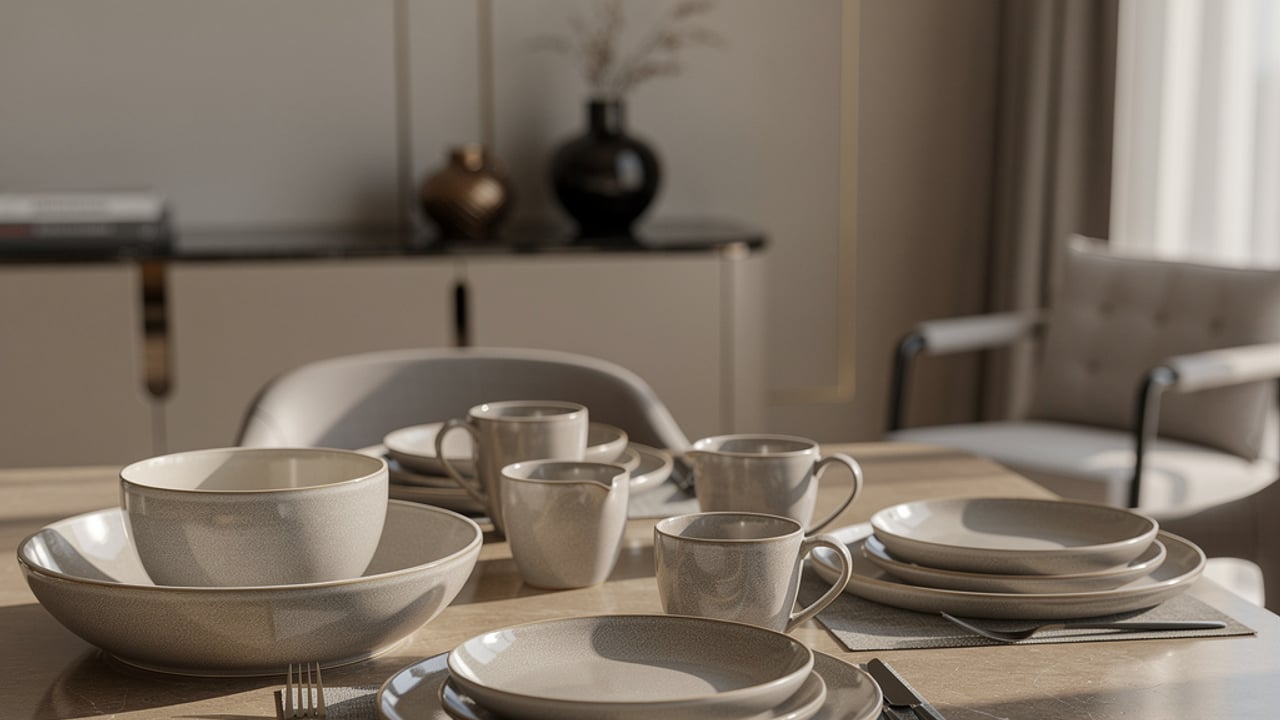
A Brief History of stoneware crockery
The postwar decades produced a fundamental reassessment of everyday domestic objects. Designers and studio potters, working in conversation with the Bauhaus legacy and influenced by Japanese mingei philosophy, began approaching fired-clay tableware as a site of genuine artistic inquiry. The result was a generation of utilitarian objects that refused the boundary between craft and fine art.
Stoneware — fired at temperatures between 1,200 and 1,300 degrees Celsius — offered a density and thermal stability that earthenware could not match. Its surfaces accepted ash glazes, salt finishes, and oxide washes with a depth that became the visual signature of the period. Studios from Gustavsberg in Sweden to Leach Pottery in Cornwall established house vocabularies that shaped decades of production.
The pieces that survive in collectible condition today document a particular moment: when industrial methods and hand-finishing coexisted, when form followed a quietly rigorous functionalism, and when the table was understood as a composed environment.
Notable stoneware crockery of the Era
Certain workshops and individual designers defined the field. Stig Lindberg at Gustavsberg produced tableware series of extraordinary restraint. Lucie Rie, working in her Albion Mews studio, brought a Viennese modernist sensibility to British studio ceramics. Rupert Spira’s predecessors at the Leach Pottery established salt-glazed traditions that persist today.
Japanese influence arrived through the work of Shoji Hamada and Kanjiro Kawai, whose approach to the utilitarian vessel as a bearer of philosophical intent permeated European studio practice. Collectors who focus on this intersection of east and west encounter some of the most intellectually coherent stoneware crockery the period produced.
Scandinavian commercial studios, by contrast, brought these ideas to a broader public through production lines that retained hand-finished qualities. Their documented series remain among the most accessible entry points for new collectors.
Where to Find Authentic stoneware crockery
Provenance is the primary concern when acquiring pieces from this period. Mid-century-designs.com presents only items with documented ownership histories, original maker’s marks, and, where available, exhibition or retail records. Each listing includes fired-clay analysis notes and glaze characterisation where relevant.
Authentication rests on several criteria: kiln marks applied beneath the glaze rather than painted over it, consistent weight distribution characteristic of the producing studio, and surface texture consistent with the documented firing methods of the period. Pieces without legible marks require additional scrutiny — reputable dealers will supply written condition reports.
Auction archives, museum collection databases, and published studio catalogues form the documentary infrastructure of any serious acquisition. Our curatorial team cross-references all pieces against these sources before listing.
Caring for Your stoneware crockery
Dense-bodied and vitrified, well-fired stoneware crockery is among the most resilient ceramic ware a collector will encounter. Nevertheless, certain practices extend the life and preserve the surface integrity of historic pieces.
Avoid thermal shock: moving a cold vessel directly into a hot oven, or pouring boiling liquid into a piece at room temperature, risks micro-fractures invisible to the eye but damaging over time. Hand-washing is strongly recommended — industrial dishwasher detergents are abrasive and, over repeated cycles, degrade period glazes perceptibly.
Storage should avoid stacking without felt or cloth separators. The foot ring of one piece resting on the glaze surface of another will, over time, produce scratching that diminishes both aesthetic and monetary value. Display on open shelving, where pieces can be appreciated as the designed objects they are, remains the preferred approach.