CATEGORY · PH SNOWBALL

PH Snowball – designed in 1958, reintroduced in 1983 and still readable as a precise multi-shade system

Louis Poulsen dates the design to 1958, describes eight shades with glare-free diffused light, and links Poul Henningsen’s thinking back to the logarithmic three-shade system

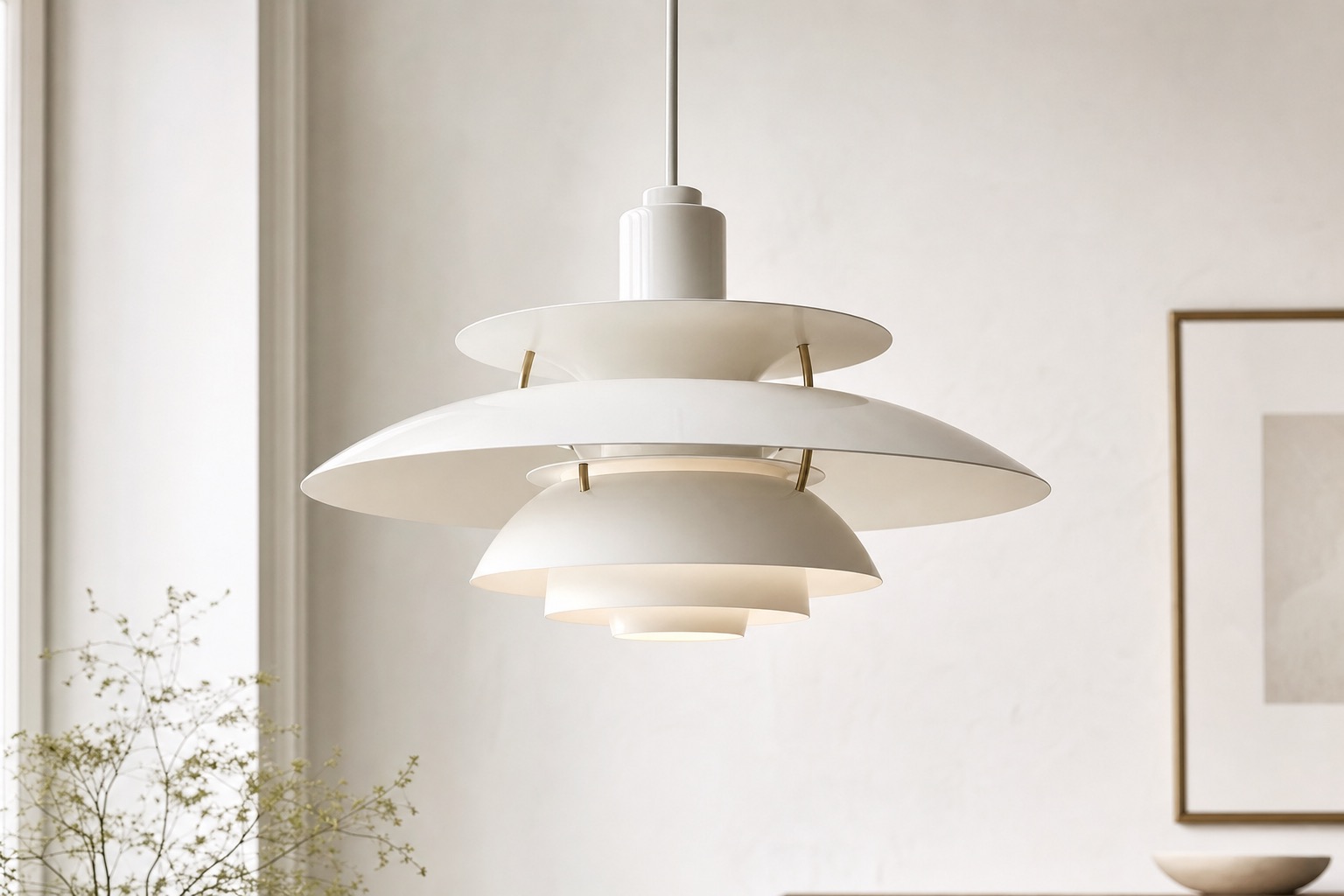
At first glance, PH Snowball can look like a calm design sculpture. The reliable sources show something more technical: Louis Poulsen describes eight shades, matt undersides and glossy top surfaces as the means by which the lamp creates uniform, glare-free diffused light. The same source dates the design to 1958 and the relaunch to 1983, while Louis Poulsen’s designer page explains Henningsen’s wider ambition for glare-free light through the three-shade system he developed in 1926.

mid-century·designs

PH Snowball

ESSAY · 01

Work & Context

mid-century·designs

PH Snowball becomes most interesting when you read it as a lighting system

Many descriptions treat PH Snowball mainly as an elegant white statement lamp. The reliable sources are more exact. Louis Poulsen does not simply describe a spherical form, but a pendant with eight shades whose matt undersides and glossy top surfaces reflect light in such a way that glare-free diffused light and uniform distribution are created around the fixture. When the lamp is switched on, the manufacturer says the top part is illuminated while the bottom part remains dark — a useful reminder that this is not just a decorative shell.

That matters on mid-century·designs, where pendant lights are often described through mood and silhouette alone. Anyone who already knows our pages on PH 5, PH Artichoke or lamps mid-century can use Snowball as a clearer case of how a lamp should be read through construction and light behaviour. The wider shop context becomes easier to navigate once you start comparing layered pendant lamps by how they actually manage glare.

Designed in 1958, but not immediately a market favourite

The design history is especially revealing. Louis Poulsen states that Poul Henningsen designed PH Snowball in 1958 and that it was exhibited together with PH 5 at the former Danish Museum of Decorative Art. The same source also says that Snowball received no particular attention at that moment and was only relaunched and manufactured from 1983. That distinction matters: historically the design belongs to the late 1950s, but its visible market life is tied more strongly to the later reintroduction.

Louis Poulsen’s Anniversary Edition page sharpens that story further. It describes PH Snowball as a lamp first shown in 1958, made up of a series of eight shades, and only reintroduced in 1983. For collectors, that is useful because it grounds both the design date and the staggered production history in direct source material.

The real logic comes from Henningsen’s lighting philosophy, not the rounded silhouette alone

To place Snowball properly, it helps to read Louis Poulsen’s page on Poul Henningsen. There the company explains that Henningsen developed his famous three-shade system in 1926, based on the curves of a logarithmic spiral, in order to create functional and completely glare-free light. That framework makes PH Snowball easier to understand not as an isolated sculptural object, but as a later variation within a disciplined lighting philosophy.

That is also why the lamp is useful in a shop context. When comparing historical or later pendant lights, the better question is not whether an object merely “looks Scandinavian”, but whether its shade layering, surface treatment, glare control and light distribution are technically legible. PH Snowball is a particularly strong example because the sources describe both form and light effect with unusual clarity.

Sources

FAQ · 02

Frequently asked about PH Snowball

5 Answers

01
When was PH Snowball designed?
Louis Poulsen dates PH Snowball to 1958. The product page also states that it was shown together with PH 5 at the Danish Museum of Decorative Art and only returned to production from 1983.
02
What makes PH Snowball more than a decorative spherical lamp?
Louis Poulsen explains the lamp through its multi-shade construction. Eight shades, matt undersides and glossy upper surfaces produce glare-free diffused light and a uniform distribution around the pendant.
03
How does Poul Henningsen’s three-shade system relate to PH Snowball?
Louis Poulsen’s designer page says Henningsen developed the three-shade system in 1926 on the basis of a logarithmic spiral in order to create functional, glare-free light. PH Snowball can be read as a later expansion of that same lighting logic.
04
Why does 1983 matter for collectors?
According to Louis Poulsen, PH Snowball received little attention when first exhibited in 1958 and was only reintroduced and manufactured from 1983. That helps separate design date from later market visibility.
05
Which structural detail is worth remembering most?
Louis Poulsen’s Anniversary Edition page explicitly describes a series of eight shades forming an elongated spherical silhouette. That layered construction is central both to the light effect and to identification.

GLOSSARY · 03

Related Terms

6 Entries

Poul Henningsen
Danish designer identified by Louis Poulsen as the author of PH Snowball. According to the designer page, his work consistently aimed at glare-free light and soft shadows.
PH Snowball
Pendant lamp produced by Louis Poulsen after a 1958 design by Poul Henningsen. The manufacturer says it was first exhibited in 1958 and only reintroduced to production in 1983.
Three-shade system
Described by Louis Poulsen as a principle developed in 1926 from the curves of a logarithmic spiral in order to create functional, glare-free light.
Eight shades
The Anniversary Edition page explicitly refers to a series of eight shades forming the elongated spherical silhouette of PH Snowball.
Matt undersides and glossy top surfaces
According to the product page, these surface treatments create attractive reflections of the diffused light and help distribute illumination evenly around the fixture.
Glare-free diffused light
Louis Poulsen uses this exact wording to describe the lighting effect of PH Snowball. It is a more useful buying criterion than sculptural appearance alone.