Akari only becomes truly interesting once you stop seeing “paper” and start seeing a documented making process
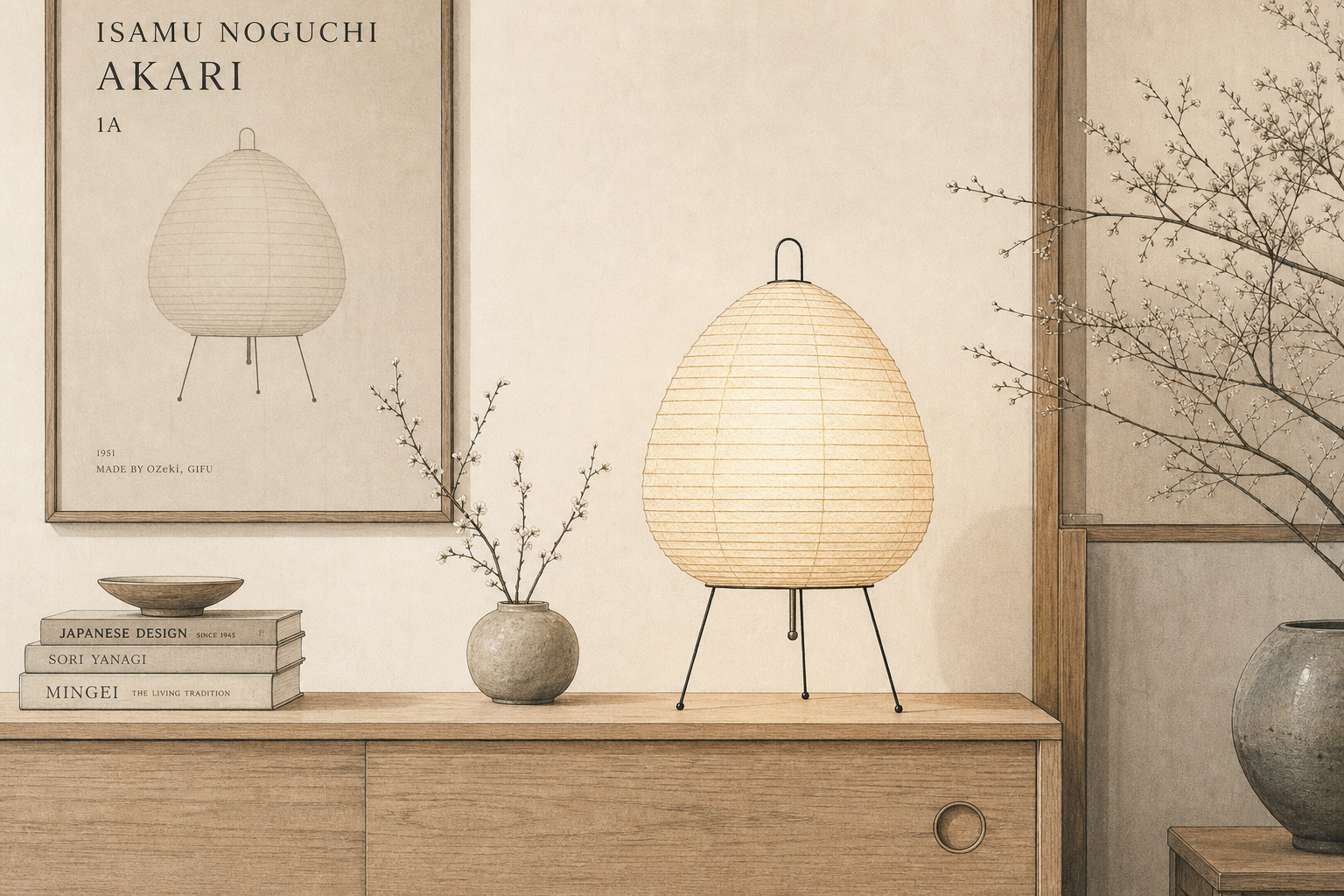
Many texts treat Noguchi Akari as a poetic paper lamp with a vaguely atmospheric Japanese aura. The reliable sources are more concrete, and therefore much more useful for buyers. The Noguchi Museum writes that Isamu Noguchi visited Gifu in 1951, a city known for lanterns and umbrellas made from paper and bamboo, and designed the first Akari there. On the product page for Akari 1A, the museum shop becomes even more specific: handmade washi paper, bamboo ribbing, a metal frame, and dimensions of 26 × 26 × 43 cm.
That matters in a shop context too. Anyone moving through mid-century·designs via lamps mid-century, the Wagenfeld lamp or the wider shop will notice how often lamps are described only through style language. With Akari, the real value is easier to prove: materials, place of production, collapsible construction and authenticity marks all belong to the object’s meaning.
The core is not a vague Japan image, but a clearly described Gifu craft sequence
The strongest source for the making process is Vitra. It explains that each lamp is handcrafted in the Ozeki workshop in Gifu. First, bamboo rods are stretched across the original wooden forms designed by Noguchi. Then washi, which Vitra says is derived from the bark of the mulberry tree, is cut into strips and glued onto the ribbing. After drying, the wooden form is removed, allowing the shade to collapse flat.
That is more than a charming workshop anecdote. For collectors and buyers, the sequence explains why Akari feels both light and structurally disciplined. The Noguchi Museum defines Akari in terms of light, while Vitra adds the idea of physical lightness. That is exactly why Akari should not be confused with generic paper lanterns: the dependable sources describe a very specific relationship between material, tension, glue and foldability.
In practice, the 1A is less about romance than about proportion, material coherence and authenticity
The source base is unusually useful for the market. The Noguchi Museum gives Akari 1A compact dimensions of 26 × 26 × 43 cm, which makes clear that the object was conceived not as a monumental sculpture but as a concentrated table lamp. The same page ties it to washi, bamboo ribbing and a metal frame. When assessing an example, it therefore makes more sense to inspect paper quality, rib rhythm, intact structure, credible proportions and plausible collapsibility than to rely on vague labels such as “Zen” or “Japanese minimalism”.
Vitra adds an especially practical checkpoint: the Akari Light Sculptures carry a stylised sun-and-moon logo that, according to the source, guarantees the authenticity of each product. Combined with the documented Gifu production, the Ozeki reference and the named materials, Akari becomes one of those rare mid-century objects that can be read not just atmospherically, but technically and historically.