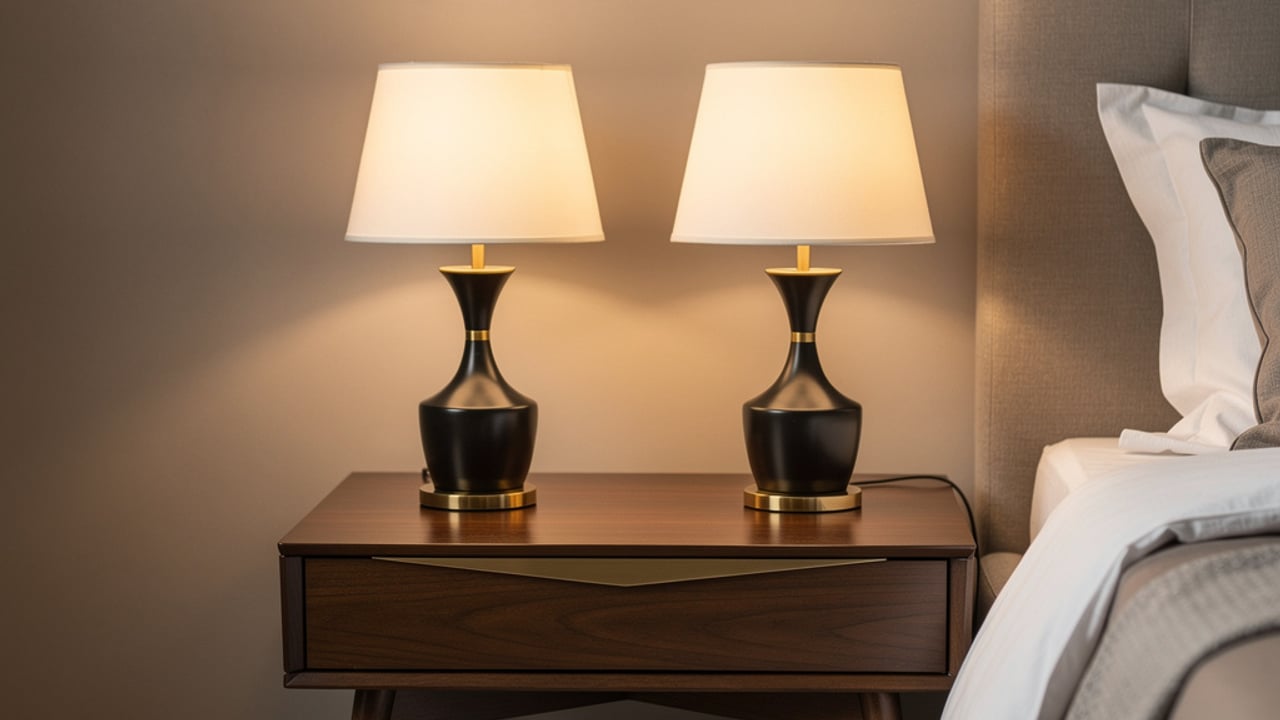
A Brief History of mid-century bedside lamps
The bedside lamp occupies a peculiar position in the history of design: intimate in scale, yet subject to the same formal ambitions that shaped public architecture and exhibition furniture. Between 1950 and 1980, a generation of designers and manufacturers redirected those ambitions toward the domestic interior with striking results. mid-century bedside lamps emerged from a postwar culture that understood light not merely as function but as atmosphere — a modifiable quality of lived space.
In Italy, studios such as Arteluce and Stilnovo pursued a vocabulary of slender stems, articulated arms, and spun-aluminium diffusers. Their output drew freely from constructivist geometry while remaining attentive to the human scale of a nightstand. In Scandinavia, the same period produced a contrasting idiom: warm teak bases, opaline glass shades, and a preference for diffused over directed light. Manufacturers including Fog & Mørup in Denmark and Bergboms in Sweden brought this philosophy to a broad market without sacrificing material integrity.
German and French workshops contributed their own registers — the functionalist rigour of Bauhaus-adjacent production houses against the more decorative confidence of French artisan metalwork. What unites these divergent traditions is a shared conviction that even the smallest luminaire deserved the same intellectual seriousness as a chair or a building facade.
Notable mid-century bedside lamps of the Era
Certain objects recur consistently in serious collections. The Gino Sarfatti Model 600 series, produced for Arteluce from the early 1950s, remains among the most architecturally resolved mid-century bedside lamps in the canon. Its adjustable reflector and understated base anticipate decades of subsequent design. Equally significant are the bedside models produced by Bent Karlby for Lyfa — objects in which the junction of shade and stem achieves an almost calligraphic precision.
The work of Lisa Johansson-Pape for Orno in Finland deserves particular attention. Her opaline glass pendants and table models brought a feminist rigour to a field dominated by male designers, producing mid-century bedside lamps that balance warmth with structural clarity. From the German context, the Kaiser Leuchten workshop generated a substantial body of adjustable and swing-arm models that reward close formal analysis.
Where to Find Authentic mid-century bedside lamps
Authentication is the central difficulty when acquiring mid-century bedside lamps on the secondary market. Original maker’s labels, intact wiring stamps, and period-consistent materials — drawn brass rather than cast zinc, mouth-blown glass rather than moulded acrylic — are the primary indices of provenance. Auction records from Bukowskis, Wright, and Quittenbaum provide useful price anchors, though condition differentials can be considerable.
This platform sources mid-century bedside lamps through a network of European specialist dealers, estate clearances, and private collections. Each listing undergoes a documented provenance review and, where necessary, restoration by craftspeople working within period-appropriate material constraints. Photography is conducted under controlled light to render patina and surface accurately.
Caring for Your mid-century bedside lamps
The longevity of mid-century bedside lamps depends on a modest but consistent maintenance discipline. Brass components should be left to develop their natural patina or, if polishing is preferred, treated only with non-abrasive compounds free of ammonia. Teak and walnut bases respond well to occasional treatment with raw linseed oil; avoid silicone-based products, which seal the grain and alter the surface quality irreversibly.
Electrical rewiring is advisable for any piece acquired without documented restoration history. A competent electrician familiar with vintage fixtures can replace deteriorated flex with period-sympathetic braided cloth cable without compromising the object’s visual integrity. Original shades, where present, should be stored away from direct sunlight to prevent discolouration of opaline or parchment materials.