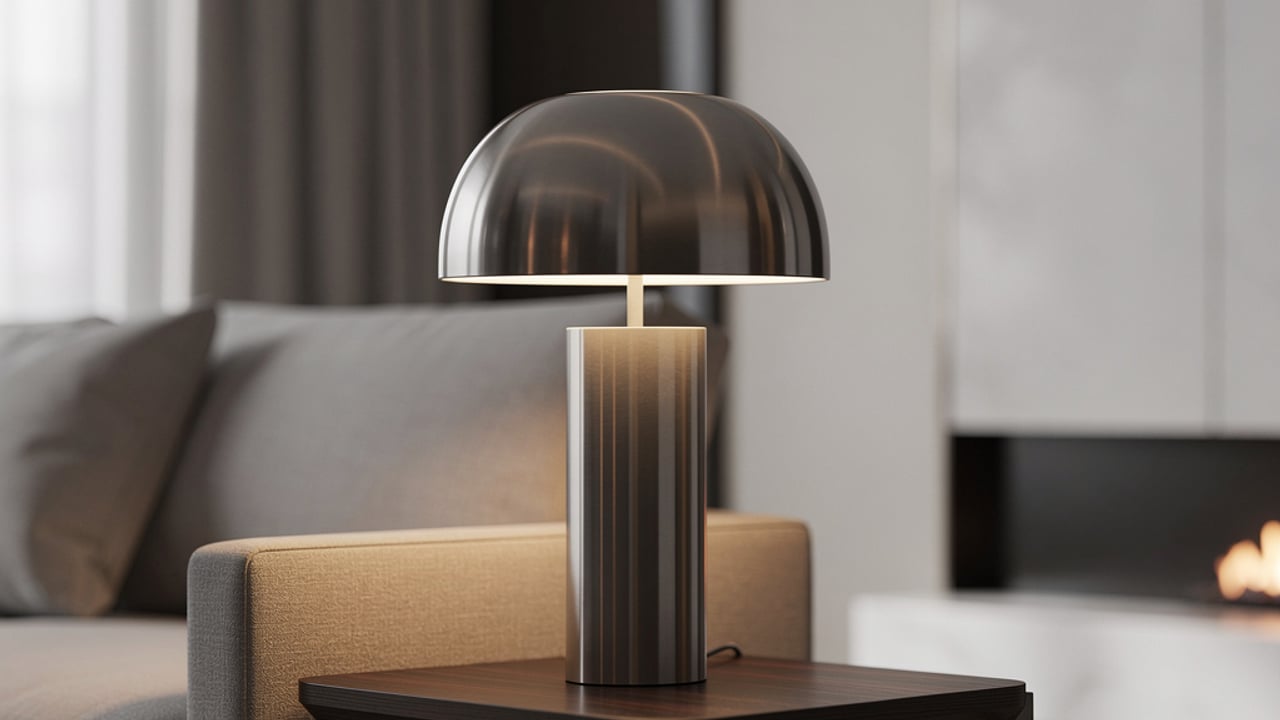
CATEGORY · METAL LAMP

The Metal Lamp in Mid-Century Design

Light as sculpture, structure as statement.

From Milanese ateliers to Scandinavian studios, the metal lamp became the defining object of post-war interior culture. Our catalogue presents rigorously authenticated examples, selected for historical significance, material integrity, and enduring formal intelligence.

mid-century·designs

metal lamp

ESSAY · 01

Work & Context

mid-century·designs

A Brief History of the metal lamp

The decades between 1950 and 1980 produced a transformation in how designers approached artificial light. The metal lamp emerged not merely as a functional object but as a vehicle for expressing the era’s faith in industry, geometry, and material honesty. Aluminium, brass, spun steel, and anodised alloys replaced the ornamental ceramics and fabric shades of earlier domestic interiors. Manufacturers in Italy, Scandinavia, and Germany understood that the fixture itself could carry aesthetic weight equal to any chair or cabinet.

In Italy, firms such as Arteluce and Stilnovo commissioned architects and industrial designers to rethink the standing and wall-mounted lamp from first principles. Gino Sarfatti’s output alone constitutes a taxonomy of structural invention: articulated arms, counterweighted stems, and conical reflectors that translated engineering logic into domestic poetry. In Scandinavia, Poul Henningsen’s earlier multi-shade philosophy continued to influence a generation of designers working in lacquered steel, while Danish workshops refined the relationship between diffused light and machined form.

By the 1970s, the vocabulary had expanded to include high-gloss enamelled finishes, tension-wire suspension systems, and the early influence of Italian Radical Design. The metal lamp of this later period often carries an almost architectural severity — objects that occupy space rather than simply illuminate it.

Notable examples of the metal lamp

Several objects within our current catalogue represent the form at its most resolved. Gino Sarfatti’s Model 1063 in spun aluminium remains one of the most cited examples of post-war Italian lighting design, its reflector geometry calibrated to distribute light without visible glare. Equally significant are floor-standing examples by Vico Magistretti, whose Atollo concept — realised in lacquered aluminium — distilled the standing lamp to hemisphere, cylinder, and cone.

From Germany, the Bauhaus-adjacent tradition produced articulated workshop lamps that crossed from industrial into domestic use with minimal revision. These pieces speak directly to the functionalist argument: that resolved engineering and resolved aesthetics arrive at the same destination.

Where to find an authentic metal lamp

Authenticity in this category depends on several convergent factors: original patina on brass or aluminium components, intact manufacturer’s labels or stamps, period-correct wiring (often replaced for safety but documented as such), and provenance tracing the object to its first owner or original point of retail. Our acquisition team works with specialist dealers in Milan, Copenhagen, and Amsterdam to source examples that satisfy these criteria before any piece enters the catalogue.

Each metal lamp listed on mid-centurydesigns.com is accompanied by a condition report, provenance summary, and where available, original manufacturer documentation. We do not list reproductions or later reissues under vintage classifications.

Caring for your metal lamp

Proper stewardship of a metal lamp from this period requires restraint. Lacquered surfaces should be wiped only with a dry microfibre cloth; solvent-based cleaners will lift or cloud original factory finishes. Bare aluminium and brass components may be stabilised with a light application of Renaissance Wax, which archival conservators use on museum objects. Wiring should be assessed by a qualified electrician familiar with vintage fixtures before use; original cables are preserved where possible but are rarely safe for live operation without inspection.

Storage in direct sunlight accelerates oxidation on anodised surfaces and can cause discolouration in enamelled finishes. A controlled interior environment — moderate humidity, indirect light — is the standard recommendation for any piece of collector-grade significance.

FAQ · 02

Frequently asked about metal lamp

5 Answers

01
How do I verify the age of a vintage metal lamp?
Authentication relies on cross-referencing manufacturer stamps, cable and plug typology, finish characteristics, and stylistic details against documented period catalogues. Provenance records — invoices, auction histories, or exhibition labels — provide additional corroboration. Our team provides condition and provenance reports with every listed piece, and we welcome independent appraisal requests from prospective buyers.
02
Are original electrical components safe to use?
Original wiring in lamps from the 1950s through 1970s frequently does not meet current safety standards. Insulation becomes brittle over decades and connections may be degraded. We recommend inspection by a qualified electrician before operating any vintage fixture. Rewiring with period-appropriate cloth-braided cable preserves the aesthetic while restoring safe function, and this work is documented in our condition reports.
03
Which designers command the highest prices in this category?
Gino Sarfatti, Angelo Lelli for Arredoluce, Vico Magistretti, and Poul Henningsen consistently achieve the strongest results at auction and in private sales. Rarity of model, condition of original finish, and completeness of provenance are the primary value drivers. Lesser-known designers from the same workshops can represent significant value when documentation is strong.
04
What distinguishes Italian from Scandinavian lighting design of the period?
Italian production of the 1950s and 1960s favoured sculptural audacity, expressive joinery, and a willingness to treat the fixture as an object of visual display. Scandinavian work of the same decades tended toward optical precision and material understatement, prioritising the quality of emitted light over the visual prominence of the object itself. Both traditions are well represented in our catalogue.
05
Do you offer international shipping for fragile lighting pieces?
Yes. All lighting pieces are packed by specialist art handlers using custom-formed foam inserts and double-wall crating. Insurance is included at declared value for every shipment. We work with freight partners experienced in handling museum-grade objects across European, North American, and Asia-Pacific destinations. Delivery timelines and crating costs are confirmed at point of purchase.

GLOSSARY · 03

Related Terms

7 Entries

Arteluce
Milanese lighting manufacturer founded by Gino Sarfatti in 1939. Arteluce became the primary vehicle for Sarfatti's prolific output and set the standard for design-led Italian lighting production through the 1970s. The firm's archive is a foundational reference for mid-century lamp scholarship.
Anodising
An electrochemical process that thickens the natural oxide layer on aluminium, increasing corrosion resistance and allowing controlled pigmentation. Widely adopted in mid-century lamp production, anodised finishes are identifiable by their characteristic translucent depth and resistance to conventional polishing.
Stilnovo
Italian lighting manufacturer active from 1946, producing work by designers including Joe Colombo and Bruno Gatta. Stilnovo pieces are distinguished by refined brass hardware, quality diffusers, and a consistent formal elegance that bridges artisanal and industrial production methods.
Bauhaus
German design school operating from 1919 to 1933, whose functional aesthetic and machine-age philosophy exerted sustained influence on post-war European product and lighting design. Bauhaus-derived principles — geometric form, honest material expression — underpin much mid-century lamp vocabulary.
Renaissance Wax
A microcrystalline wax formulated by the British Museum's conservation laboratory in the 1950s. Used by conservators on metal, painted, and lacquered surfaces to provide a stable, reversible protective layer without altering surface appearance or accelerating deterioration.
Italian Radical Design
A design movement of the late 1960s and 1970s centred in Florence and Milan, rejecting functionalist orthodoxy in favour of conceptual provocation. Groups including Superstudio and Archizoom produced lamp and furniture work that challenged conventions of use, material, and domestic meaning.
Spun Aluminium
A metalworking technique in which a rotating disc of aluminium is shaped over a mandrel to produce smooth, hollow forms — typically cones, hemispheres, or cylinders. The process was central to mid-century lamp shade production, allowing precise geometric forms at moderate manufacturing cost.