CATEGORY · GRANDFATHER CLOCKS

Monumental Timekeepers of the Modern Era

Floor clocks as sculpture, precision, and domestic architecture

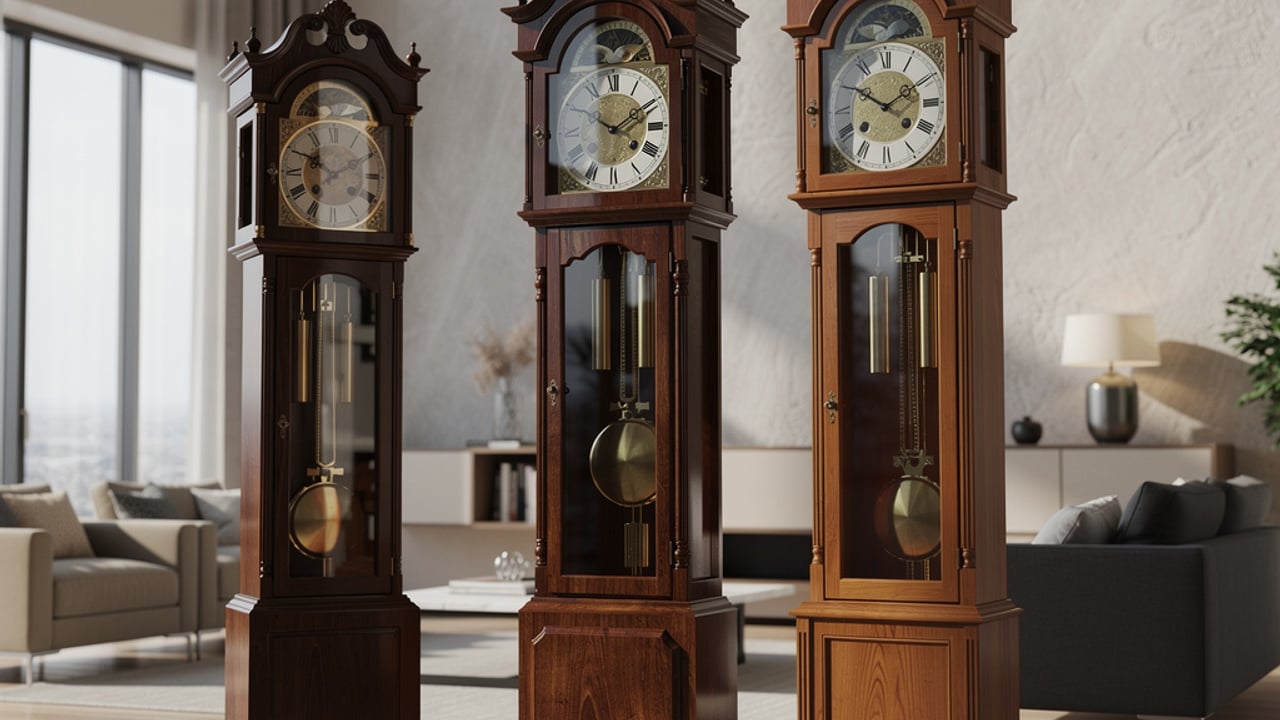
From Scandinavian workshop floors to Milanese interiors, the tall-case clock underwent a quiet reinvention between 1950 and 1980. Each piece offered here represents a verified chapter in that story — functional, formidable, and irreplaceable.

mid-century·designs

grandfather clocks

ESSAY · 01

Work & Context

mid-century·designs

A Brief History of grandfather clocks

The tall-case clock — the form the English-speaking world eventually codified as grandfather clocks — reached its design apex long before the mid-twentieth century. Yet the postwar decades produced a distinct and underappreciated chapter. Scandinavian cabinetmakers, working in teak and rosewood, reinterpreted the vertical case as an exercise in restraint. German movement manufacturers at firms such as Hermle and Kieninger refined their mechanical calibres to a pitch of reliability that earlier centuries could not match. The result was a body of work that sits at the intersection of horological tradition and modernist discipline.

The longcase form had always been as much furniture as instrument. Its proportions — typically between 1.8 and 2.3 metres in height — demanded that the maker think architecturally. In the postwar period, that architectural thinking aligned naturally with the clean geometries then reshaping domestic interiors across Europe and North America.

Notable grandfather clocks of the Era

Several workshops produced pieces that now command serious attention among collectors. Danish cabinetmaker Johannes Hansen collaborated with movement suppliers to enclose precision eight-day calibres within cases of oiled teak whose joinery was as considered as any chest produced under Hans Wegner’s direction. In Germany, the Black Forest tradition was not abandoned but edited: ornamental excess gave way to cases in walnut or lacquered oak that could occupy a modernist interior without apology.

American production followed a parallel but distinct trajectory. Howard Miller, working from Zeeland, Michigan, commissioned case designs that reflected the influence of Herman Miller’s broader design culture — spare forms, quality veneers, movements sourced from established European suppliers. Pieces from this period represent some of the most accessible authentic grandfather clocks available to collectors entering the market today.

Where to Find Authentic grandfather clocks

Provenance is the first discipline of collecting. Authentic grandfather clocks from the 1950–1980 period should be accompanied by documentation of the movement maker, the case workshop, and — where possible — the original retail context. Estate records, original receipts, and period catalogues all contribute to a defensible attribution.

At mid-centurydesigns.com, every piece undergoes examination by a specialist before listing. Movement condition, case integrity, pendulum authenticity, and dial originality are assessed individually. A clock offered without its original pendulum rod and bob, or with a replacement dial, is listed with those conditions stated explicitly. There are no composite pieces presented as unaltered examples.

Caring for Your grandfather clocks

A mechanical longcase movement requires servicing at intervals of eight to ten years under normal domestic conditions. The oil used to lubricate the gear train and escapement degrades over time regardless of how often the clock runs; a movement left unserviced too long will suffer accelerated wear to its pivots and bushings. Any competent horological conservator can perform this work without diminishing the piece’s integrity or value.

Case care follows the material. Teak and rosewood cases benefit from an annual application of a quality furniture wax — never silicone-based products, which penetrate the grain and complicate future restoration. Lacquered cases should be cleaned only with a dry microfibre cloth. The pendulum suspension spring, a small ribbon of tempered steel at the movement’s top, should be inspected during each service; it is the most common point of mechanical failure in otherwise sound movements.

FAQ · 02

Frequently asked about grandfather clocks

5 Answers

01
How do I verify that a vintage grandfather clock has its original movement?
Request the movement's serial number and cross-reference it with the manufacturer's production records, many of which have been digitised by horological societies. A replacement movement will typically show inconsistencies in case-mounting hardware, pendulum length, and beat rate relative to the original specification. A qualified clockmaker can confirm authenticity during a pre-purchase inspection.
02
What movement makers are most associated with quality mid-century tall-case clocks?
Hermle (West Germany), Kieninger (Black Forest), and Franz Hermle & Sohn produced the movements found in the majority of quality European longcase clocks from this period. In North America, movements were frequently sourced from these same German suppliers. The calibre number, stamped on the movement plate, identifies the maker and model precisely.
03
Does running a vintage clock continuously affect its long-term condition?
Continuous operation is generally preferable to intermittent use, provided the movement has been recently serviced. A clock that runs regularly keeps its oil distributed across the gear train. Stopping and restarting a poorly lubricated movement is more damaging than sustained running. Confirm with a conservator that the movement is service-ready before setting it in continuous operation.
04
Are chiming movements more difficult to service than time-only calibres?
Chiming movements — particularly those with Westminster, Whittington, or St Michael sequences — contain additional gear trains and hammer assemblies that require separate adjustment. Service time and cost are proportionally higher. However, chiming calibres from Hermle and Kieninger are well documented and parts availability remains good, making competent restoration entirely achievable.
05
What case woods are most commonly found in mid-century Scandinavian longcase pieces?
Teak dominated Scandinavian production through the 1950s and into the 1960s, followed by a shift toward rosewood as teak supplies tightened. Some Danish workshops used oak with oil finishes as an alternative. Cases are typically solid-wood construction rather than veneered, which contributes to their structural longevity and makes sympathetic restoration more straightforward.

GLOSSARY · 03

Related Terms

7 Entries

Hermle Calibre
A movement designation used by Franz Hermle & Sohn of Gosheim, Germany. Hermle calibres are identified by a number-slash-beat combination stamped on the back plate, providing precise identification of gear train configuration, power reserve, and chime capability.
Anchor Escapement
The recoil or deadbeat mechanism by which a clock's gear train is regulated. The anchor, shaped roughly like a ship's anchor, engages the escape wheel at two pallets. Most quality mid-century longcase movements employ a deadbeat variant that reduces recoil wear on the escape wheel teeth.
Pendulum Bob
The weighted disc at the base of the pendulum rod whose mass and position determine beat rate. In quality mid-century movements the bob is typically lenticular in profile, fabricated in brass or zinc alloy, and adjustable via a threaded rating nut for fine regulation.
Teak (Tectona grandis)
A tropical hardwood that defined the visual character of Scandinavian furniture production from roughly 1950 to 1970. Its high natural oil content makes it resistant to moisture and stable under central heating — properties that suited it to case construction requiring dimensional precision.
Johannes Hansen Workshop
A Copenhagen cabinetmaking firm closely associated with Hans Wegner's production work. The workshop's stringent joinery standards and material selection made it representative of the Danish approach to furniture as craft object, standards that extended to collaborative clock-case commissions.
Longcase Movement
A weight-driven mechanical movement designed for vertical installation within an enclosed case. The case height accommodates the fall distance of the driving weights over a defined running period — typically eight days — and houses the pendulum at a length producing a one-second beat.
Howard Miller Clock Company
An American manufacturer founded in 1926 in Zeeland, Michigan, by Howard Miller, son of Herman Miller furniture company founder D.J. De Pree. The company imported and rehoused European movements in cases reflecting the modernist design sensibility of its parent company's broader output.