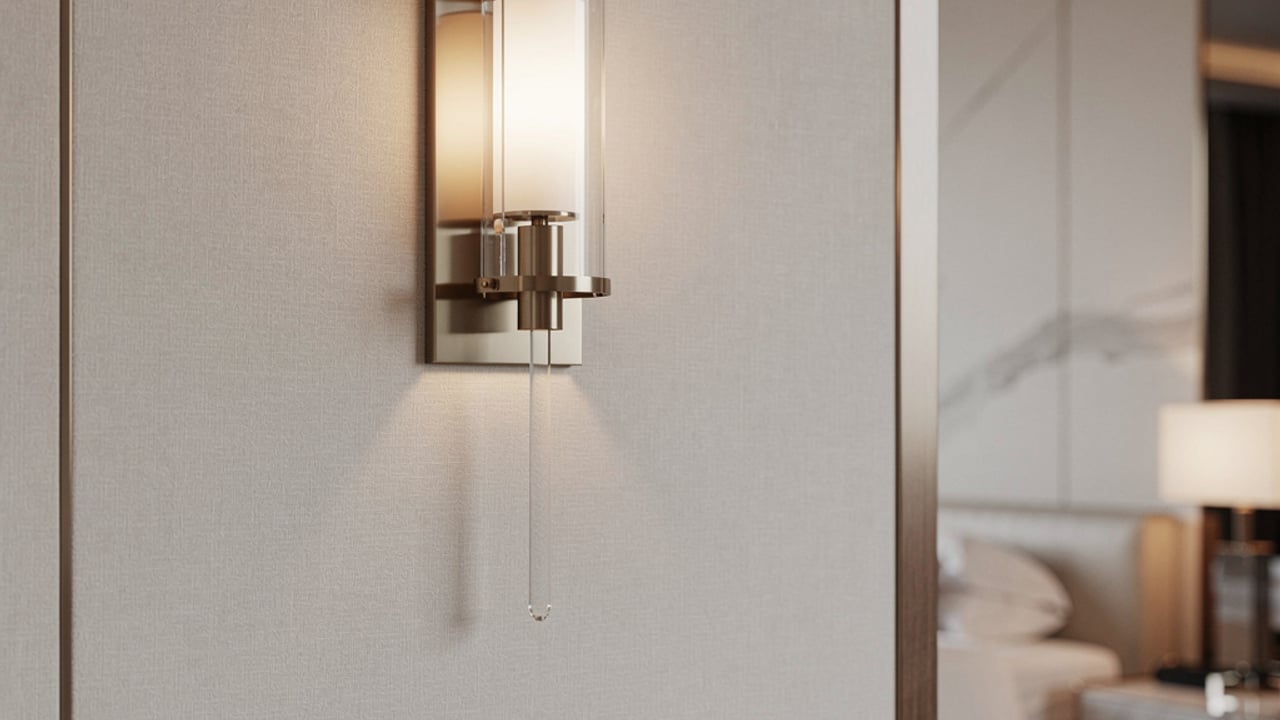
CATEGORY · WALL LAMP

The Authentic Vintage Wall Lamp

Light as architecture, fixture as sculpture.

From the studios of postwar Milan to the workshops of Scandinavian modernism, the wall-mounted sconce became one of the defining objects of the mid-century interior. Each piece in this collection is authenticated, catalogued, and offered with full provenance documentation.

mid-century·designs

wall lamp

ESSAY · 01

Work & Context

mid-century·designs

A Brief History of wall lamp Design, 1950–1980

The decades between 1950 and 1980 represent the most concentrated period of innovation in artificial lighting that the twentieth century produced. Architects and industrial designers, freed from wartime material restrictions and emboldened by new manufacturing processes, turned their attention to the domestic interior with singular focus. The wall lamp emerged not merely as a functional adjunct to ceiling lighting but as a considered architectural element — a means of sculpting space, modulating shadow, and articulating the plane of a wall.

In Italy, houses such as Arteluce and Stilnovo commissioned designers of the calibre of Gino Sarfatti and Franco Mebio to treat the sconce as they would a piece of sculpture: rigorously engineered, visually resolved, and capable of transforming an ordinary room into a composed environment. In Scandinavia, the tradition was quieter but no less precise, favouring natural materials and diffused light that softened the long Nordic winter.

The period also witnessed a transatlantic exchange. American manufacturers, responding to the influence of European exhibitions and the Museum of Modern Art’s design programmes, began producing work that synthesised European formal rigour with the optimism of postwar consumer culture. The result was a body of objects whose quality and ambition remain unsurpassed.

Notable wall lamp Designs of the Era

Certain objects define the canon. Gino Sarfatti’s articulated arm models for Arteluce — produced throughout the 1950s and into the 1960s — demonstrate an engineer’s command of pivoting mechanisms combined with a sculptor’s sensitivity to proportion. The brass and lacquered-metal constructions of the Italian Stilnovo atelier achieved a refinement of finish that later mass production has never convincingly replicated.

In Germany, the Bauhaus legacy persisted through manufacturers such as Tecnolumen, whose collaborations with Wilhelm Wagenfeld produced restrained, functional pieces of extraordinary elegance. Danish designers, working within the tradition established by Poul Henningsen, prioritised the quality of emitted light above all formal considerations — a philosophical position that yielded objects of calm, lasting beauty.

Each of these represents an identifiable moment in the history of design, and collecting them is, in a meaningful sense, collecting that history.

Where to Find Authentic wall lamp Examples

Authenticity is the central question in this market. The decades covered by this catalogue generated enormous quantities of lighting, and reproduction and reissue exist alongside genuine period examples in numbers that can mislead even experienced collectors. Mid-century-designs.com maintains a curatorial standard that requires physical examination of each object, cross-referencing against period catalogues, and — where applicable — accompanying documentation of provenance.

Each listing includes detailed photography of maker’s marks, wiring condition, and any restoration work undertaken. Our network of specialist restorers operates to museum-grade standards, preserving original patina while ensuring electrical safety compliance for contemporary use.

Caring for Your wall lamp After Acquisition

Original mid-century lighting requires attentive stewardship. Brass and aluminium surfaces should be cleaned only with dry or very lightly dampened cloths; abrasive compounds will remove the patina that constitutes a significant part of the object’s historical value. Rewiring, when necessary, should be entrusted to an electrician familiar with vintage fixtures, using period-appropriate cable where visible wiring forms part of the design.

Bulb selection matters considerably. Many period designs were calibrated for incandescent sources of specific wattages and colour temperatures. The substitution of LED equivalents, while electrically sensible, may alter the quality of light in ways that compromise the designer’s original intention. Specialist suppliers now offer LED sources matched to vintage colour temperatures, and we recommend consulting these before making substitutions.

FAQ · 02

Frequently asked about wall lamp

5 Answers

01
How do I verify that a vintage wall lamp is an authentic period piece and not a later reissue?
Examine maker's marks, casting quality, and wiring construction. Period pieces typically show hand-finishing marks, original fabric-covered cable, and patina consistent with age. Cross-reference the model against period manufacturer catalogues. Reissues, while sometimes authorised, use modern components and lack the material evidence of age present on originals.
02
Is it safe to use an original mid-century wall lamp in a contemporary home?
Yes, provided the fixture has been inspected and, where necessary, rewired by a qualified electrician. Original wiring insulation degrades over decades and should not be trusted without professional assessment. The structural and mechanical components of well-made mid-century lighting are generally robust and require only cleaning and occasional lubrication of moving parts.
03
Which designers produced the most collectible examples during the 1950–1980 period?
Gino Sarfatti for Arteluce, Serge Mouille in France, Poul Henningsen for Louis Poulsen, and Angelo Lelli for Arredoluce are among the most consistently sought-after names. Italian manufacturers Stilnovo and Fontana Arte also produced significant bodies of work that command sustained collector attention in the current market.
04
What is a reasonable budget for acquiring a genuine mid-century designer sconce?
Entry-level authenticated pieces by minor manufacturers or unsigned studio work begin around £400–£800. Work by named designers from major houses — Sarfatti, Mouille, Henningsen — ranges from £1,500 into five figures for rare models in exceptional original condition. Condition, completeness of original components, and provenance documentation all affect valuation significantly.
05
Does restoration affect the value of a vintage lighting piece?
Sympathetic restoration — rewiring, replacement of missing hardware with period-correct components, careful cleaning — generally preserves or supports value. Insensitive restoration, including repainting, polishing of original patina, or substitution of non-original shades, diminishes both historical integrity and market value. Documentation of any restoration work undertaken is considered best practice and should accompany the object.

GLOSSARY · 03

Related Terms

7 Entries

Arteluce
Milanese lighting manufacturer founded by Gino Sarfatti in 1939. Produced some of the most rigorously designed luminaires of the postwar period. Sarfatti's engineering-led approach to light diffusion and mechanical articulation defined Italian modernist lighting for two decades.
Stilnovo
Italian lighting house active from the late 1940s through the 1970s, based in Milan. Known for refined brass and enamelled-metal constructions combining technical precision with decorative restraint. Works are catalogued and frequently appear in major auction house lighting sales.
Patina
The surface alteration — oxidation, discolouration, or wear — that accumulates on metal and other materials over time. In the context of vintage objects, patina constitutes evidence of age and authenticity. Its preservation is central to responsible conservation practice and collector valuation.
Bauhaus
German design school founded in Weimar in 1919 by Walter Gropius, closed under National Socialist pressure in 1933. Its doctrine of functional form, rejection of ornament, and integration of craft with industrial production remained a foundational influence on mid-century European design.
Serge Mouille
French designer and silversmith (1922–1988) whose sculptural lighting objects, produced in small numbers from his Paris atelier during the 1950s, are among the most recognisable works of postwar French design. Characterised by organic, insect-like forms in matte black lacquered aluminium.
Provenance
The documented history of an object's ownership and origin. In the vintage market, robust provenance — receipts, exhibition records, period photographs — provides evidence of authenticity and supports valuation. Absence of provenance does not imply inauthenticity but increases the weight of physical examination.
Fontana Arte
Milanese manufacturer established in 1932 under the artistic direction of Gio Ponti. Specialised in glass and crystal lighting of exceptional refinement. Work from the 1950s and 1960s is considered canonical in Italian design history and commands consistent collector demand.