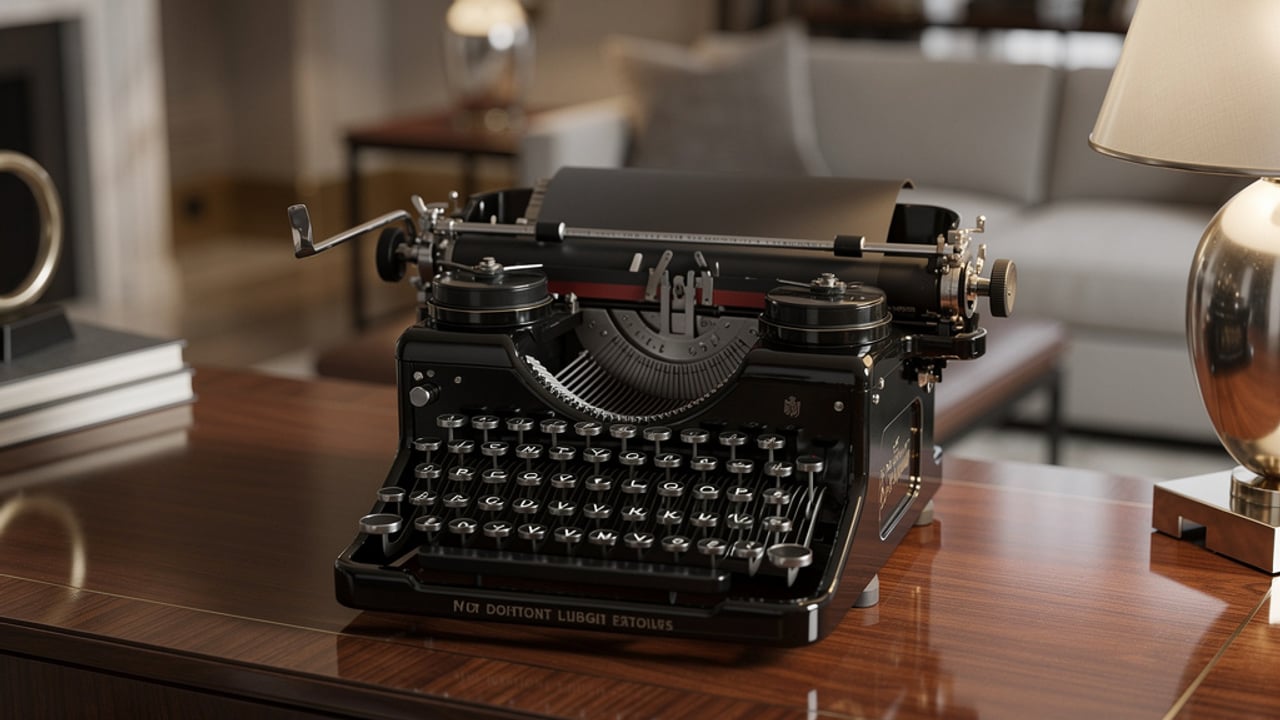
A Brief History of typewriter old
The category we designate as typewriter old encompasses mechanical writing instruments produced between roughly 1950 and 1980 — a period that witnessed both the refinement of mid-century industrial aesthetics and the first tremors of digital displacement. These decades produced machines of remarkable formal clarity: die-cast aluminium housings, considered colour palettes drawn from the same sensibility that shaped automotive and domestic appliance design, and typefaces cast in steel with a precision few modern objects match.
Manufacturers such as Olivetti, Hermes, and Imperial understood the machine as a designed object, not merely a functional tool. Ettore Sottsass’s work for Olivetti in particular elevated the category into the domain of cultural artefact. The Valentine, launched in 1969, announced itself as a statement of intent — portable, chromatic, and thoroughly of its moment. Yet the quieter, less celebrated machines of the same era carry equal design intelligence in a more restrained register.
Provenance matters when acquiring any typewriter old from this period. Machines that retain original cases, platens with minimal wear, and intact decals command significantly higher attention from serious collectors. Service history, while rarely documented, can sometimes be traced through manufacturer stamps applied during authorised repair.
Notable typewriter old of the Era
Within the broader field of typewriter old production, certain models define the period with particular authority. The Olivetti Lettera 32, the Hermes 3000, the Underwood Champion, and the Adler Tippa S each represent distinct national design traditions operating at the same historical moment. The Hermes 3000, manufactured in Yverdon, Switzerland, is regarded by many as the apogee of portable typewriter engineering: its segment-shift mechanism, pebbled seafoam casing, and notably light touch distinguish it across six decades.
The Underwood tradition — rooted in American manufacturing culture — produced machines of greater visual mass, their black enamel and chrome trim legible as objects of industrial ambition. Collectors who prioritise formal variety often maintain examples from both the Swiss and American lineages.
Where to Find Authentic typewriter old
Authentication is the primary discipline when acquiring any typewriter old at the collector level. Mid-century-designs.com sources directly from documented private collections, estates, and specialist dealers across Western Europe and North America. Each machine is examined for originality of components, consistency of patina, and mechanical function before listing.
Serial number databases maintained by collector communities allow precise dating of most major manufacturers’ output. Cross-referencing a machine’s serial number against known production records is a standard first step in any serious acquisition process. Beware of machines with replaced platens presented as entirely original, a substitution that is common and not always disclosed.
Caring for Your typewriter old
The long-term preservation of a typewriter old requires modest but consistent attention. Type slugs should be cleaned periodically with a soft brush and isopropyl alcohol to prevent ink accumulation from affecting print quality. Platens made from natural rubber — common in machines of this era — benefit from occasional treatment with a rubber conditioner to retard further hardening.
Storage in stable temperature and humidity conditions prevents the oxidation of exposed metal components and the degradation of decals. Original cases, where present, provide adequate protection for display storage. Machines intended for active use should be serviced by a technician familiar with mid-century mechanical systems; contemporary repair manuals are available for most significant models and remain the authoritative reference for adjustment tolerances.