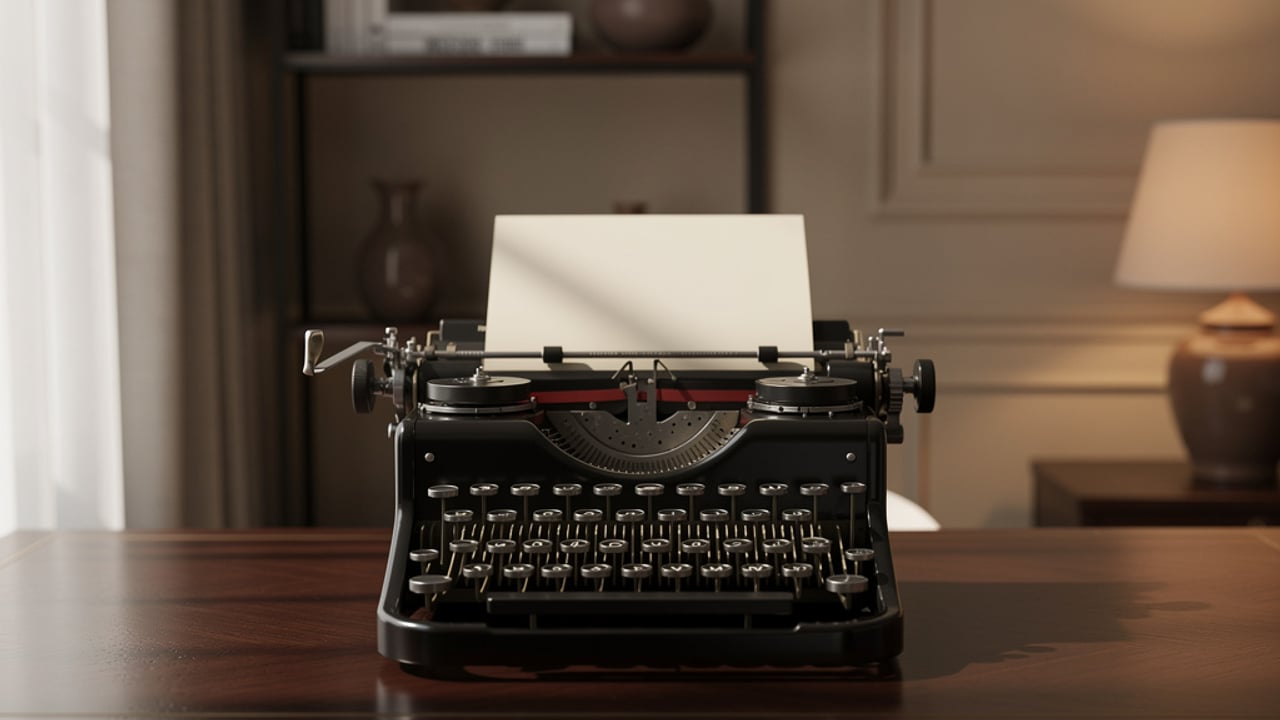
A Brief History of old typewriter
The mid-century decades — roughly 1950 through 1980 — represent the apex of industrial typewriter design. Manufacturers such as Olivetti, Hermes, and Adler competed not merely on mechanical grounds but on the terrain of industrial aesthetics, commissioning designers of international standing to rethink the form entirely. The result was a generation of machines whose sculptural coherence has rarely been equalled in consumer object design. To encounter a well-preserved old typewriter from this period is to engage with a resolved argument about the relationship between function and appearance.
The postwar economic expansion created conditions in which typewriter manufacturers could invest seriously in design research. Ettore Sottsass’s work for Olivetti stands as the signal example: his Valentine of 1969 repositioned the old typewriter as a portable cultural statement, rendered in ABS plastic in colours drawn from graphic design rather than the grey and green of the office. These decisions were not superficial; they reflected a broader discourse about democratising access to writing tools.
Notable old typewriter of the Era
Several models have achieved a canonical status that collector demand continues to affirm. The Olivetti Lettera 32, introduced in 1963 and designed by Marcello Nizzoli, is perhaps the most formally accomplished portable of the twentieth century. Its die-cast aluminium housing and precisely weighted key action represent industrial manufacturing at its most considered. The Hermes 3000, produced in Switzerland from 1958, offers a contrasting example: larger, more robustly constructed, its seafoam-green casing and curved silhouette embody a distinctly European industrial idiom. Each old typewriter of this calibre arrived with a designed case, a designed ribbon system, and often a designed typeface — the machine was conceived as a total object.
German manufacturers contributed the Adler Tippa and the Triumph Gabriele series, machines whose engineering precision reflects the broader reputation of postwar West German industry. Collectors attending to condition should note that the mechanical complexity of these objects makes professional servicing essential before acquisition.
Where to Find Authentic old typewriter
Authenticity verification for an old typewriter requires attention to several converging lines of evidence. Serial number records, where manufacturer archives survive, permit precise dating. Original decals, platen knobs, and ribbon spools that have not been replaced contribute substantially to collector value. Condition reports should specify whether the escapement mechanism functions within its original tolerances and whether the type slugs retain their original faces without wear or unauthorised substitution.
Mid-century-designs.com works with a network of specialist restorers and archivists to provide documentation commensurate with the seriousness of each acquisition. Provenance, where traceable — correspondence, estate records, institutional ownership — is noted in individual listings. The serious collector of an old typewriter should expect the same rigour of documentation applied to furniture or ceramic objects of equivalent period and quality.
Caring for Your old typewriter
Preservation of a vintage old typewriter demands an understanding of its material constitution. The die-cast aluminium and pressed steel housings common to mid-century portables are susceptible to surface oxidation if stored in humid environments; silica gel packs within a closed case mitigate this effectively. Internal mechanisms benefit from periodic application of appropriate clock oil at pivot points — modern petroleum-based lubricants are generally contraindicated, as they attract dust and can compromise the precision tolerances of older mechanisms.
Ribbons remain available from specialist suppliers in both fabric and film formats; using a correct ribbon tension ensures that the type impression remains even and does not stress the escapement. The platen — the rubber cylinder against which type strikes — hardens with age and benefits from occasional treatment with a platen rejuvenator compound. A machine maintained with this degree of attention will remain in full mechanical function for decades further, which is itself a form of fidelity to the intentions of its original designers.