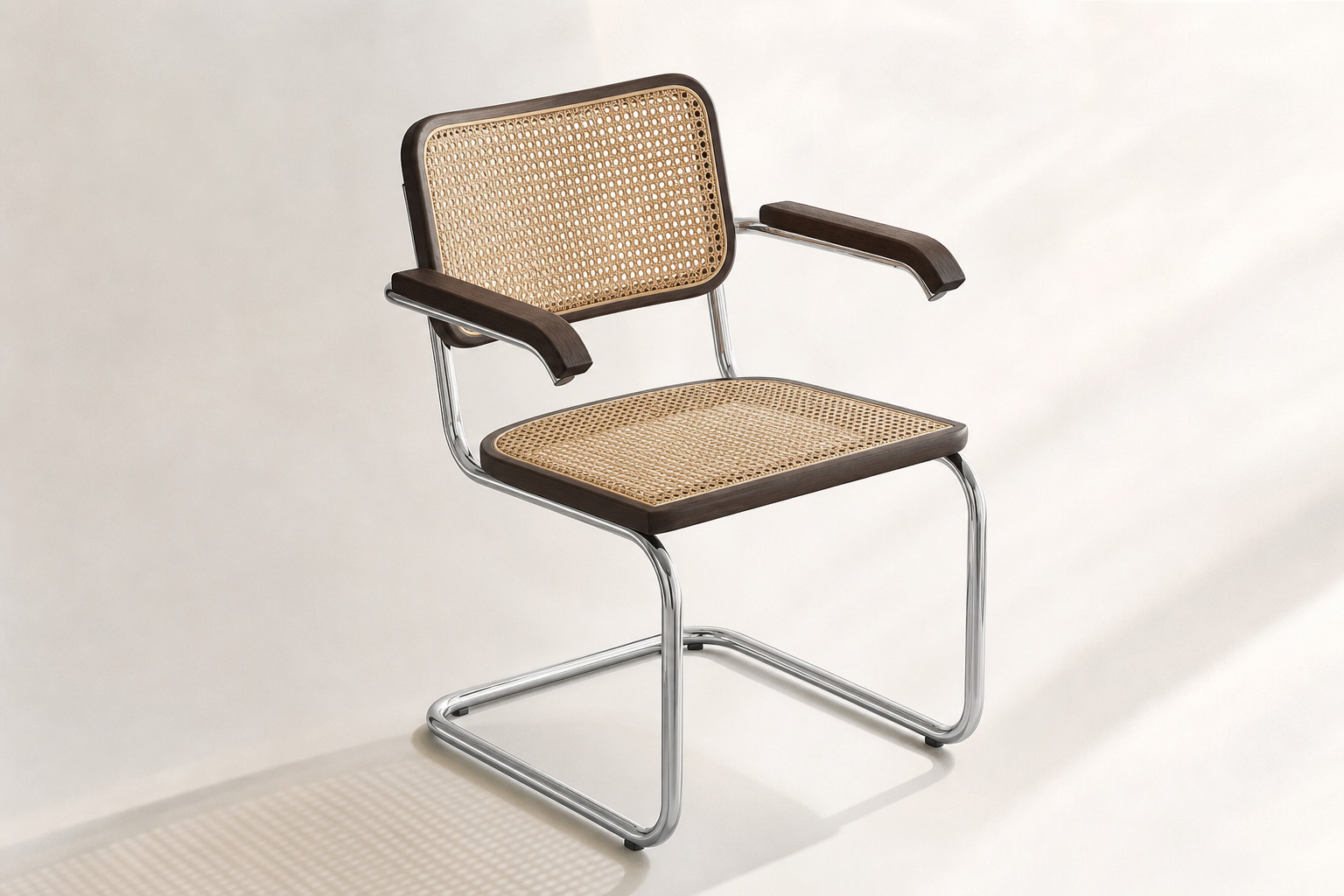
The S 64 becomes clearer once you read it as a deliberate material hybrid
Many listings jump straight to the word Cesca when describing the Thonet S 64. The reliable sources are more exact. Thonet states that Marcel Breuer designed the S 32 and S 64 in Berlin in 1928 and that both models have been produced since 1930. The Victoria and Albert Museum records its collection example as Model B32 and describes it very concretely as tubular steel with bent beechwood and caning. Knoll adds that the design was originally known as the B32. Taken together, those three facts are far more useful for buyers than a vague appeal to icon status.
In the context of Bauhaus and the wider shop, the S 64 is a strong example of why collectible furniture should be read through construction as much as through silhouette. The value is not in the name alone, but in the way the object’s materials and model history can be checked.
The real point is the tension between cane tradition and tubular-steel modernity
Thonet describes the S 32 / S 64 family as a compelling combination of Vienna wickerwork and tubular steel. That pairing is the chair’s real intellectual core. The seat and back use wood frames and woven cane, clearly recalling older furniture traditions, while the supporting cantilever frame gives the chair its modern, elastic presence. The result is neither a nostalgic bentwood piece nor a cold machine object, but a carefully balanced hybrid.
The V&A makes that structure unusually easy to verify by describing seat and back panels of bent beechwood, filled with caning. On the vintage market, that matters because it gives you a checkable construction brief, not just a famous outline. Anyone evaluating an older S 64 should therefore look closely at tube dimensions, wood frames, cane quality, the transitions between wood and steel, and later repairs or re-caning.
S 64, B32 and Cesca are not random names but layers of model history
The most useful part of the source base is that the names differ, yet still fit together. Thonet now uses S 64 and identifies it as the version with armrests. Knoll frames the design historically as B32 and describes its cantilevered form. The V&A also uses Model B32. For collectors, that means older literature, auction catalogues and dealers may use different names without necessarily contradicting one another. Often they are simply pointing to different moments in the same design history.
That is why it is smarter to search not just for “Cesca chair” but also for B32, S 64 and Breuer/Thonet. Reading those names in parallel is one of the simplest ways to avoid confusing later retail language with earlier historical designation.
Even current Thonet dimensions can help assess historical plausibility
Thonet lists specific dimensions for the present S 64 V: 58 cm width, 82 cm height, 60 cm depth, 45 cm seat height and 67 cm armrest height. Figures like these are not a substitute for provenance, but they are practical when comparing later versions, restorations or suspiciously altered examples. If a chair deviates strongly in proportion, that is a reason to examine period, maker or intervention more closely.
That is the real value of the S 64 in a serious collecting context: it is not only photogenic, but unusually readable through sources. Thonet provides the production and typological logic, the V&A provides the precise material description, and Knoll anchors the historical designation B32. Together they offer a much better buying compass than the generic statement that the chair is simply “an icon.”