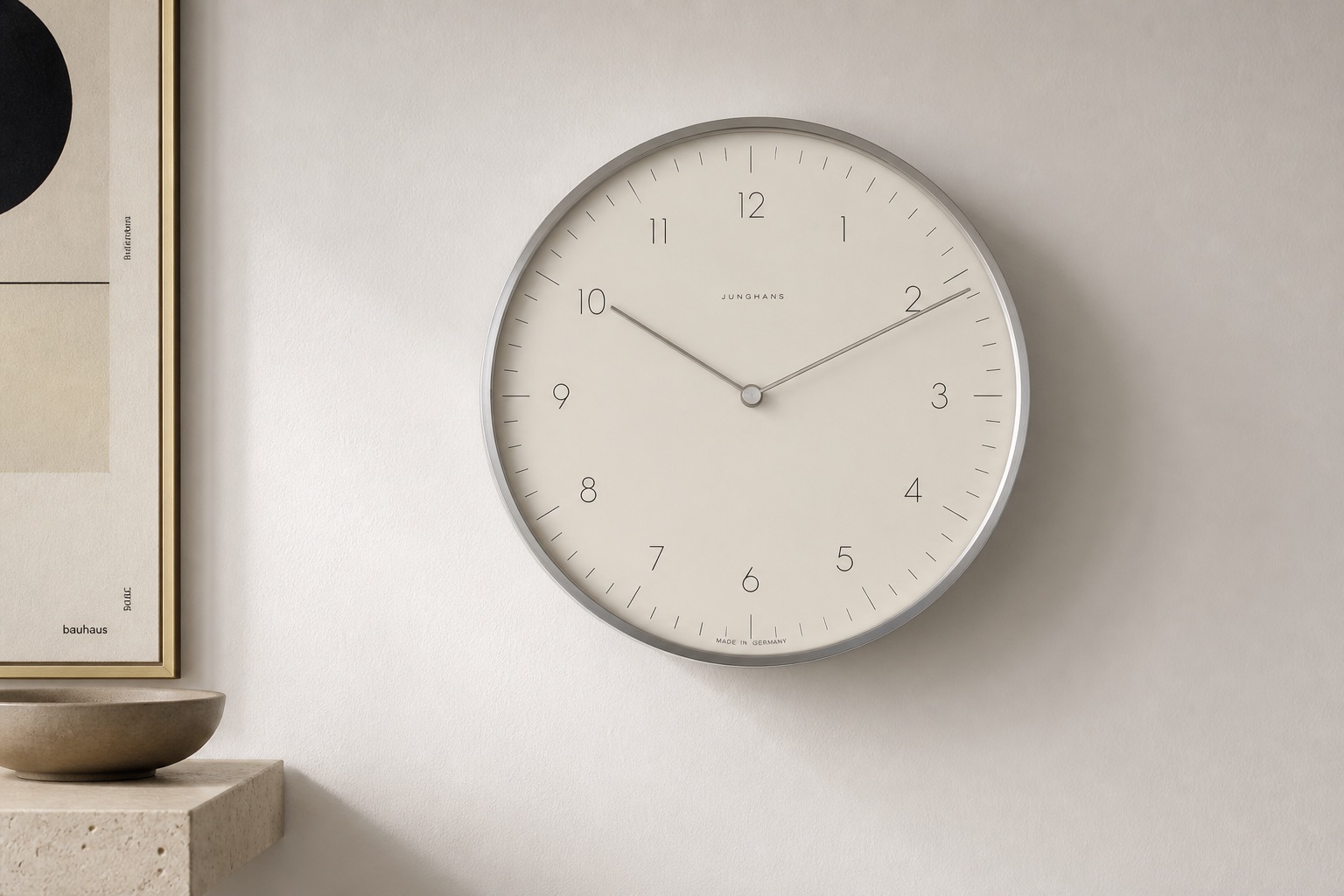
The Max Bill wall clock becomes most useful when it is treated as a specific Junghans typology
Many wall clocks are quickly marketed as “Bauhaus” or “Max Bill.” With the Max Bill wall clock, it is worth staying much closer to the documented sources. Junghans Vintage: Max Bill explains that Max Bill first designed a kitchen clock for Junghans in 1956, and that wall clocks followed around 1958/59. For buyers at mid-century·designs, that matters because the wall clock becomes legible not as a mood reference but as a historically distinguishable object type.
Anyone moving between Junghans clock, Max Bill kitchen clock, Bauhaus, and the main shop benefits from that precision. The Max Bill wall clock is not simply any reduced clock face with neat numerals; it is a documented Junghans product with a traceable history of movements, sizes, and case variants.
Junghans frames the current wall clock as a reading instrument, not just décor
The current product page Junghans Shop: max bill wall clock 22 cm is very clear about this. It says that Max Bill wall clocks are a “puristic statement” that combine “maximum simplicity” with “optimum readability.” The same page also mentions a satin-finish, diamond-coated aluminium housing on the narrow front ring.
That wording is especially useful in a shop context. It shifts attention away from the vague idea of a “beautiful design clock” and toward the concrete details buyers should inspect: bezel proportion, typographic clarity, hand shape, and whether the case really carries the intended restraint. In the Max Bill wall clock, strict readability is not a side effect; it is the point of the design.
The official Junghans manual shows how closely the present still follows the historic line
The official manual Junghans: wall and table clocks / max bill describes the wall and table clocks as one of the company’s most fascinating model series and states explicitly that it is “still produced in almost unchanged form today.” The text also presents Max Bill as a Bauhaus-trained designer who handled constructive clarity and precise proportions with unusual consistency.
For buyers, that is more than brand storytelling. It explains why present-day examples only feel convincing when they actually maintain that proportional discipline. A Max Bill wall clock does not live on patina alone; it lives on the precision with which numerals, ring, hands, and empty space work together.
For collectors, variant knowledge matters more than the blanket label “Max Bill”
This is where Junghans Vintage becomes especially valuable again. The page names three wall-clock versions: one chrome-plated model and two brass-case variants. It also distinguishes 30 cm and 24 cm formats, explains which versions were fitted with or without glass, and identifies the historic wall clocks with the electromechanical Junghans W285 movement.
That is the practical buying payoff. When evaluating an older example, attention should go beyond the familiar dial graphic toward the exact combination of diameter, case depth, bezel, glass, and movement. The sources make clear that the name Max Bill covers several distinguishable historic wall-clock types, and those differences are what determine authenticity, pricing, and classification.