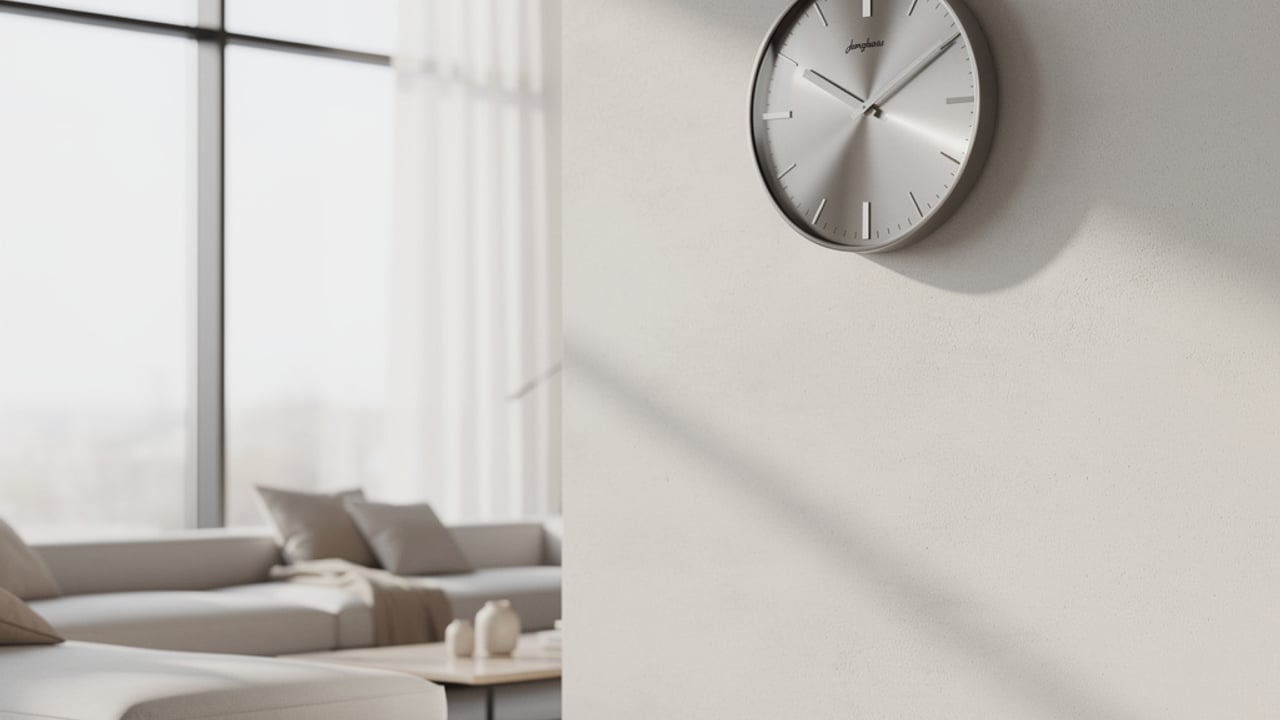
The Enduring Legacy of the junghans clock
Founded in 1861, Gebrüder Junghans Uhrenfabrik grew from a modest Württemberg workshop into one of the largest clock manufacturers in the world by the early twentieth century. Yet it was the postwar decades — roughly 1950 through 1980 — that produced the objects most coveted by today’s collectors. Under the influence of the Ulm School’s functionalist philosophy, the company’s designers stripped away ornament and privileged legibility, material honesty, and structural clarity. The result was a body of work that reads, in retrospect, as a precise index of West German industrial culture at its most self-assured.
The forms are characteristically restrained: wall-mounted discs in matte lacquer or anodised aluminium, desk units in moulded ABS with flush-set numerals, and the celebrated battery-operated movements that democratised precision timekeeping across the domestic interior. Collectors value these objects not merely as functional instruments but as embodiments of a specific design philosophy — one in which every radius, every typeface, and every surface treatment carried argumentative weight.
Identifying an Authentic junghans clock
Authentication requires attention to several converging details. Movement markings — typically stamped with calibre numbers on the brass plate — should correspond to published production records for the stated period. Case materials are equally diagnostic: genuine examples from the 1960s favour aluminium extrusions and injection-moulded thermoplastics rather than the resin composites that characterise later reproductions. Dial typography, particularly the proprietary sans-serif lettering used through the mid-1970s, should be crisp and flush-printed rather than applied as a separate layer. Any junghans clock offered without a traceable movement calibre warrants additional scrutiny before acquisition.
Provenance documentation — original retailer receipts, period catalogue appearances, or estate inventories — substantially reinforces authenticity and, where present, is reproduced in full within our listing records.
The Design Vocabulary of the junghans clock
The visual language of these timepieces owes a conscious debt to the HfG Ulm, the postwar design academy whose faculty included Otl Aicher and Hans Gugelot. The school’s systems-oriented thinking encouraged manufacturers in the region to regard product design as a discipline with its own internal logic rather than a cosmetic applied to engineering. The resulting aesthetic — rational, modular, typographically rigorous — is immediately legible in the wall and table clocks produced through the 1960s and early 1970s.
Hand design is particularly instructive. Baton and wedge-shaped hands in polished or brushed metal were preferred over the ornamental forms common to French and Italian contemporaries. Bezels, where present, were typically flush-mounted to eliminate visual interruption between face and surround. This commitment to surface continuity gives the best examples a sculptural quality that transcends their functional category.
Caring for Your junghans clock
Proper stewardship begins with understanding the movement type. Battery-operated calibres from the 1960s and 1970s require periodic cell replacement using zinc-carbon or alkaline equivalents of the correct voltage — substituting lithium cells can damage the coil assembly. Mechanical movements benefit from professional cleaning and lubrication on a ten-year cycle; use only horological-grade oils and avoid petroleum-based lubricants, which degrade brass components over time.
Case surfaces should be cleaned with a lint-free cloth lightly dampened with distilled water. Avoid solvents on lacquered aluminium, as they strip the anodised layer irreversibly. Storage in stable, low-humidity environments prevents the corrosion that most commonly diminishes collector value. A properly maintained junghans clock will retain both mechanical function and surface integrity across several generations of ownership.