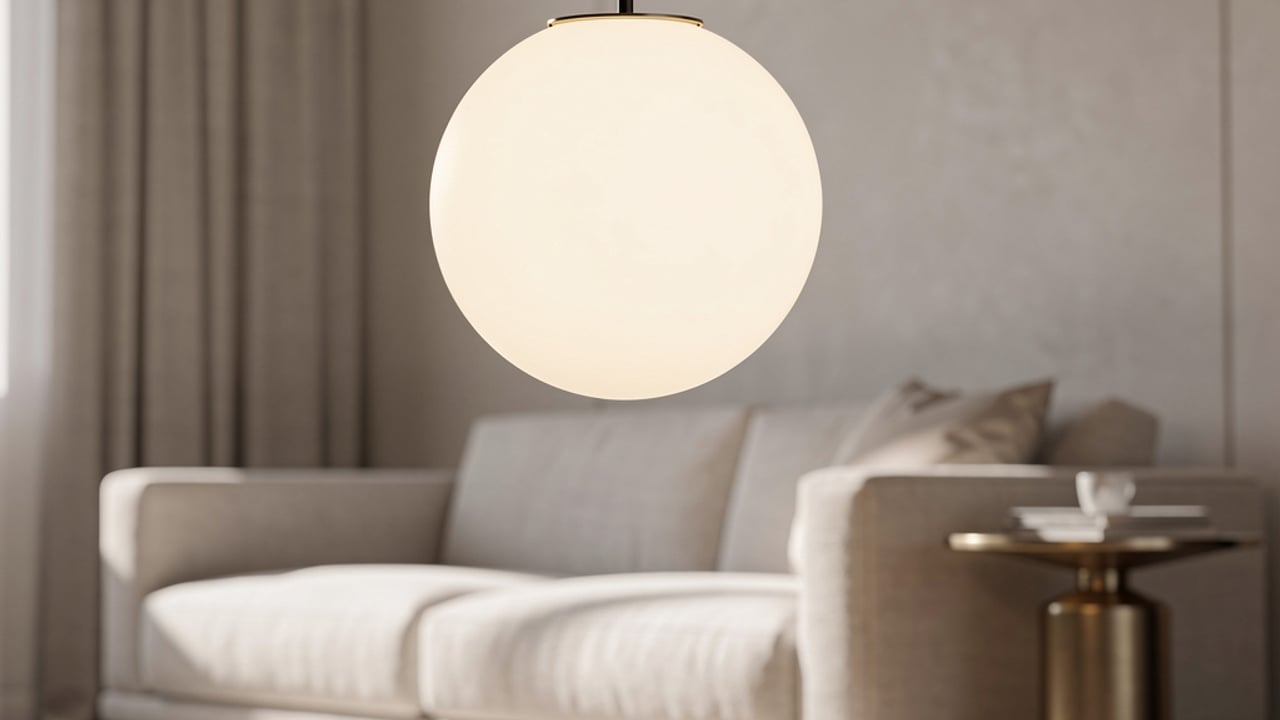
A Brief History of the ball lamp
The sphere has always carried philosophical weight — wholeness, infinity, perfection. When postwar designers began applying it to domestic lighting, the gesture was neither arbitrary nor merely decorative. The ball lamp emerged in the late 1950s as a direct consequence of new manufacturing freedoms: injection-moulded plastics, spun aluminium, and fibreglass allowed forms that earlier industrial processes could not sustain at scale.
Scandinavian and Italian studios led the initial experiments, but the format quickly became international. By the mid-1960s, spherical luminaires appeared in progressive interiors from Helsinki to São Paulo, signalling a deliberate break from the organic, biomorphic shapes of the previous decade. The globe was rational yet playful — an object equally at home in a Milanese apartment and a speculative film set.
Production peaked between 1965 and 1972, years that also saw the apex of Pop and Space Age aesthetics. Designers treated the ball lamp not merely as a source of light but as a three-dimensional manifesto: proof that utility and sculptural rigour were not incompatible ambitions.
Notable ball lamp Designs of the Era
Verner Panton’s output for Louis Poulsen and later for various Danish manufacturers established a vocabulary that younger studios throughout Europe rapidly absorbed. His approach — treating light diffusion as inseparable from outer geometry — influenced the entire category.
Achille and Pier Giacomo Castiglioni brought an equally rigorous, if more ironic, sensibility to Italian production. Their collaborations with Flos during this period produced work that balanced industrial logic with quiet wit. Concurrent Finnish production, particularly from studios orbiting Marimekko’s cultural orbit, tended toward softer translucency and warmer diffusion.
Japanese manufacturers, responding to both European influence and native Metabolism aesthetics, produced their own interpretations — often in lacquered paper or thin-walled ceramic — that have only recently attracted serious collector attention in Western markets.
Where to Find an Authentic ball lamp
Authentication demands attention to four primary indicators: material composition, production seams, hardware provenance, and period documentation. Original luminaires from this era carry maker’s marks, often stamped or moulded into the interior socket housing rather than applied externally.
At mid-centurydesigns.com, every piece listed in this category has passed a two-stage review: first by provenance specialists examining acquisition history, then by conservators assessing physical condition against known production records. Certificates of authenticity accompany each sale, and condition reports are available on request before any transaction is finalised.
Collectors should treat any listing without verifiable hardware provenance with appropriate caution. Reproductions proliferated rapidly after key patents lapsed in the 1980s, and surface ageing can be artificially induced.
Caring for Your ball lamp
Spherical diffusers — whether acrylic, opaline glass, or fibreglass — are sensitive to both chemical cleaning agents and prolonged UV exposure. For acrylic and plastic housings, a lightly dampened microfibre cloth removes surface deposits without inducing micro-abrasions that cloud the material over time.
Socket hardware should be inspected annually. Original ceramic lamp holders from the 1960s remain functional but may require re-wiring to meet current safety standards; this work should be carried out by a conservator familiar with period electrical components rather than a general electrician. Retain any original wiring in a labelled archival bag — it forms part of the object’s material history and affects resale valuation.
Store disassembled globes in acid-free tissue within rigid containers. Stacking, even briefly, risks stress fractures along production seams.