CATEGORY · ARTEMIDE ECLISSE

Artemide Eclisse – designed in 1965, awarded in 1967 and still readable as a mechanism

Artemide dates Vico Magistretti’s design to 1965 and the Compasso d’Oro to 1967; ADI explains the rotating shade as the core of its light control

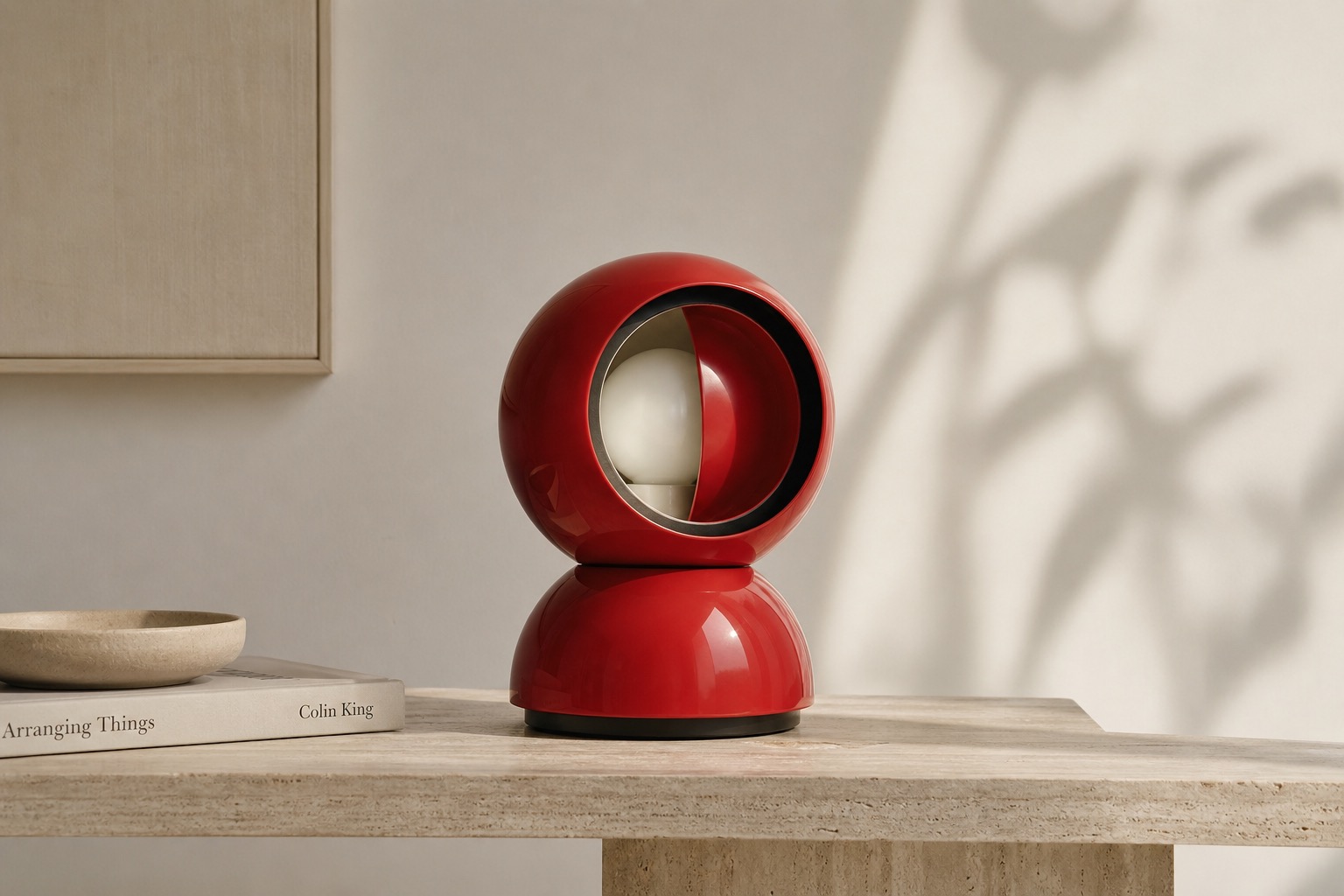
With Eclisse, the shape is only half the story. Artemide dates the design to 1965 and explains its lighting effect through a movable inner shade that partially 'eclipses' the bulb. ADI describes that technical solution as the reason for the Compasso d’Oro in 1967, while the Metropolitan Museum records a 1967 museum example as red paint coated metal with clearly documented dimensions.

mid-century·designs

Artemide Eclisse

ESSAY · 01

Work & Context

mid-century·designs

Eclisse becomes most interesting once you read it as a small lighting machine

Many texts treat Artemide Eclisse as a charming spherical lamp with strong 1960s character. The reliable sources describe something more exact. Artemide states that Vico Magistretti designed it in 1965 and explains its key idea through function: a movable inner shade can partially “eclipse” the light source. That is what creates the shift between direct and diffuse light.

This is especially useful in a shop context because Eclisse shows how strongly many mid-century lamps were built around an operating idea rather than around appearance alone. Anyone browsing mid-century·designs through lamps mid-century, metal lamp or the wider shop can read Eclisse as a reminder that a small object matters when its light logic is as clear as its silhouette.

The decisive design move is the rotating shade, not the round shell alone

Artemide presents Eclisse as a balance between form and function and ties that claim directly to the rotating inner shade. This is more than brand rhetoric. The ADI Design Museum confirms the importance of that mechanism in its statement for the 1967 Compasso d’Oro: the jury appreciated the novelty of a technical solution in which the simple movement of the rotating shade changes the intensity of the light output. That makes the lamp’s historical significance unusually easy to ground.

So Eclisse is not merely a coloured metal sphere, but a compact object of use. This point is what separates it from many later retro references that imitate the rounded look without offering equally precise light control. Artemide also adds that Eclisse is a table lamp that can also be wall mounted. The function is therefore more spatially flexible than the lamp’s modest scale might suggest.

For collectors, material, colour and proportions are unusually verifiable

The Metropolitan Museum of Art documents its example as the “Eclisse” Lamp from 1967, designed by Vico Magistretti and manufactured by Artemide S.p.A. The material description is especially practical: the museum lists “Red paint coated metal.” It also gives dimensions of 7 × 4 3/4 in. or 17.8 × 12 cm. Details like that matter on the vintage market because they allow a more concrete plausibility check than generic phrases such as “space-age style” or “Italian design classic”.

Anyone assessing older or historical Eclisse lamps should therefore focus less on the word “icon” and more on mechanism, painted finish, proportions, wall/table configuration and manufacturer identification. The source base is unusually helpful here: Artemide provides the functional description, ADI provides the award context, and the Met provides a museum-documented object with material and dimensions. That combination gives buyers something far more useful than decorative nostalgia.

Sources

FAQ · 02

Frequently asked about Artemide Eclisse

5 Answers

01
When was Artemide Eclisse designed?
Artemide states that Vico Magistretti designed Eclisse in 1965. The Metropolitan Museum documents a 1967 example, and the ADI Design Museum lists 1967 as the year of the Compasso d’Oro award.
02
Why is Eclisse more than a decorative spherical lamp?
Artemide explains the lamp through its rotating inner shade, which partially obscures the light source and allows either direct or diffuse light. The ADI Design Museum highlights that same technical solution in its award statement.
03
What material does the Met list for its museum object?
The Metropolitan Museum explicitly gives the medium as “Red paint coated metal”. For collectors, that is useful because the object’s surface and material are described by a museum source rather than by generic dealer language.
04
Is Eclisse only a table lamp?
No. Artemide describes Eclisse as a table lamp but adds that it can also be wall mounted. That dual use is part of the design’s practical intelligence.
05
Which award is associated with Eclisse?
Artemide says the lamp won the Compasso d’Oro in 1967. The ADI Design Museum confirms the award year and describes the design as combining high aesthetic value with a technically novel and marketable solution.

GLOSSARY · 03

Related Terms

6 Entries

Vico Magistretti
Italian designer of Eclisse. Artemide, the Metropolitan Museum and the ADI Design Museum all identify him as the author of the lamp.
Artemide
Italian manufacturer of Eclisse. The Metropolitan Museum lists Artemide S.p.A. as the manufacturer of its museum object, while ADI names Artemide as producer of the awarded design.
Compasso d’Oro
Major Italian design prize. Artemide and the ADI Design Museum both date Eclisse’s award to 1967.
Rotating inner shade
The movable internal shade that, according to Artemide, partially “eclipses” the light source and shifts the lamp between direct and diffuse light.
Red paint coated metal
The Metropolitan Museum’s material description for its 1967 Eclisse object. It is a useful benchmark for assessing historical finishes.
Direct and diffuse light
Artemide describes Eclisse as a lamp with a fixed outer shell and movable inner shell, allowing controlled variation of light output.