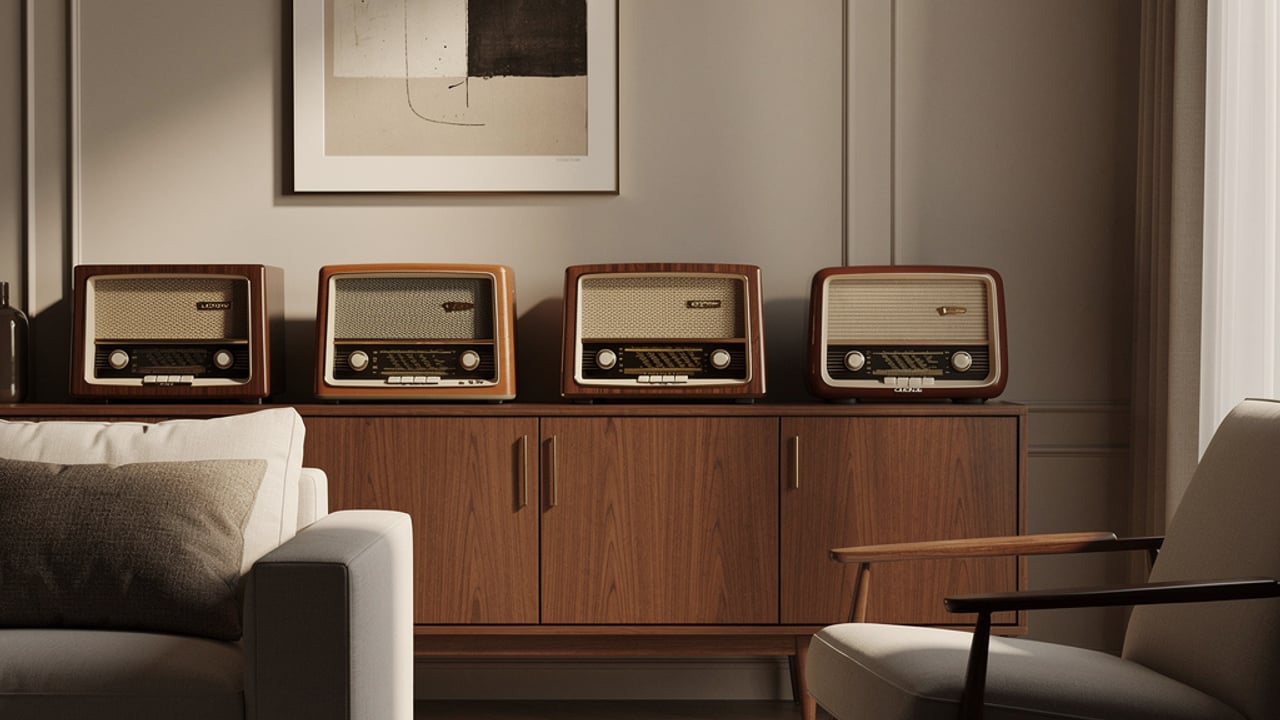
A Brief History of 50s radios
The decade following the Second World War produced a remarkable convergence of technological ambition and design reform. Manufacturers on both sides of the Atlantic—and increasingly in postwar Germany and Japan—understood that the domestic radio was no longer merely a receiver of sound but an object that would anchor the modern living room. The silhouette had to earn its place.
By 1950, the bakelite shell that had defined the previous generation was giving way to thermoplastics, aluminium fascias and lacquered wood veneers. Dials became typographically considered; grille cloths were woven in colours that answered contemporary textile trends. The result was a category of objects that industrial design historians now regard as among the most resolved of the entire postwar period.
German manufacturers, led by Braun under the influence of Hans Gugelot and Dieter Rams, pursued a reductive rigour that would prove enormously influential. American producers—Zenith, Emerson, Motorola—answered with a more exuberant formal vocabulary, deploying chrome detailing and asymmetric cabinets that echoed the tailfin aesthetic of the period’s automobile industry.
Notable 50s radios of the Era
Certain objects from this period have achieved canonical status. The Braun SK 4, introduced in 1956, set a standard for material honesty and typographic restraint that remains instructive. Emerson’s Model 747 and 812 demonstrated how thermoplastic could be moulded into genuinely sculptural form without sacrificing legibility. Zenith’s Trans-Oceanic series, though partly a product of the late 1940s, reached its formal peak in the 1950s with the L600 and R600 models, valued today for both their engineering and their considered portable design.
Collectors should also note the work of smaller European producers—Grundig’s Majestic series, Roberts Radio in the United Kingdom, and the striking output of Italian manufacturer Phonola—each of which brought distinct national design traditions to bear on the same technological substrate.
Where to Find Authentic 50s radios
Authenticity is the central question for any serious collector. The market contains a significant proportion of restored sets in which original components have been replaced, cabinets refinished, and dial glasses substituted. While sympathetic restoration is not disqualifying, undisclosed intervention is.
Our catalogue entries for 50s radios include provenance documentation where available, condition reports prepared to auction-house standards, and clear disclosure of any restoration work. We do not list sets whose cabinet or electrical history cannot be reasonably established. Each object is photographed against a neutral ground with macro detail of grille cloth, dial, knobs and any maker’s marks.
For collectors new to the category, we recommend prioritising sets with original power cords replaced by a qualified electrician—a safety measure that need not compromise visual integrity—over cosmetically pristine examples with uncertain electrical history.
Caring for Your 50s radios
Proper stewardship of 50s radios requires attention to both the cabinet and the chassis. Thermoplastic and bakelite housings should be cleaned with a soft, slightly damp cloth and kept from prolonged exposure to direct sunlight, which causes irreversible fading and brittleness. Wood-veneered cabinets respond well to a light application of microcrystalline wax applied annually.
Electrically, any set intended for regular use should be inspected by a technician familiar with vintage valve equipment. Capacitors degrade over decades and can fail in ways that damage more costly components. A professional recap, properly documented, adds to rather than diminishes a set’s collectible value when disclosed transparently. Store in stable humidity between 45 and 55 percent; avoid attics and basements where temperature fluctuation accelerates material fatigue.