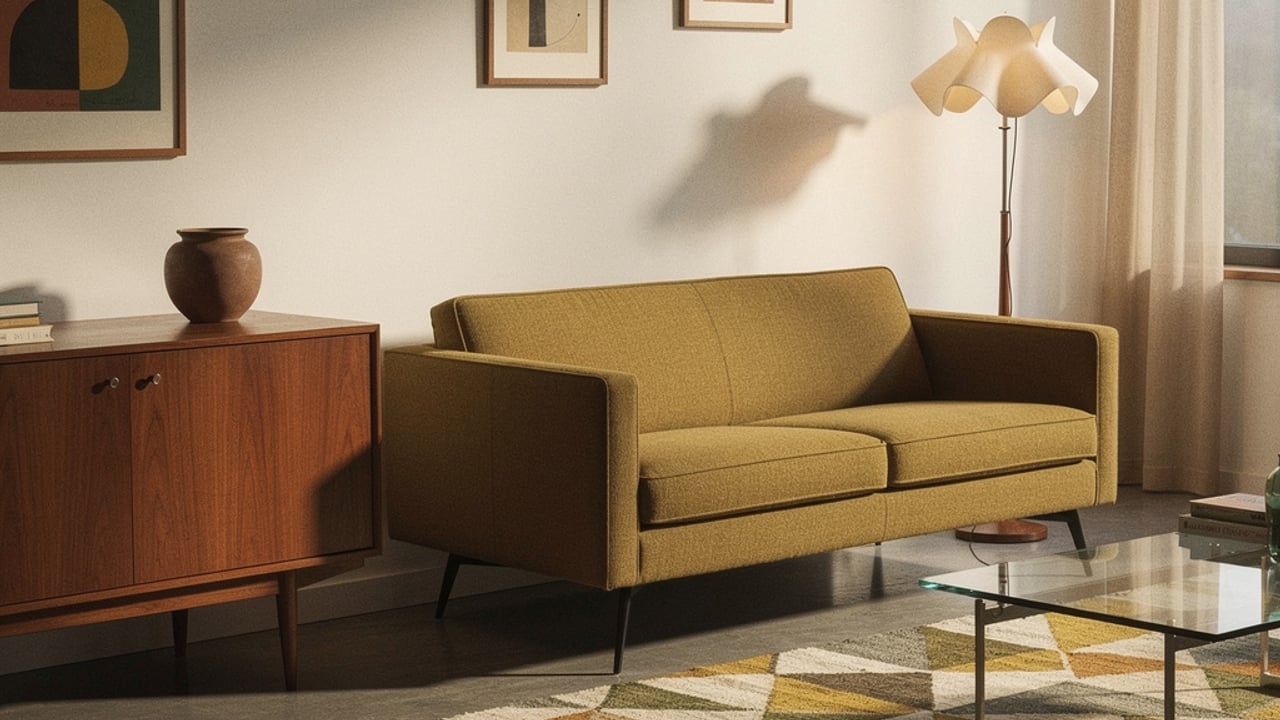
ERA · 1960S

The 1960s: A Decade Redefined

Form, material, and ideology converged in furniture history's most restless era.

From Scandinavian restraint to Italian provocation, the furniture produced during this extraordinary decade resists easy categorisation. Each piece in this collection has been authenticated, condition-assessed, and contextualised within the broader arc of postwar design history.

mid-century·designs

1960s

ESSAY · 01

Work & Context

mid-century·designs

The 1960s and the Remaking of Domestic Space

Few decades imposed themselves on the designed interior as forcefully as the 1960s. Economic expansion, new polymer technologies, and a wholesale rejection of postwar austerity combined to produce furniture that questioned every inherited assumption about form, material, and function. Designers working across Milan, Copenhagen, New York, and London operated with a shared sense of urgency, as though the chair, the table, and the storage unit were instruments through which an entire cultural argument might be advanced.

The period’s radicalism was not purely aesthetic. Clients were younger, more internationally mobile, and less deferential to the patrician tastes that had governed interior decoration since the nineteenth century. Furniture became autobiographical. To choose a Verner Panton stacking chair or an Eero Aarnio Globe was to declare an allegiance, to place oneself on the forward edge of a cultural moment that moved with extraordinary speed.

Materials That Defined 1960s Production

No single material index the 1960s more precisely than fibreglass-reinforced polyester. Herman Miller’s fibreglass shell chairs, originally developed by Charles and Ray Eames in the late 1940s, reached their widest distribution precisely during this decade, colonising offices, universities, and domestic interiors with equal confidence. Simultaneously, the Italian avant-garde embraced expanded polyurethane foam and ABS plastic as vehicles for sculptural experimentation that wood could never have permitted.

Chrome-plated tubular steel, inherited from the Bauhaus, was redeployed with a harder, more commercial edge. Rosewood and teak veneers — especially in Scandinavian production — achieved a refinement of grain and joinery that remains technically unmatched. Provenance and material integrity are, accordingly, the twin pillars of valuation for any authenticated piece from this period.

Collecting Strategies for 1960s Originals

Authentication is the collector’s first obligation. Production runs for many canonical pieces of the decade continued well into the 1970s and beyond, with later editions sometimes carrying revised construction methods or inferior material substitutions. Early production examples are typically identified through manufacturer’s labels, original hardware specifications, and period sales documentation.

Condition assessment must account for the particular vulnerabilities of each material. Fibreglass is susceptible to delamination and UV-induced colour shift. Foam upholstery almost invariably requires replacement, though the outer fabric or leather should be preserved wherever structurally viable. Teak and rosewood surfaces respond well to specialist conservation; original lacquer finishes, by contrast, demand careful appraisal before any intervention is considered.

Market positioning for this category has stabilised considerably over the past decade. Canonical pieces by documented designers — particularly those with clear exhibition histories or original retail receipts — command consistent premiums at auction and through specialist dealers. Lesser-known but equally accomplished work from German, Dutch, and Finnish makers continues to offer genuine value for the knowledgeable buyer.

The Critical Legacy of 1960s Design

Historians have moved beyond the celebratory framework that dominated early scholarship on this period. The current critical consensus acknowledges both the liberating energy of the decade’s formal experiments and the limits of a discourse that frequently excluded non-Western making traditions and the labour conditions underlying mass production.

For the collector, this maturer perspective is an asset rather than a complication. It produces more rigorous cataloguing standards, more honest condition reporting, and a market less vulnerable to cyclical fashion. The best pieces from this period endure not because they are nostalgic objects but because the problems they addressed — how to seat a body with intelligence and economy, how to make a room feel simultaneously open and inhabited — remain unsolved in any permanent sense.

FAQ · 02

Frequently asked about 1960s

5 Answers

01
How do I verify that a piece is a genuine 1960s original rather than a later reissue?
Examine manufacturer's labels, which typically carried specific typeface conventions and adhesive compounds associated with particular production periods. Original hardware — screws, bolts, and glides — will show consistent patination. Period sales receipts, exhibition catalogues, and provenance letters from original owners provide the strongest documentary evidence.
02
Which designers represent the most reliable long-term value within mid-century furniture collecting?
Designers with substantial museum representation, documented critical reception, and clear production provenance hold value most consistently. Eames, Jacobsen, Panton, and Wegner occupy the first tier. Work by Gae Aulenti, Joe Colombo, and Vico Magistretti offers compelling value for collectors willing to research more deeply into Italian production histories.
03
Is it advisable to reupholster original foam and fabric on pieces from this period?
Replacement of deteriorated foam is generally necessary for structural integrity and is accepted practice in the collector market. Original fabric or leather should be documented photographically before removal. Period-correct replacement materials, sourced from specialist suppliers, preserve value more effectively than contemporary alternatives, however technically superior.
04
What condition issues are most commonly encountered in fibreglass shell furniture?
UV exposure causes surface colour to shift toward yellow or grey tones, particularly on white and light-coloured shells. Delamination of the fibreglass laminate may occur at stress points near mounting hardware. Surface crazing is common and largely stable. Internal structural integrity should be assessed before purchase, especially on cantilevered or pedestal base configurations.
05
How should authenticated vintage furniture be stored and displayed to minimise deterioration?
Stable humidity between 45 and 55 percent and temperatures below 21 degrees Celsius are the primary environmental requirements. Direct sunlight must be avoided for all organic materials. Fibreglass and plastics benefit from UV-filtering glazing in display settings. Wooden pieces should be kept away from radiators and air conditioning vents to prevent checking.

GLOSSARY · 03

Related Terms

8 Entries

Pop Design
A design tendency of the mid-to-late 1960s that appropriated mass-cultural imagery and industrial materials to challenge fine art hierarchies. Characterised by bold colour fields, disposable aesthetics, and formal wit. Associated with designers including Peter Murdoch and the Italian Radical Design movement.
Scandinavian Modern
A design tradition emerging from Denmark, Sweden, Finland, and Norway from the 1930s onward, emphasising craft integrity, natural materials, and ergonomic precision. Distinguished from contemporary Italian production by its preference for teak, rosewood, and wool over synthetic polymers and bold chromatic contrasts.
Italian Radical Design
A critical movement centred in Milan and Florence from approximately 1966, challenging the commercial consensus of mainstream Italian industrial design. Groups including Archizoom and Superstudio produced provocative objects that foregrounded conceptual argument over functional resolution, influencing subsequent postmodern furniture discourse.
ABS Plastic
Acrylonitrile butadiene styrene, a rigid thermoplastic widely adopted in furniture production from the mid-1960s. Valued for its impact resistance, dimensional stability, and receptiveness to pigmentation. Used extensively by Verner Panton, Joe Colombo, and their contemporaries in stackable and moulded seating.
Teak
A dense tropical hardwood from Southeast Asia, extensively used in Scandinavian furniture production through the 1950s and 1960s for its dimensional stability, natural oil content, and distinctive warm grain. Increasingly subject to provenance scrutiny in contemporary collection and auction contexts due to sustainability concerns.
Rosewood
A collective term for several dense, richly grained tropical hardwoods of the genus Dalbergia. Prized in mid-century Scandinavian and Brazilian furniture for its deep reddish-brown tones and fine figure. International trade is now regulated under CITES Appendix II, requiring documented provenance for legal sale.
Fibreglass Shell
A moulded composite of woven glass fibres embedded in polyester resin, developed for furniture production in the late 1940s by Charles and Ray Eames. Offered an unprecedented combination of structural efficiency, ergonomic curvature, and economical mass manufacture. Distinguishable from later polypropylene editions by weight and surface texture.
Bauhaus
German art and design school operating between 1919 and 1933, whose integration of craft training with industrial production methods established foundational principles for twentieth-century furniture design. The tubular steel furniture of Marcel Breuer and Ludwig Mies van der Rohe remained a direct formal reference throughout the postwar decades.