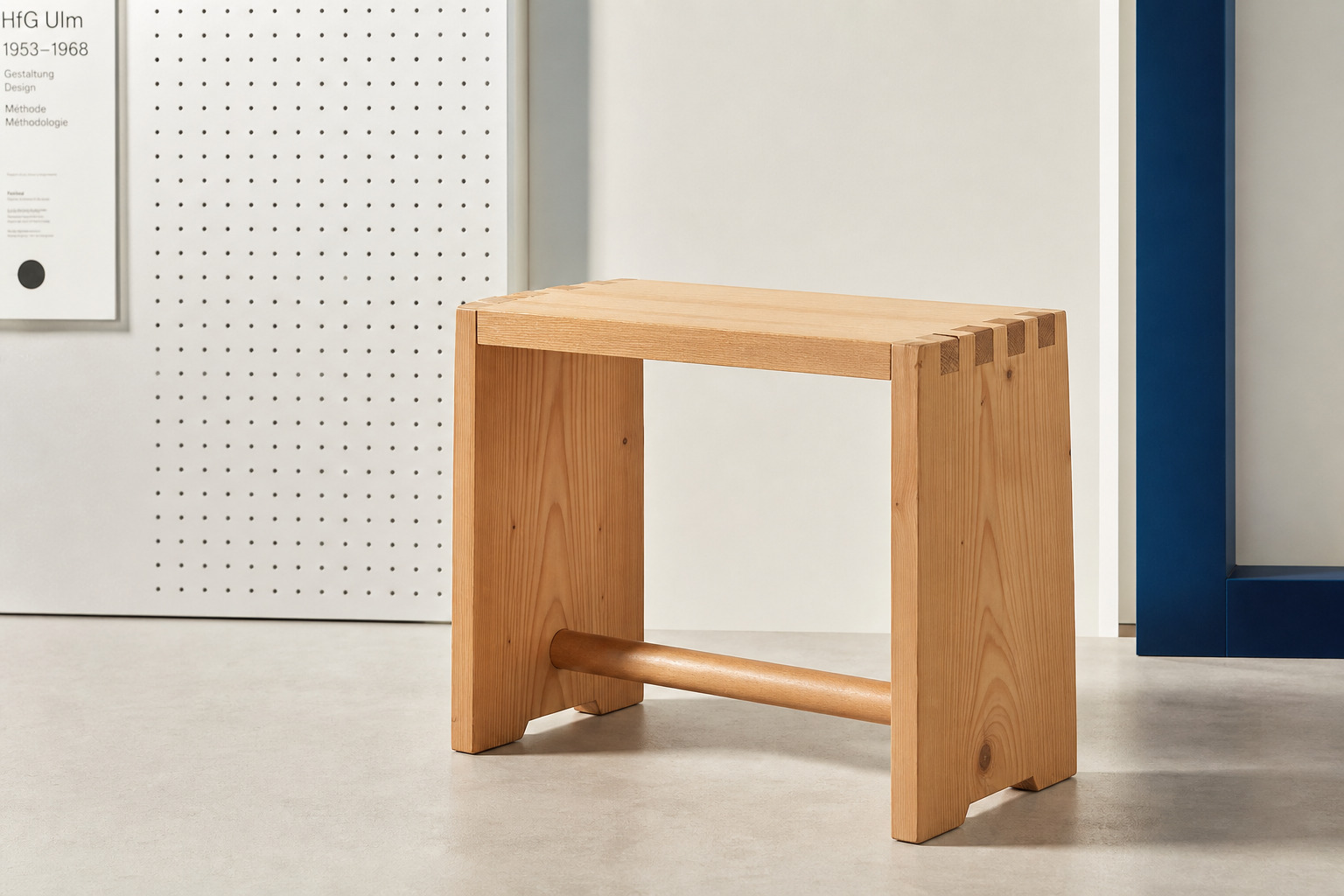
The Ulm stool matters because its modest form is backed by unusually precise documentation
The Ulm stool is one of those postwar design objects whose importance can be reconstructed from public institutional sources rather than dealer legend. Museum Ulm presents it as an object based on the original 1954 design and names Max Bill, Hans Gugelot and Paul Hildinger as central contributors. The Museum Angewandte Kunst Frankfurt also dates it to 1954 and places it directly within the history of the Hochschule für Gestaltung Ulm. The Museum für Gestaltung Zürich likewise records “Stool, Ulmer Hocker, 1954” by Max Bill and explains its role as a model utilitarian object within the school.
That three-source overlap matters for collectors. The stool is not merely a vaguely Bauhaus-like seat; it is a clearly situated object from the early HfG context. Readers interested in adjacent design history can compare it with our page on Bauhaus, where the continuity and difference between Bauhaus ideals and postwar Ulm thinking become easier to read.
Its construction translates austerity into a durable design language
The Museum Angewandte Kunst gives the most concrete account of how the stool was built. Because the new HfG campus was developed under tight financial pressure, the furniture also had to be conceived with extreme economy. According to the museum, the Ulm stool consists of three spruce boards connected by finger joints, plus a beech dowel that stabilizes the sides and doubles as a carrying handle. The lower open edges are reinforced with beech strips to reduce wear.
Museum Ulm describes the same logic in the current wb Form production: spruce for the side and seat surfaces, beech for the crossbar and base strips. What matters most is less the exact timber specification of every later edition than the coherence of the construction itself. The Ulm stool remains a powerful example of how very little material can produce an object of clear structure and high utility.
Its real strength is documented versatility rather than pure formalism
The most useful sources are not only about authorship but about use. The Museum für Gestaltung Zürich stresses that the stool emerged from the collaboration of Bill, Gugelot and Hildinger and functioned in teaching as a multifunctional utilitarian object. Photographs document its use as a lectern, as seating in the dining hall, lecture hall, workshop and student apartment, as a box for transporting books, and even as a nightstand.
Museum Ulm frames the object similarly, adding uses such as side table, shelving element, transport container and serving tray. For today’s market, that is the practical takeaway: a serious mid-century object is not defined by silhouette alone but by a credible, documented logic of use. The Ulm stool offers exactly that. For more collectible objects with the same spirit, browse mid-centurydesigns.com/en/shop.