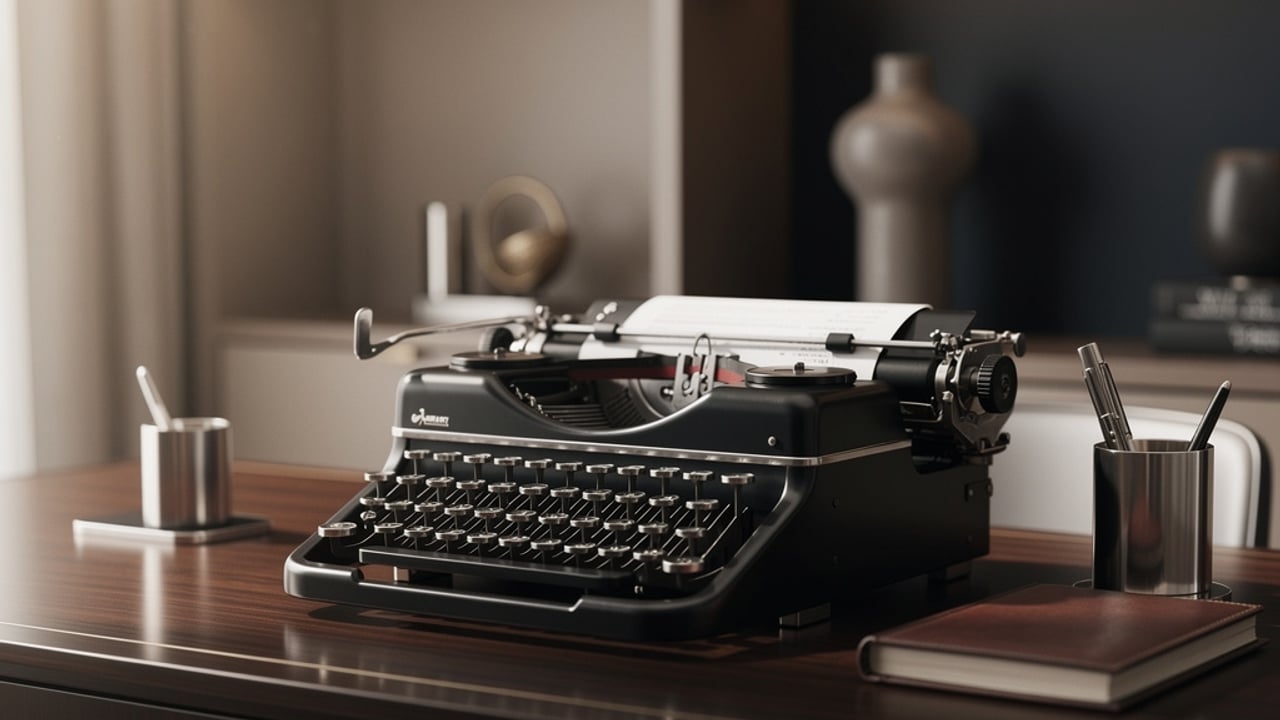
CATEGORY · TYPING MACHINE

The Vintage Typing Machine

Where industrial precision meets mid-century design philosophy.

Each typing machine in our collection represents a confluence of engineering rigour and aesthetic intention. Drawn from the most significant decades of industrial design, these objects reward close attention — as artefacts of use and as sculptural statements.

mid-century·designs

typing machine

ESSAY · 01

Work & Context

mid-century·designs

A Brief History of the typing machine

The postwar decades transformed the typing machine from a purely utilitarian instrument into one of the defining objects of modernist material culture. Between 1950 and 1980, manufacturers across Italy, Germany, Switzerland, and the United States engaged leading industrial designers to reimagine the form entirely. The result was a generation of machines that balanced ergonomic function with an aesthetic language borrowed equally from automotive design and the Bauhaus legacy.

Olivetti’s collaborations with Marcello Nizzoli and later Ettore Sottsass placed the Italian firm at the centre of this transformation. The Lettera 22, introduced in 1950, became a canonical object — lightweight, portable, and visually resolved in a way no previous typing machine had achieved. German manufacturers such as Triumph-Adler and Olympia pursued a parallel but distinctly cooler rationalism, favouring precision engineering and restrained palette over Italian expressiveness.

By the 1970s, the arrival of electric mechanisms and early electronic components introduced new formal possibilities and new challenges for designers negotiating between the machine’s industrial heritage and the emerging visual language of consumer electronics.

Notable typing machine designs of the Era

The canon of mid-century typing machine design is anchored by a handful of objects that appear regularly in museum permanent collections and at auction. Nizzoli’s Lexikon 80 for Olivetti (1948, with continued production into the 1950s) established a vocabulary of softened volumes and integrated casing that influenced an entire generation of product designers. Sottsass’s Valentine (1969), produced in collaboration with Perry King, departed sharply from this tradition — its red ABS casing and pop sensibility made it both a commercial object and a work of design provocation.

Olympia’s SM series, Hermes’s 3000, and the Royal Quiet De Luxe each represent distinct national approaches to the same mechanical problem, and each rewards careful study as a document of its industrial moment.

Where to Find Authentic typing machine Pieces

Authenticity is the central concern when acquiring any mid-century typing machine. The market contains a significant volume of restored, partially replaced, or misattributed machines, and provenance documentation is essential. Serious collectors prioritise examples with original casing intact, undisturbed decal and badge work, and mechanical function consistent with the original specification.

Our catalogue draws exclusively from vetted private collections and specialist dealers in Italy, Germany, and the United Kingdom. Each listing includes condition reports prepared by conservators with backgrounds in industrial objects and material history. We do not list machines that have undergone cosmetic repainting or non-period mechanical substitution without explicit disclosure.

Caring for Your typing machine Collection

The long-term preservation of a vintage typing machine depends on environmental control and minimal intervention. These objects were manufactured to be used, and many of the plastics, rubber components, and lubricants employed between 1950 and 1980 are now inherently unstable. Collectors should maintain relative humidity between 45 and 55 percent and avoid prolonged exposure to direct light, which accelerates the yellowing of ABS and cellulose acetate casings.

Mechanical servicing, when required, should be entrusted to technicians familiar with period materials. The use of contemporary petroleum-based lubricants on mid-century mechanisms can cause irreversible swelling of rubber platens and carriage components. For display purposes, a closed case with acid-free internal lining will protect both the casing finish and any surviving original paperwork or accessories.

FAQ · 02

Frequently asked about typing machine

5 Answers

01
How do I verify the authenticity of a mid-century typing machine?
Authentic examples carry period-consistent serial numbers traceable through manufacturer archives, original badge and decal work, and mechanical components specific to the production year. Compare chassis markings against documented production records. Reputable dealers provide condition reports and, where possible, acquisition provenance. Independent assessment by a conservator specialising in industrial objects is advisable for significant purchases.
02
Which manufacturers are most collected in the vintage typing machine market?
Olivetti commands the strongest collector interest, particularly models designed by Marcello Nizzoli and Ettore Sottsass. Hermes, Olympia, and Torpedo are prized for German and Swiss engineering precision. Royal and Underwood attract North American collectors. Condition, original accessories, and design attribution drive value differentials within each manufacturer's catalogue.
03
Is a restored typing machine less valuable than an unrestored example?
In most cases, yes. The collecting market strongly favours unrestored examples with original finish and components, even when showing honest wear. Cosmetic restoration — repainting, re-decaling, or replacing original rubber parts with non-period materials — diminishes both historical integrity and resale value. Full disclosure of any restoration work is standard practice among reputable dealers.
04
What should I look for when inspecting a vintage typing machine in person?
Examine the casing for evidence of repainting — look for masking shadows near chrome trim and uniformity inconsistent with age. Check the platen for original rubber hardness and surface texture. Inspect typebars for even wear and original typeface. Confirm that the carrying case, if present, is period-correct and shows consistent ageing with the machine itself.
05
How should a typing machine be stored when not on display?
Store in a stable environment at 45–55% relative humidity and 18–20°C. Wrap loosely in acid-free tissue, avoiding sealed plastic which traps moisture. Do not store with the platen under sustained pressure. Keep original cases when available, as they provide both physical protection and contribute to the object's completeness and documented history.

GLOSSARY · 03

Related Terms

8 Entries

Olivetti
Italian manufacturer founded 1908, whose mid-century design programme — engaging Nizzoli, Sottsass, and Bellini — established a standard for integrated industrial and graphic design rarely matched in the consumer goods sector.
ABS Casing
Acrylonitrile butadiene styrene, a thermoplastic widely adopted in product design from the 1960s onward. Prone to UV-induced yellowing over time; original colour integrity is a significant condition factor in mid-century object assessment.
Marcello Nizzoli
Italian industrial and graphic designer (1887–1969) whose work for Olivetti, including the Lexikon 80 and Lettera 22, defined the aesthetic ambitions of postwar Italian product design and influenced a generation of European designers.
Ettore Sottsass
Italian-Austrian designer (1917–2007) whose Olivetti Valentine (1969) introduced pop aesthetics to office equipment. Later founder of the Memphis Group; his career spans rationalist modernism to postmodern design provocation.
Platen
The rubber-covered cylindrical roller against which type strikes in a mechanical typing machine. Original platens harden with age; their condition and originality are primary indicators of mechanical integrity and preservation quality.
Bauhaus
German design school (1919–1933) whose philosophy of integrating craft, fine art, and industrial production established foundational principles — functional form, material honesty, rational construction — that shaped mid-century industrial design globally.
Triumph-Adler
German office equipment manufacturer whose mid-century portable and desktop models exemplified the rational engineering aesthetic associated with West German industrial design, characterised by precision mechanism, restrained form, and durable construction.
Cellulose Acetate
A semi-synthetic plastic used in early- to mid-century product casings. Subject to off-gassing and dimensional instability over time; its presence in an object requires careful environmental management to retard deterioration.