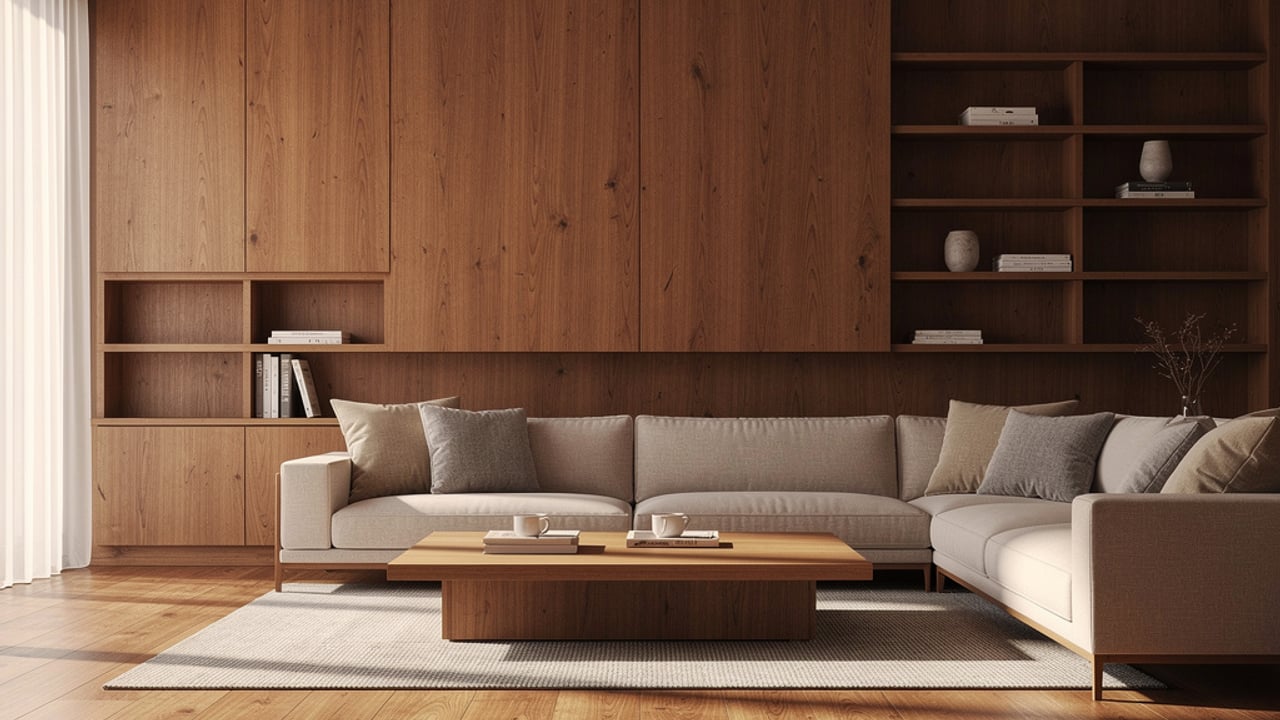
MATERIAL · TEAK

Teak: The Timber of a Design Era

From Danish workshops to international living rooms — a material that defined a generation.

Few materials are as inseparable from twentieth-century design history as this close-grained tropical hardwood. Prized for its density, its warm amber register, and its exceptional resistance to movement, it became the preferred medium of the most consequential furniture workshops of the postwar decades.

mid-century·designs

Teak

ESSAY · 01

Work & Context

mid-century·designs

Teak and the Architecture of the Postwar Interior

The decades following the Second World War produced a sustained reconsideration of how domestic interiors should be conceived and furnished. Across Scandinavia, Britain, and eventually North America and Japan, designers and cabinetmakers sought a material that could satisfy simultaneously the demands of industrial production and the expectations of a clientele newly attuned to craft. The answer, arrived at independently across many workshops, was a single timber: Teak.

Sourced primarily from managed forests in Burma, Thailand, and teak-producing regions of Southeast Asia, the wood arrived in European workshops already possessed of a reputation for maritime durability. Shipbuilders had long relied on its natural oils and interlocked grain structure to resist the expansion and contraction caused by moisture and temperature change. Furniture makers discovered that these same properties translated with remarkable fidelity to the conditions of the heated Scandinavian interior — underfloor warmth, low humidity, the particular thermal rhythms of northern domestic life.

The result was a material culture of unusual coherence. Chairs, sideboards, dining tables, and storage systems produced across a thirty-year span share a tonal and structural family resemblance that collectors and historians find difficult to disentangle from their aesthetic pleasure in the objects themselves.

Teak in the Danish Cabinetmaking Tradition

Denmark’s contribution to the history of postwar furniture is disproportionate to its size. The annual Copenhagen Cabinetmakers’ Guild exhibitions, held from the 1920s through the 1960s, functioned as a proving ground for designers who subsequently achieved international recognition: Hans J. Wegner, Arne Jacobsen, Finn Juhl, and Børge Mogensen among them. The Guild exhibitions placed a premium on joinery, on the legibility of construction, and on the honest expression of material. In this context, the timber’s figure and its response to hand-finishing made it the favoured choice for showpiece objects.

Wegner’s Round Chair of 1949 — produced in several timber variants but most frequently encountered in this warm-toned hardwood — exemplifies the Guild ideal: a design whose structural logic is inseparable from its visual effect, and whose surface rewards sustained attention in a way that lacquered or painted alternatives cannot.

Teak in Industrial and Contract Production

Beyond the atelier tradition, the material also proved amenable to the semi-industrial production methods that allowed postwar design to reach a broader market. Manufacturers including France & Søn, Dyrlund, and the Danish cooperative production houses developed joinery and finishing techniques that preserved much of the hand-crafted appearance while enabling consistent output. Flat-pack and knocked-down construction — an economic necessity as Scandinavian design reached export markets in Britain, Germany, and the United States — was facilitated by the timber’s dimensional stability, which reduced the risk of panels warping in transit or in unfamiliar climatic conditions.

British retailers, most notably Heals and Habitat in its early years, stocked these pieces alongside domestic production, introducing them to a generation of consumers who associated the material itself with a set of values — simplicity, honesty, quality — that the objects appeared to embody.

Teak Today: Condition, Patina, and Authentication

For the collector approaching this material in the present market, condition assessment requires attention to several distinct factors. The natural oils that give the timber its durability also mean that neglected surfaces typically respond well to careful restoration: a light application of period-appropriate oil can recover depth of colour without disguising evidence of age. Original finish, where intact, is always preferable, and patina acquired through decades of use — the subtle lightening of high-contact surfaces, the darkening of joints — constitutes evidence of authenticity rather than detraction.

Authentication of signed or attributed pieces depends on construction analysis as much as on labels or stamps, many of which were applied with adhesive that has long since failed. Drawer construction, hardware specification, and the profile of turned or tapered elements are among the diagnostic features that allow confident attribution. Pieces offered through mid-centurydesigns.com are assessed against these criteria before listing.

FAQ · 02

Frequently asked about Teak

5 Answers

01
How can I tell whether a piece described as Teak is genuine or a later reproduction?
Authentic postwar pieces typically show hand-finished surfaces, period-correct joinery — often mortise-and-tenon or dowelled construction — and hardware consistent with the decade of manufacture. Reproductions frequently betray themselves through machine-routed profiles, anachronistic fixings, or a uniformity of grain and colour inconsistent with natural timber variation. A specialist assessment is advisable for high-value attributions.
02
What is the correct way to clean and maintain vintage timber furniture?
Remove dust with a dry or very lightly dampened cloth. Avoid silicone-based polishes, which build up and obscure grain. Period-appropriate teak oil, applied sparingly and buffed out fully, will feed dried surfaces without creating a surface film. Avoid prolonged exposure to direct sunlight and maintain consistent humidity levels to prevent movement in joints and panels.
03
Does restoration affect the value of a mid-century piece?
Sensitive restoration — confined to cleaning, re-oiling, and the tightening or re-gluing of original joints — is generally considered neutral or positive by the market. Refinishing that removes original patina, replacing hardware with non-period components, or structural repairs using anachronistic materials will typically reduce collector value and complicate future attribution.
04
Are there sustainability concerns associated with collecting vintage timber furniture?
Collecting vintage and antique furniture is widely considered among the most sustainable approaches to furnishing an interior, as no new material is extracted. The timber used in postwar pieces was sourced under pre-CITES regulatory conditions; collecting these objects does not implicate current protected-forest concerns and actively extends the working life of existing material.
05
Which designers most significantly shaped the aesthetic associated with this material?
Hans J. Wegner, Finn Juhl, Børge Mogensen, and Arne Vodder are among the Danish designers whose work is most closely identified with this material. Outside Scandinavia, the British designer Robin Day and the Japanese-American sculptor and designer Isamu Noguchi each produced significant pieces that engage its tonal and structural qualities in distinct cultural registers.

GLOSSARY · 03

Related Terms

8 Entries

Danish Modern
A design movement centred on Danish workshops from roughly 1945 to 1975, characterised by organic form, visible joinery, and the prioritisation of craft. It produced the most internationally influential body of domestic furniture of the twentieth century and remains a primary focus for serious collectors.
Rosewood
A dense, richly figured tropical hardwood used alongside and often in combination with lighter timbers in Scandinavian and Brazilian modernist furniture. Its dramatic grain and deep burgundy-to-black coloration made it the prestige material for statement pieces from the late 1950s onward, though CITES restrictions now complicate its trade.
Joinery
The craft discipline concerned with the construction of wood joints without the use of nails or metal fasteners. In mid-century furniture, the legibility and precision of joinery — mortise-and-tenon, dovetail, finger joint — is a primary indicator of workshop quality and period authenticity.
Scandinavian Functionalism
A design philosophy, dominant from the 1930s through the 1970s, holding that objects should be shaped entirely by their intended use, material properties, and production method. Distinguished from German functionalism by a persistent accommodation of craft, ornament derived from structure, and human ergonomic consideration.
Patina
The surface character acquired by an object through age and use: oxidation of metal hardware, the gradual shift in timber colour from exposure to light and oils, wear patterns on contact surfaces. Regarded by serious collectors as evidence of authenticity and as an aesthetic quality in its own right.
Walnut
A North American and European hardwood used extensively by American mid-century designers including George Nakashima, Edward Wormley, and Paul McCobb. Its cooler, grayer tonal range and pronounced figure distinguish it from Scandinavian timber preferences and align it with a distinct strand of postwar American modernism.
Veneer
A thin layer of high-quality or figured timber bonded to a substrate of lesser material, typically plywood or particleboard. Used by major Scandinavian manufacturers to extend expensive timbers across flat panel surfaces while maintaining dimensional stability. Distinguished from solid construction by edge profiles and cut sections.
Mortise-and-Tenon
A foundational woodworking joint in which a projecting tongue on one member is inserted into a corresponding cavity in another. Standard in high-quality mid-century cabinetry, its presence — assessed through dimensional analysis or X-ray — is a reliable indicator of period manufacture and workshop quality.