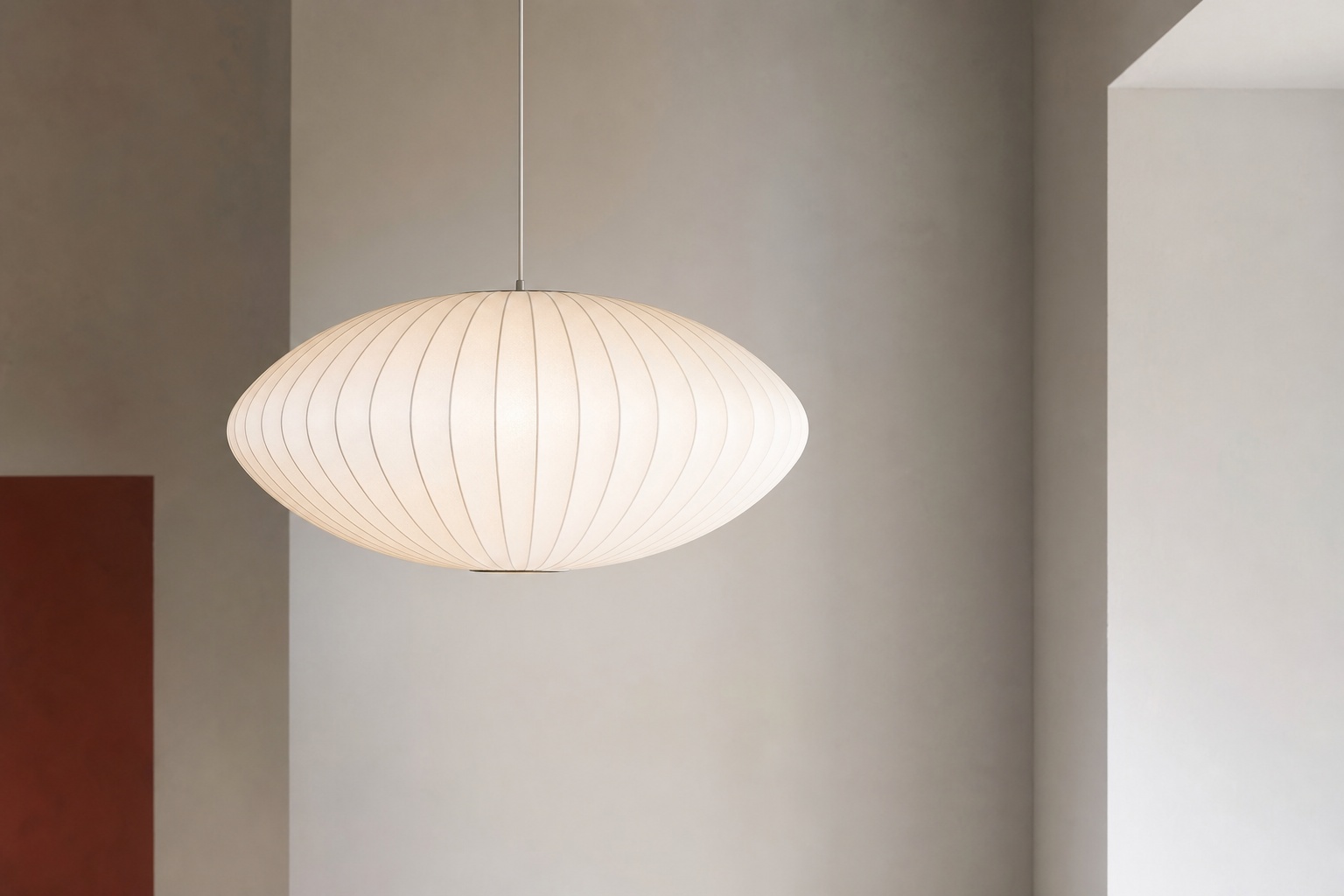
The Nelson Bubble Lamp becomes clearer once you read it as a technical material experiment rather than just a soft shape
Many retail texts treat the Nelson Bubble Lamp mainly as an atmospheric mid-century light with an organic silhouette. The dependable sources describe something more precise. Herman Miller explains that George Nelson in 1952 started from Swedish hanging lamps with silk coverings, whose construction he found too laborious and whose price he found too high. Out of that dissatisfaction he developed his own answer: a lightweight steel frame finished with a smooth translucent plastic skin.
That is far more useful to buyers than a generic style label. The Brooklyn Museum documents a 1952 Bubble Lamp as an object made of plastic polymer and steel, and it even records dimensions of 14 × 10 inches together with a 15-foot cord. Vitra places the Bubble Lamps (1952 onwards) within George Nelson’s wider body of work and shows that these lights were not an isolated idea but part of a broader design role that shaped Herman Miller for decades. Anyone browsing mid-century·designs through lamps mid-century, the Wagenfeld lamp or the wider shop therefore gets an especially well-documented comparison object here.
The real innovation was not the form alone, but the process behind it
On its family page for Nelson Bubble Lamps, Herman Miller explains why Nelson wanted an alternative in the first place. The Swedish examples, according to the source, used silk cut into sections and sewn over a wire frame. Nelson wanted the same sense of lightness, but in a method that was less costly and more convincing for modern production. Herman Miller therefore describes a process in which a steel frame was covered with a sprayed self-webbing plastic layer and then finished with a smooth translucent surface.
That passage matters because it explains why Bubble Lamps are more than generic “paper-lamp” imagery with a mid-century mood. Their significance lies in a clearly described shift from textile appearance to modern plastic technology. That is the difference between a historically grounded design object and later imitations that merely borrow the silhouette.
For collectors, the source base matters: material, maker context and object marking
The Brooklyn Museum becomes even more specific in the verifiable details. It names Herman Miller, Inc. as the manufacturer, dates the object to 1952, and records a label reading “BUBBLE LIGHTING FIXTURES / patent applied for / herman miller clock company / ZEELAND, MICHIGAN.” In the vintage and design market, those details are more useful than vague attributions because they connect material, marketing and company context.
Herman Miller also makes clear that the idea did not remain a single model but grew into a family of pendants, wall sconces, table lamps and floor lamps. Together with Vitra, which places the Bubble Lamps within Nelson’s influential work for Herman Miller, this creates one of those rare cases where a popular mid-century object can be read not just decoratively, but technically and historically. When assessing a Bubble Lamp, it therefore makes more sense to inspect material effect, credible construction, maker context and clean object identity than to focus only on the softly rounded form.