CATEGORY · OLIVETTI LETTERA 32

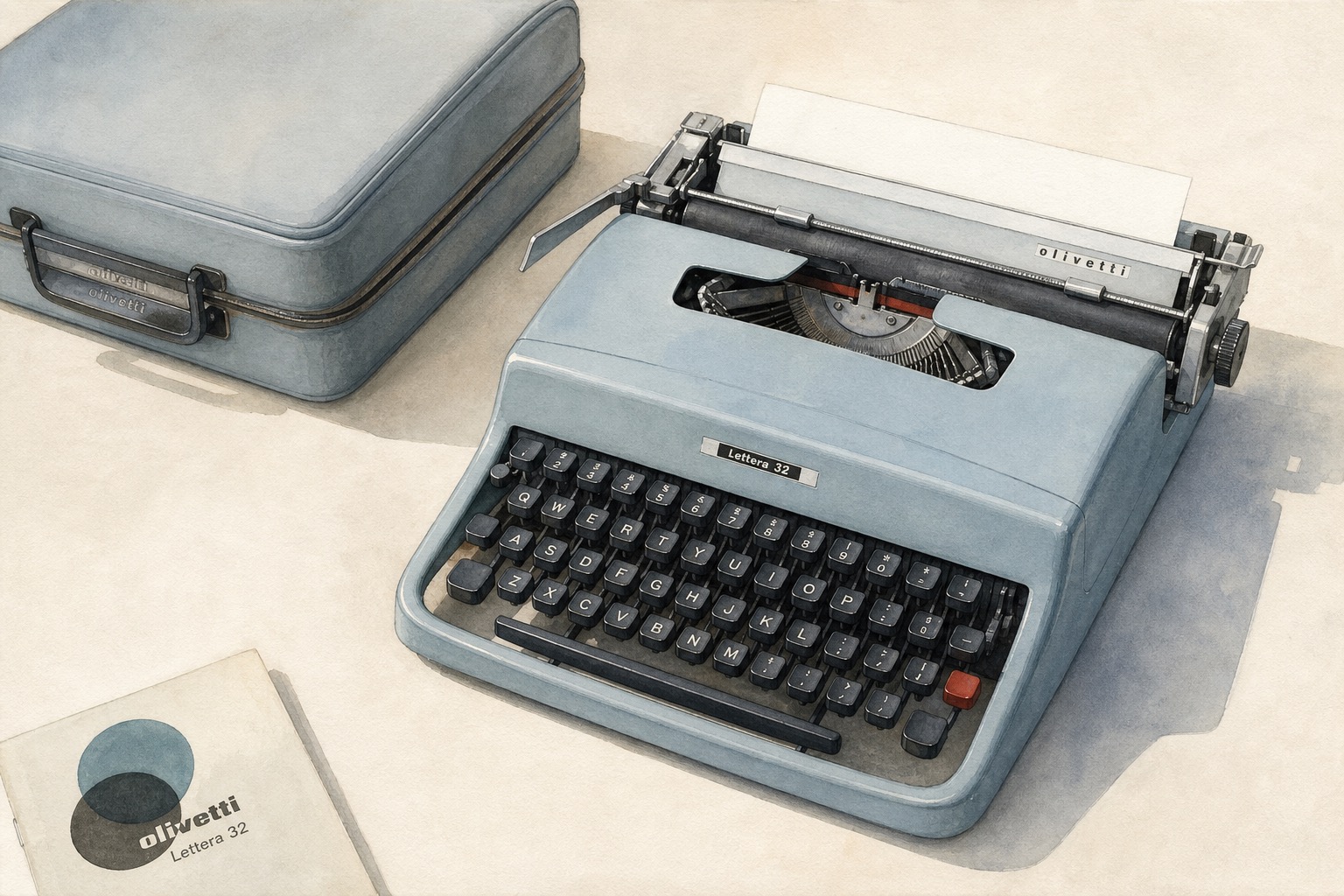
Olivetti Lettera 32 – dated to 1963 at SFMOMA, built as a portable machine and promoted within a few years through unusually strong visual campaigns

SFMOMA records the Lettera 32 as a 1963 design object; Archivio Storico Olivetti documents a 1965 Folon poster; Archivio Grafica Italiana records a further Lettera 32 poster by Walter Ballmer from 1968

The Olivetti Lettera 32 becomes more interesting when it is read as more than typewriter nostalgia. SFMOMA lists it as the Lettera 32 Portable Typewriter by Marcello Nizzoli and Ing. C. Olivetti & C., dated 1963, and identifies a material mix of metal, plastic, and paint. The object then reappears in documented visual culture: Archivio Storico Olivetti describes a 1965 Jean Michel Folon poster for the portable Lettera 32, while Archivio Grafica Italiana records a famous 1968 Lettera 32 poster by Walter Ballmer with photography by Sergio Libis. That overlap of product design and public communication is what makes the Lettera 32 especially useful in a shop context.

mid-century·designs

Olivetti Lettera 32

ESSAY · 01

Work & Context

mid-century·designs

The Lettera 32 matters not only as a vintage typewriter but as a product whose form and communication were tightly aligned

The Olivetti Lettera 32 is often sold simply as a beautiful old travel typewriter. The stronger sources are more precise. SFMOMA records it as the Lettera 32 Portable Typewriter from 1963, tied to Marcello Nizzoli and Ing. C. Olivetti & C. The museum also gives a useful material description: metal, plastic, and paint. That already moves the discussion beyond generic mid-century nostalgia.

For buyers at mid-century·designs, this is practical. Anyone moving between our pages on Vintage Typewriter, Olivetti Valentine, or the main shop usually wants more than atmosphere. The museum record helps frame the Lettera 32 as a clearly defined portable product: compact, materially mixed, and deliberately shaped for use.

The advertising sources show how quickly Olivetti turned the Lettera 32 into a public image

The most revealing evidence comes from the machine’s graphic afterlife. Archivio Storico Olivetti describes a 1965 poster by Jean Michel Folon for the portable Lettera 32. In the archive’s summary, many small figures sit where the keys would be, each typing on a lowercase letter. That is not neutral product depiction; it is a visual argument about access, everyday use, and familiarity.

A second and even more design-historical signal comes from Archivio Grafica Italiana. Its database records a 1968 Lettera 32 poster by Walter Ballmer, with photography by Sergio Libis, and calls it “one of the most famous posters in the history of Italian graphic design.” In a shop context, that matters. The Lettera 32 was not only manufactured; it was deliberately staged as a mass-readable cultural object.

That is why buyers should assess the whole portable logic, not just the brand name

Taken together, the sources create a useful reading. The Lettera 32 is both a 1963 museum-dated design object and a repeatedly documented communication image of the 1960s. When assessing one today, it makes sense to inspect more than age or logo: body proportions, keyboard layout, carrying case, material consistency, and the credibility of the portable construction all matter.

Compared with later, more overtly stylised typewriters, the Lettera 32 remains compelling because it combines product discipline with public legibility. For related context, see our pages on Typing Machine and Old Typewriter.

Sources

FAQ · 02

Frequently asked about Olivetti Lettera 32

5 Answers

01
Who is credited with the Lettera 32?
SFMOMA lists the Lettera 32 Portable Typewriter under Marcello Nizzoli and names Ing. C. Olivetti & C. as the manufacturing context for the object.
02
What is the clearest date for the Lettera 32?
SFMOMA dates its collection object to 1963. The documented advertising materials from 1965 and 1968 then show how quickly the machine entered Olivetti’s visual culture.
03
What materials does the museum record?
SFMOMA describes the Lettera 32 as a design object in metal, plastic, and paint. That helps buyers discuss the machine in material terms rather than as a vague retro silhouette.
04
What do the posters add to the story?
Archivio Storico Olivetti documents a Jean Michel Folon poster from 1965 made for the portable Lettera 32, while Archivio Grafica Italiana records a 1968 Lettera 32 poster by Walter Ballmer and notes its importance within Italian graphic design. Together, they show that the machine was promoted as a public-facing cultural object, not just an office tool.
05
What should buyers inspect on a Lettera 32 today?
Ask for detailed photos of the case, keyboard, body, paint, and underside. Because the best sources stress both portability and strong visual identity, condition, completeness, proportions, and coherent portable construction matter more than a generic “Olivetti” label.

GLOSSARY · 03

Related Terms

6 Entries

Marcello Nizzoli
Italian designer credited by SFMOMA for the Lettera 32, crucial for placing the machine inside Olivetti’s design history.
Ing. C. Olivetti & C.
Manufacturer reference on the SFMOMA page for the Lettera 32, anchoring it as a concrete industrial product rather than a loose style object.
Portable Typewriter
SFMOMA’s designation for the Lettera 32, making portability part of the product category rather than a secondary feature.
Jean Michel Folon
Artist named by Archivio Storico Olivetti for a 1965 Lettera 32 poster, evidence that the machine entered visual communication very early.
Walter Ballmer
Designer credited by Archivio Grafica Italiana for a 1968 Lettera 32 poster, linking the machine to Olivetti’s sophisticated corporate graphics.
Sergio Libis
Photographer named by Archivio Grafica Italiana for the 1968 Lettera 32 poster, showing how tightly product and image production were connected.