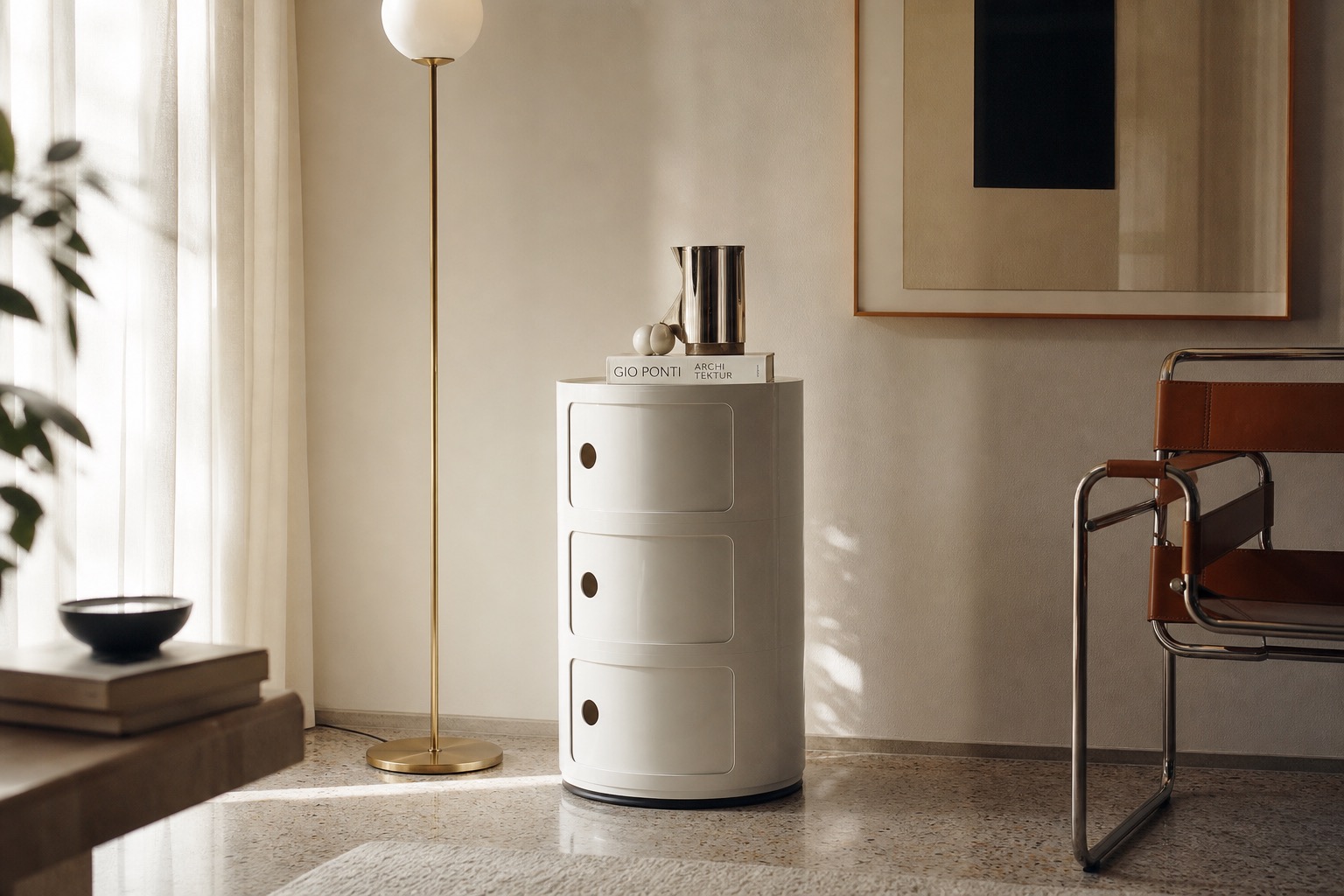
Componibili is a strong case study in how mid-century plastic can remain legible today
Many dealer descriptions treat Kartell Componibili as little more than a stylish storage cylinder for bedrooms or living rooms. The stronger sources are more precise. Kartell states that Componibili first appeared in 1967 and has since become a timeless furnishing classic. Design Museum Brussels adds an important nuance: the square version was designed in 1967, while the round version followed in 1969. That distinction is useful for collectors because it helps separate broad style language from actual chronology.
The object’s formal logic is equally well documented. Design Museum Brussels describes Componibili as a round or square modular storage unit and explains that the original idea relied on customizable stackable modules. Kartell, by contrast, describes today’s Classic range as fixed compositions of two, three or four elements and gives the current round version a 32 cm diameter. For readers already exploring the 1960s, Componibili is a concise example of how informal postwar living habits translated into furniture with a lighter visual footprint.
Why the material is not a minor technical note
The material is central to the object’s meaning. The Museum of Design in Plastics describes its documented example as a round two-element cabinet with two sliding doors made from injection-moulded ABS, or acrylonitrile butadiene styrene. That matters because Componibili does not merely happen to be plastic: its clean cylindrical body and smooth moving openings depend on an industrial material capable of consistent serial production.
This is the point where design history becomes more useful than atmosphere. Componibili works because geometry, production method and material reinforce each other. Its rounded edges, sliding openings and modular logic would not read the same way in a conventional case-built cabinet. For readers interested in mid-century modern decor, it is a good reminder that small storage furniture can be historically significant when its construction and social use align so clearly.
What buyers can verify in today’s market
For present-day buyers, the practical value lies in checkable details. The Museum of Design in Plastics records a base inscription reading “Kartell. 4965-67. designer: Anna Castelli. Made in Italy”. The same source also lists 40 cm height and 32 cm diameter for its example. Those are useful checkpoints when evaluating market listings: do the proportions, maker reference and construction details align?
It is also worth keeping the difference between the historic system and current retail versions in mind. Design Museum Brussels explicitly notes that the original concept was configurable and stackable, whereas today’s market is dominated by the simplified round form. Kartell in turn presents the current family as fixed units. So if you are browsing vintage-adjacent plastic furniture, look beyond colour and silhouette and verify module logic, opening type, dimensions and maker markings. For a broader overview of collectible objects, see mid-centurydesigns.com/en/shop.