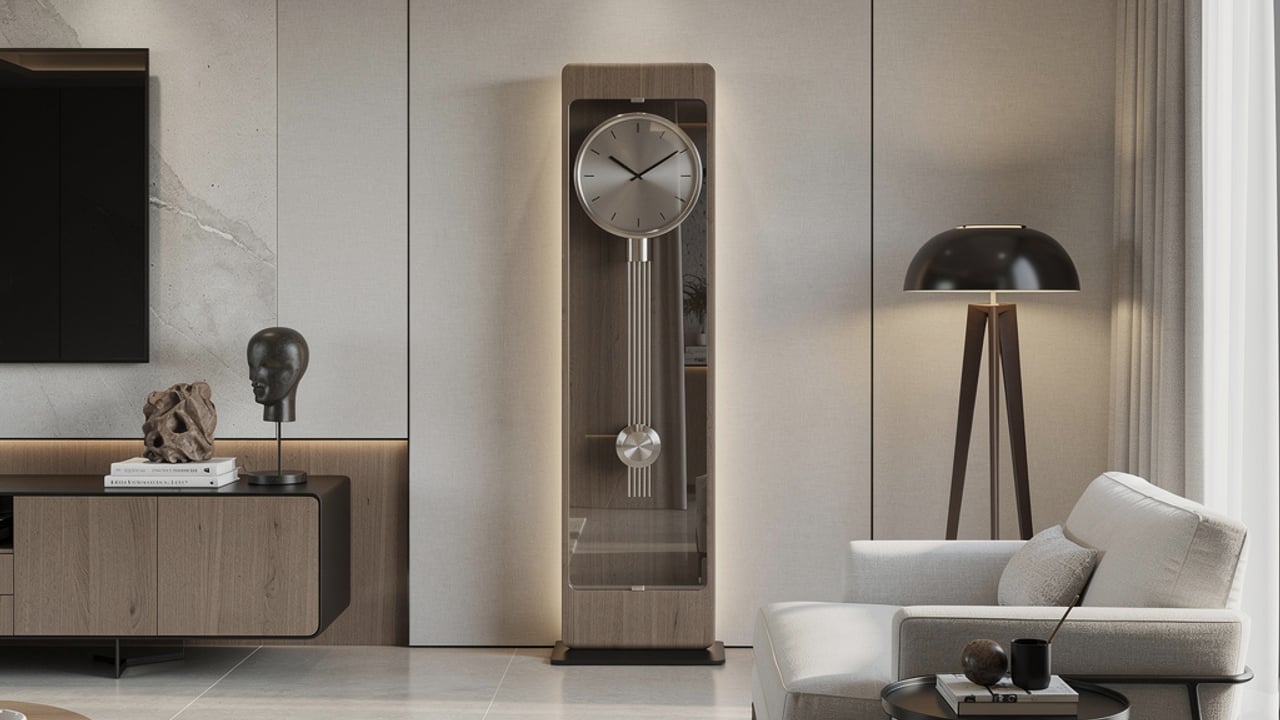
A Brief History of grandmother clock
The grandmother clock emerged as a domestically scaled counterpart to the full longcase, standing typically between 1.5 and 1.8 metres. Its proportional reduction was never merely a concession to smaller interiors; rather, designers of the postwar period recognised in this format an opportunity to reconcile the weight of horological tradition with the spare geometries of modernist interiors. Scandinavian workshops in particular embraced the form during the 1950s and 1960s, producing cases in teak and rosewood that aligned with the broader ethos of functional beauty then emanating from Copenhagen and Stockholm.
By the late 1960s, ateliers in Germany and the Netherlands were producing variants in lacquered steel and smoked glass, pushing the form further toward the idiom of industrial design. The pendulum clock, long associated with domestic conservatism, was thus repositioned as a serious object of material culture.
The Design Language of the grandmother clock
What distinguishes a well-resolved example is the coherence between case, movement, and dial. The finest mid-century pieces treat these three elements as a unified composition rather than an assembly of components. Case joinery in solid walnut or teak, recessed brass hinges, and bevelled glass panels are recurring marks of quality. Dials range from stark minimalist faces bearing only index markers to more elaborate enamel surfaces referencing earlier Vienna regulator traditions. The pendulum itself, often visible through a glazed trunk door, contributes to the visual rhythm of the object, transforming the measurement of time into a quietly theatrical act.
Provenance and Authentication of the grandmother clock
Authentication of a vintage grandmother clock rests on several intersecting forms of evidence. Movement signatures, case construction techniques, and original finish all contribute to a coherent provenance narrative. Our specialists cross-reference extant maker catalogues, period trade publications, and auction records when preparing condition reports. Labels, stamps, and retailer tags — where present — are photographed in detail. Cases that retain original surface patina, rather than having been refinished, are prioritised, as the evidence of age is itself an irreplaceable aspect of the object’s biography.
Buyers should request documentation of the movement’s calibre, the country of manufacture, and any recorded exhibition or collection history. Gaps in provenance are disclosed transparently rather than obscured.
Caring for Your grandmother clock
A grandmother clock in regular use requires periodic attention to sustain both its mechanical integrity and its material condition. The movement should be professionally serviced every five to seven years, with lubricants renewed and pivot wear assessed. Cases in natural wood benefit from occasional treatment with a non-silicone wax; silicone-based products penetrate the grain and complicate future restoration. The clock should be positioned away from direct sunlight and heat sources, both of which accelerate fading and dry out adhesive joints. Levelling is essential: a pendulum that does not swing in a true vertical plane will affect beat regulation and accelerate wear on the escapement.