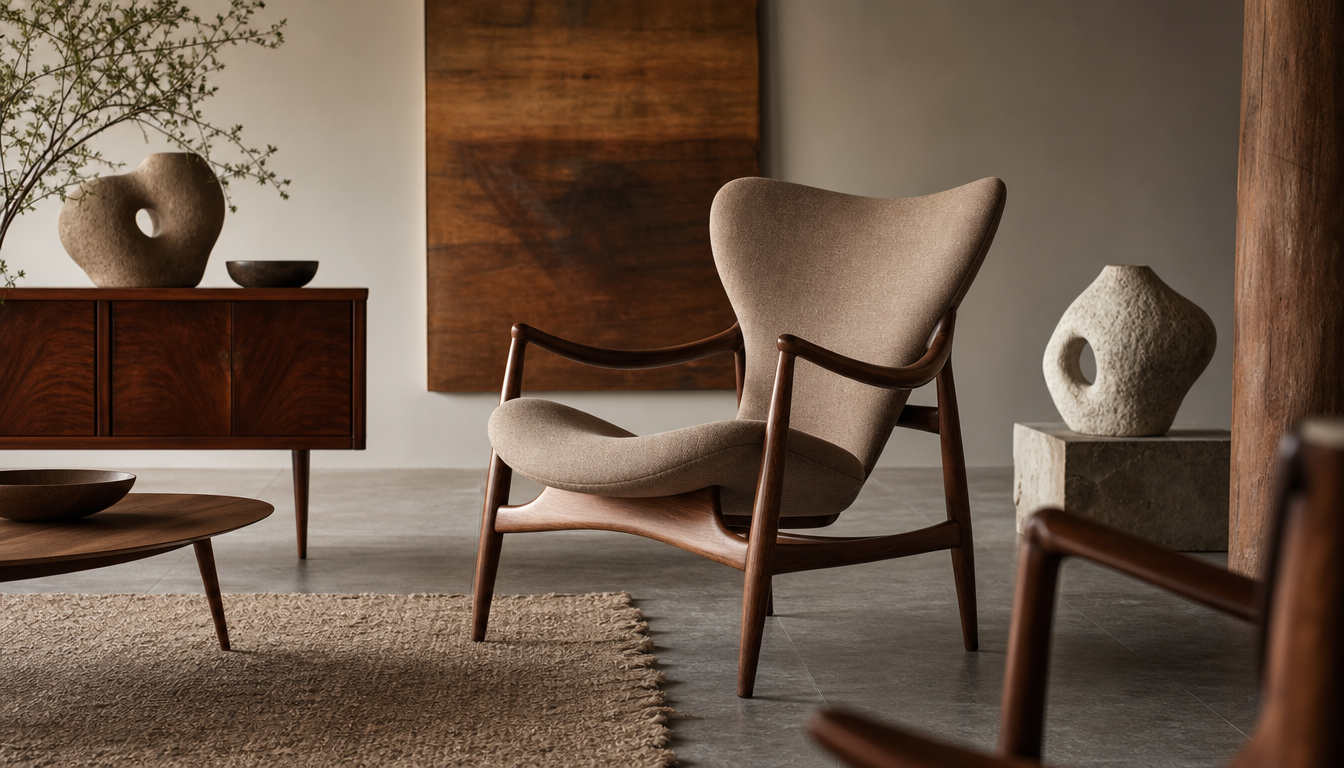
Finn Juhl: The Sculptor Among Furniture Designers
Anyone seriously engaging with Danish furniture design of the 20th century cannot overlook Finn Juhl. Yet he was not a trained cabinetmaker, not a master craftsman in the traditional sense, but an architect. And it was precisely this background that shaped everything he designed. While contemporaries such as Hans J. Wegner or Børge Mogensen took craftsmanship as their starting point, Juhl thought in sculptures, in spaces, in the relationship between body and object. His furniture pieces are not functional containers, but plastic statements. The seat floats. The backrest supports itself. The wood envelops the upholstered body instead of encasing it.
Finn Juhl was born in 1912 in Frederiksberg and studied architecture at the Royal Danish Academy of Fine Arts in Copenhagen, where he later also taught. His early designs emerged from the late 1930s onwards in close collaboration with master cabinetmaker Niels Vodder, without whom many of his most radical ideas would simply not have been realizable. Vodder possessed the technical craftsmanship to actually produce Juhl’s organic constructions. Their collaboration, presented at the Cabinetmakers’ Guild exhibitions in Copenhagen between 1937 and 1957, is today regarded as one of the most fruitful partnerships in the history of European design.
For collectors and designers interested in original pieces, understanding this history of origin is not an academic exercise. It is the foundation of every well-informed purchasing decision.
Characteristic Materials and Construction Principles
Finn Juhl worked primarily with Danish teak and walnut, with teak dominating particularly in his designs from the early 1950s onwards. Teak was the preferred material for high-quality furniture in post-war Denmark: long-grained, oil-resistant, with a warm reddish-brown grain that complemented upholstery fabrics and wool textiles beautifully. For older pieces from the late 1930s and 1940s, especially the designs made for Niels Vodder, Juhl frequently used light maple or dark mahogany, which lends these early works a distinctive visual weight of their own.
What is truly characteristic about Juhl’s construction principle is the so-called floating seat construction: the seat body is set apart from the frame, resting on it without being embedded in it. This detail, which virtually no other designer in furniture history has implemented as consistently, demands the utmost precision in mortise-and-tenon joinery. In original pieces from the Vodder workshop, these joints are hand-crafted and reveal, upon closer inspection, the individual traces of the cabinetmaker.
The upholstery, often in wool in muted mid-century tones such as mustard yellow, slate blue or brick red, was frequently sourced from Danish textile manufacturers such as Unika-Væv. A period-correct original upholstery, where preserved, significantly increases the historical value of a piece, even if it is in need of restoration. Subsequent re-upholstery in undocumented fabrics, by contrast, is a common finding on the market that complicates condition assessment.
Regional Schools, Contemporaries and the Danish Design Heritage
Finn Juhl cannot be understood in isolation. He emerged within the context of a generation of Danish designers who, in the mid-20th century, collectively developed a design language that set itself apart from Swedish Functionalism as much as from American Streamlining. The term “Danish Modern”, which established itself in the 1950s and 1960s primarily in the USA as an export label, encompassed a broad spectrum: from the more restrained, craft-grounded works of Hans J. Wegner to the classically rational designs of Arne Jacobsen, through to the sculptural, deliberately artistic stance of Juhl.
Within this constellation, Juhl occupied a singular position. He was often perceived by Danish design critic and architect Tobias Faber and by his contemporaries as the one who brought furniture closest to the fine arts. When his work was shown in 1951 at the “Good Design” exhibition at the Museum of Modern Art in New York, this was not a commercial marketing exercise, but a curatorial decision by Edgar Kaufmann Jr., who regarded Juhl’s designs as genuine artistic objects.
Of particular relevance to collectors, alongside the Vodder pieces, are the designs Juhl developed from the 1950s onwards for the American manufacturer Baker Furniture. These pieces were produced in larger quantities, are regularly found on the international market, but differ in workmanship and material from the hand-crafted Vodder originals. Both production lines have their specific collector value, yet require different condition criteria and provenance information. In addition, there are later reissues by the Danish manufacturer House of Finn Juhl, which has produced licensed reproductions since 1990. These are of high quality, but cannot be compared historically or financially with original pieces.
Authenticity and Condition: What Collectors Should Look For
The market for Finn Juhl originals is demanding and, as in all areas of blue-chip design, increasingly burdened by reproductions and misattributed pieces. The examination of a piece begins with provenance documentation. Vodder workshop pieces typically bear a stamped or inlaid master’s mark on the underside of the frame or the seat body. The absence of this stamp is not an automatic disqualifier, but it substantially increases the effort required for verification.
Key criteria in detail:
Construction and wood joinery. In authentic Vodder pieces, the mortise-and-tenon joints and shoulder cuts reveal, under magnification, the hallmarks of individual hand craftsmanship. Machine-milled joints indicate serial production or reproductions.
Wood surface and patina. Original teak develops a characteristic oxidation patina over decades: a deepening of the grain, a slight graying of unmaintained surfaces, a warmth of colour that differs distinctly from refreshed or refinished pieces. Reworked surfaces, identifiable by an overly uniform brightness or sanding marks, diminish collector value.
Upholstery and cover fabrics. A fully original upholstery is rare; its presence, however, is worth documenting. More important than the appearance of the upholstery is the integrity of the underlying substructure, which in original pieces consists of hand-cut webbing and traditional filling materials.
Provenance and accompanying documentation. Invoices from Danish antique dealers, auction records from Copenhagen or Helsinki, illustrations in dated design publications – all of this increases the reliability of an attribution and thereby provides the basis for a well-founded price assessment.
At mid-centurydesigns.com, every Finn Juhl piece on offer is examined for provenance, construction characteristics and condition before being included in the inventory. The documentation you will find for each object was compiled on the basis of this review: factual, complete, without omitting relevant findings. Whoever purchases a piece buys not just the object, but also the knowledge about it. That is the standard to which the curation at mid-centurydesigns.com is committed.