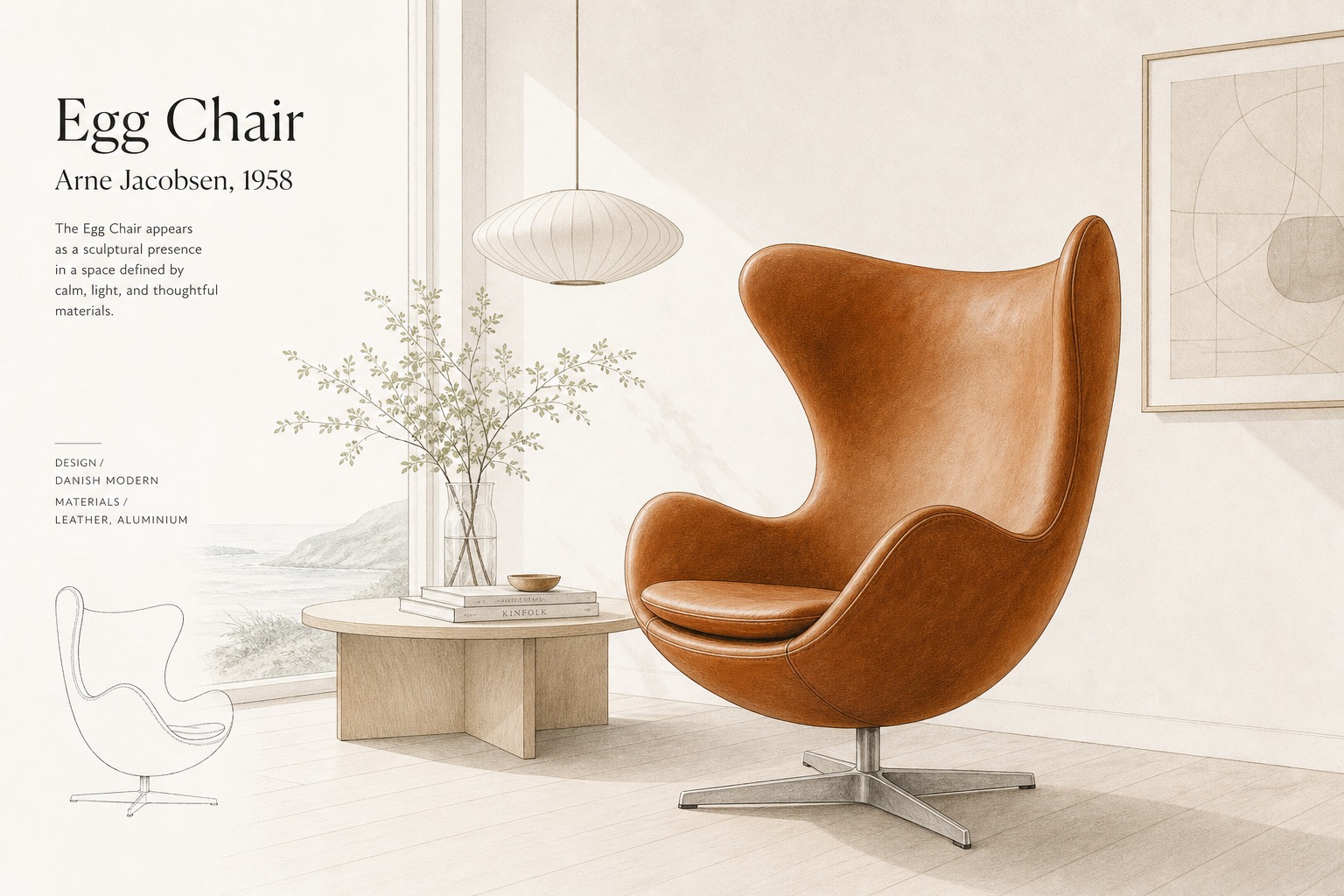
The Egg Chair becomes more interesting once you stop reading it as a mere Scandinavian silhouette
For the Egg Chair, the strongest starting point is not market mythology but published documentation. The official Arne Jacobsen archive lists the object plainly under Furniture 1958 and calls it part of the total design for SAS Royal Hotel. On the official Fritz Hansen Egg page, the chair is presented as a work by Arne Jacobsen, whose shape was developed through experiments with wire and plaster. The Metropolitan Museum of Art adds a museum-grade material description for a 1958 example: ox-hide, plastic, aluminum and a foam-covered molded-plastic frame.
That overlap matters for collectors and buyers. The Egg Chair is not just an organic lounge chair with an instantly recognisable outline; it is a well-documented object positioned between architecture, industrial production and comfort engineering. For related context, see our page on Arne Jacobsen, compare it with the Panton Chair, or browse the shop.
Its origin lies in a hotel commission, not in an abstract style formula
Arne Jacobsen’s own archive calls the Egg chair a pivotal element in his interior design for the SAS Royal Hotel. That already sets the tone for how the object should be read: not as a free-floating symbol of Scandinavian taste, but as furniture conceived within a larger architectural programme. The Met reinforces that point by stating that the model was originally designed for the SAS Royal Hotel in Copenhagen and only later put into general production.
For the vintage market, that changes the criteria of evaluation. The Egg Chair should be judged through project context, manufacturer attribution, production period and material logic together. Those factors are more useful than the generic idea of an “iconic chair”.
The shell depended on a specific technological shift
One of the most useful factual details comes from the Arne Jacobsen archive itself. It explains that the chairs for the SAS Royal Hotel were made in a hard foam material rather than through a construction of steel frame and wood, and were then padded and upholstered. That is crucial, because the enveloping form of the Egg Chair is tied directly to a manufacturing method, not just to a sculptural ambition.
The Met confirms the same logic from a museum perspective, describing its 1958 example as ox-hide upholstery over a foam-covered molded-plastic frame with aluminum. For buyers, this is more than a technical aside. It explains why good original examples derive so much of their authority from the exact relationship between shell, padding and base, and why weaker copies often look heavy or inert even when the outline seems superficially close.
Even the form development is unusually well documented
Fritz Hansen adds a rare and concrete insight into the chair’s genesis: Jacobsen found the perfect shape for the chair by experimenting with wire and plaster in his garage. That sentence matters because it takes the Egg Chair out of the realm of vague legend. Its contour was not an arbitrary flourish; it emerged from a deliberate modelling process.
That is the practical takeaway for today’s market. Buyers should look beyond instant recognisability and check shell proportion, the transition between back and wings, upholstery tension, execution of the aluminum base and documented provenance. Only then does a famous design image become a convincing mid-century object.